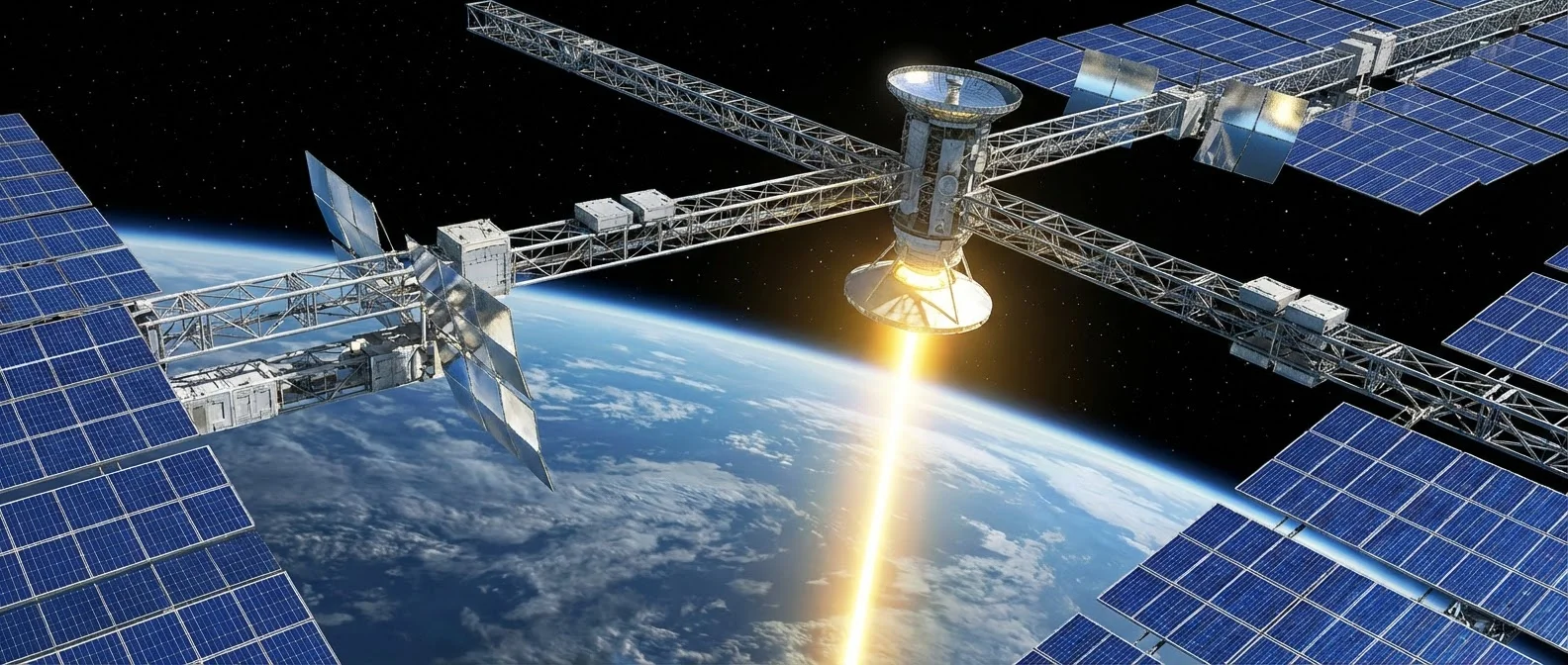
Imagine satellites collecting solar energy in space — where the sun shines 24 hours a day, with no clouds, no atmosphere — and beaming it wirelessly to Earth. This concept moved from fantasy to engineering milestone: in June 2023, Caltech successfully transmitted solar energy from space to Earth for the first time, while the ESA is preparing the SOLARIS program for space-based solar power stations from 2030.
📖 Read more: Nuclear Fusion: Unlimited Energy by 2040
What Is Space-Based Solar Power?
Space-Based Solar Power (SBSP) refers to collecting solar energy from satellites orbiting Earth and transmitting it to the surface via microwaves or lasers. An SBSP system consists of three key components:
Why Space?
Ground-based solar panels operate on average only ~29% of the day — the atmosphere, clouds, nighttime, and tilt drastically reduce output. Space changes everything:
Advantages of Space-Based Solar Power
- 144% stronger light — no atmospheric absorption or reflection
- 24-hour collection — a GEO satellite is shadowed for only 72 minutes/night (equinoxes)
- 40× greater output compared to equivalent ground panels
- Zero CO₂ emissions — clean energy with no fuel
- Targeted distribution — the satellite can direct energy where it's needed
- No land or water — doesn't compete with agriculture or water resources
Historical Timeline
Modern Programs & Milestones
🇯🇵 Japan — JAXA
Japan is a pioneer: in 2008 it established space solar power as a national goal. In March 2015, JAXA wirelessly transmitted 1.8 kW over 50 meters, while Mitsubishi Heavy Industries achieved 10 kW over 500 meters — proving that converting electricity to microwaves and back works.
🇺🇸 Caltech — SSPD-1
Thanks to the $100+ million donation from Donald & Brigitte Bren (2013), Caltech in partnership with Northrop Grumman developed the Space Solar Power Demonstrator (SSPD-1). In June 2023, it achieved something historic: the first detection of solar energy beamed from space to Earth. Although the power was small, it's proof-of-concept that the technology works.
📖 Read more: Perovskite: Next-Gen Solar Panels 2026
🇪🇺 ESA — SOLARIS
In August 2022, the European Space Agency (ESA) proposed the SOLARIS program — a feasibility study for solar power satellites from 2030. In August 2025, King's College London researchers estimated that SBSP could provide up to 80% of Europe's renewable energy by 2050.
🇨🇳 China — CAST
China has extremely ambitious plans: In 2019, it began constructing an SBSP test base in Bishan (Chongqing). According to Xinhua (2019), it plans to launch a 200-ton station capable of megawatt power by 2035.
🇺🇸 US Navy & SSPIDR
In May 2020, the US Naval Research Laboratory conducted the first orbital solar power test aboard the mysterious X-37B space plane. The Air Force is developing the SSPIDR (Space Solar Power Incremental Demonstrations and Research) project.
🇬🇧 UK Space Energy Initiative
In 2022, the UK's Space Energy Initiative announced plans for the first solar power station in space by the mid-2040s, aiming to cover 30% of the country's electricity demand.
The Major Obstacles
| Challenge | Details |
|---|---|
| Launch costs | A 4 GW station weighs 4,000-80,000 tons. With Falcon Heavy (~$2,000/kg), costs reach tens of billions. We need $100-200/kg. |
| Antenna size | The GEO transmitter: ~1 km diameter. The ground rectenna: ~10 km. Enormous structures. |
| Space debris | Large structures face collision risk — especially in LEO (Kessler Syndrome). |
| Panel degradation | In space, PV panels degrade ~8× faster due to radiation and micrometeorites. |
| Conversion losses | Photons → electrons → microwaves → electrons: each conversion loses energy. Overall efficiency ~50%. |
| Safety | The microwave beam (23 mW/cm² at center) exceeds the OSHA limit (10 mW/cm²). If misdirected, it could be dangerous. |
Alternative Approaches
What's Changing Now?
Two breakthroughs have changed the economics since the 1980s:
📖 Read more: Antimatter: Energy Beyond Imagination
Falling Launch Costs
SpaceX has dramatically reduced costs — Falcon Heavy costs ~$2,000/kg, while Starship promises to reach below $100/kg. If achieved, SBSP becomes economically viable for the first time.
Photovoltaic Advances
Modern lightweight PV cells achieve 150 W/kg (2015), with a target of 1 kg/kW in the near future. This means a 4 GW station would need only ~4,000 tons of panels instead of 80,000.
"Solar power satellites should no longer be envisioned as requiring unimaginably large initial investments in fixed infrastructure before the emplacement of productive power plants can begin."
Global Impact: The Energy Revolution from Orbit
SBSP technology has transformative potential for regions that face unique energy challenges — from island nations to remote military outposts to developing countries with limited grid infrastructure:
Who Benefits Most?
- ESA SOLARIS program — Europe is positioning itself as a SBSP leader with a structured development roadmap
- Island nations — satellite energy could power remote islands without undersea cables or expensive fuel imports
- Military & disaster relief — the US DoD funds Aetherflux/SSPIDR for forward operating bases; beamed power could transform humanitarian response
- Developing nations — SBSP can leapfrog traditional grid infrastructure, similar to how mobile phones bypassed landlines
- EU Green Deal — King's College London 2025 estimate: 80% of Europe's renewable energy from SBSP by 2050
- International cooperation — India-US Kalam-NSS Initiative (2010), China-India proposals (2012) show SBSP as a diplomatic bridge
Development Timeline
Why It Matters for the Planet
Global energy demand keeps rising. Fossil fuels are depleting and destroying the climate. Terrestrial renewables — solar, wind, hydro — have natural limits: they depend on weather, land, and water. SBSP offers something unique: constant, inexhaustible, clean energy available 24/7 anywhere on the planet.
If just 5% of national energy consumption came from SBSP, our carbon footprint would be significantly reduced. And unlike nuclear or fossil fuels, SBSP produces no hazardous waste and doesn't compete for drinking water.
"Space solar power may well emerge as a serious candidate among the options for meeting the energy demands of the 21st century."