Imagine a battery that charges in 10 minutes, lasts 1,000 kilometers, never catches fire, and endures 100,000 charge cycles. This isn't science fiction — it's the promise of solid-state batteries (SSBs), a technology poised to upend everything from electric vehicles to smartphones and satellites.
📖 Read more: Sodium Batteries: The Cheap Alternative to Lithium
What Is a Solid-State Battery?
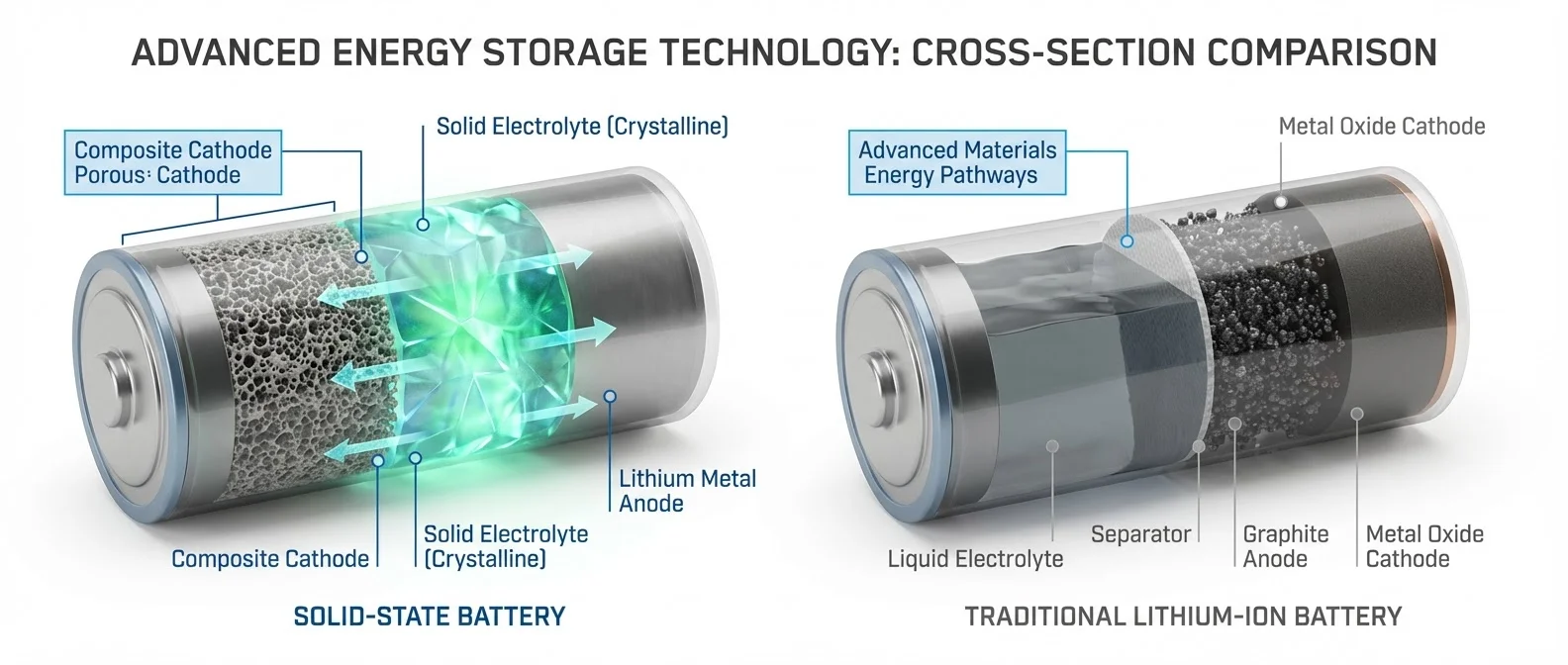
A solid-state battery (SSB) uses a solid electrolyte instead of a liquid or gel polymer to conduct lithium ions between electrodes. This seemingly simple change delivers dramatic improvements in energy, safety, and lifespan.
🔋 Conventional Li-ion
Liquid electrolyte, flammable. Energy density <300 Wh/kg. Operating temperature: -20°C to 60°C. Voltage: ≤4.5V. Risk of thermal runaway.
⚡ Solid-State
Solid electrolyte, non-flammable. Energy density >350 Wh/kg (up to 500 Wh/kg). Temperature: -50°C to 125°C. Voltage: >5V. Heat generation just 20-30% of conventional.
The solid electrolyte simultaneously acts as an ideal separator that allows only lithium ions to pass through. This eliminates many problems of liquid electrolytes: flammability, limited voltage, unstable solid-electrolyte interface, and poor cycling performance.
History: From Faraday to the Future
The story begins much earlier than you'd expect. Between 1831-1834, Michael Faraday discovered the first solid electrolytes — silver sulfide and lead(II) fluoride — laying the foundation for solid-state ionics. In the 1950s, silver-conducting electrochemical systems used solid electrolytes, but with low energy density.
🏛️ Milestone: 2011
Kamaya et al. demonstrated the first solid electrolyte (Li₁₀GeP₂S₁₂ or LGPS) that exceeded the ionic conductivity of liquid counterparts at room temperature. For the first time, bulk solid-ion conductors matched Li-ion performance.
Advantages That Change Everything
The Automaker Race: Who Will Get There First?
The automotive industry has invested billions in SSBs, as the technology promises EVs with 1,000+ km range, minutes-long charging, and zero fire risk.
🇯🇵 Toyota
Patent leader: 8,274 SSB patents (2020-2023). Research since 2012. Partnership with Panasonic. Commercial target: 2027+. Toyota considers SSBs a “game changer” for EVs.
📖 Read more: Neuron Computers: Biological Brains on a Chip
🇺🇸 QuantumScape
Unicorn startup backed by VW. Ceramic solid electrolyte. Target GWh-scale production. Lithium-metal anode without graphite. One of the most ambitious players in the field.
🇩🇪 Mercedes-Benz
Major investment in ProLogium (Jan 2022). Collaboration with Factorial Energy (US). Plans for 8 battery gigafactories. Target: next-gen ceramic SSBs.
🇯🇵 Nissan & Honda
Nissan: EV with SSB by FY2028, in-house development. Honda: pilot production line since 2024, commercial maturity by 2030. Both bet on SSBs as a competitive lever.
"Solid-state batteries are not merely an evolution — they are a paradigm shift. They give EVs what they've been missing: range, charging speed, and safety that surpasses the combustion engine."
Beyond Cars: Surprising Applications
Materials & Technology: How Do They Work?
The solid electrolyte can be based on various materials:
Ceramic Oxides
LAGP, LATP, LLZO (garnet-type), LLTO (perovskite-type). Stable but brittle. Require high pressure for good electrode contact.
Sulfides
Li₁₀GeP₂S₁₂ (LGPS), Li₃PS₄. Excellent room-temperature ionic conductivity. However, moisture-sensitive and low oxidation stability.
Chlorides
Li₃MCl₆, Li₂M₂/₃Cl₄. Lower cost, high humidity tolerance, excellent oxidation stability. Emerging material category.
Polymers
Poly(ethylene oxide) — PEO. Bolloré used LMP (Lithium Metal Polymer) in the BlueCar (2011) with a 30 kWh battery. Flexible but low room-temperature conductivity.
Challenges: Why Don't We Have Them Yet?
Five technical hurdles keep SSBs from mass production:
📖 Read more: octopus-cloaking-technology
John Goodenough: The “Father” Never Stopped
John Goodenough, co-inventor of the Li-ion battery (Nobel Prize in Chemistry 2019), didn't rest on his laurels. In 2017, at age 94, he unveiled a glass-electrolyte solid-state battery using an alkali-metal anode (lithium, sodium, or potassium). His message was clear: innovation has no age limit.
🧪 Japanese Record: No Pressure Required
In November 2022, a research team from Kyoto University, Tottori University, and Sumitomo Chemical achieved stable SSB operation without applying pressure, reaching a capacity of 230 Wh/kg. They used novel copolymerized electrolyte materials — bringing factory-scale production closer to reality.
The Patent Race
Patent filings reveal the current leaders:
- Toyota: 1st place — 8,274 SSB patents (2020-2023)
- LG: 2nd place — thousands of patents in electrolytes and electrodes
- Samsung: 3rd place — partnership with Hyundai
- Murata: 4th place — focus on small SSBs for electronics
- Panasonic: 5th place — 3-minute charging prototype
According to the WIPO 2024 report, research and patenting activity in SSBs grew significantly between 2010 and 2023. Isostatic pressing technology saw a 22% CAGR in patents (2017-2024), reaching 2,110 patents by November 2025.
Timeline: When Will We See Them?
📅 2025-2027
Pilot production lines. Toyota commercial SSBs. ProLogium at GWh scale. First demo EVs. Small-scale drone and wearable applications.
📅 2028-2030
Nissan EV with SSB. Honda commercial maturity. BMW/Ford via Solid Power. Mass logistics drone applications. Costs drop significantly.
📅 2030-2035+
Full commercial maturity. SSBs gradually replace Li-ion in EVs. Hyundai/Ionic Materials enter the market. Grid storage and aviation applications.
Global Impact
Solid-state batteries represent far more than a technical upgrade:
- EV adoption: Cheaper, safer SSBs will accelerate the global transition to electric vehicles
- Lithium supply chains: Growing European interest in lithium mining to secure SSB raw materials
- Grid storage: SSBs could revolutionize renewable energy storage with their long cycle life
- Maritime: SSBs can power electric vessels — crucial for island connectivity and clean shipping
"The solid-state battery isn't just a better battery. It's the technology that will make electric cars better, cheaper, and safer than combustion vehicles — no asterisks needed."