📖 Read more: Greece in Space: The First National Mission
🏗️ A 130-Year-Old Idea
The first reference to a space elevator belongs to Russian pioneer Konstantin Tsiolkovsky, who in 1895 was inspired by the Eiffel Tower and envisioned a tower reaching geostationary orbit. In 1960, Soviet engineer Yuri Artsutanov proposed something more realistic: instead of building a tower from the bottom up, we could lower a cable from a satellite in geostationary orbit downward.
The idea entered literature in 1979, when Arthur C. Clarke published the novel “The Fountains of Paradise,” introducing the space elevator to millions of readers. Clarke's novel sparked serious engineering research into the concept.
⚙️ How It Works
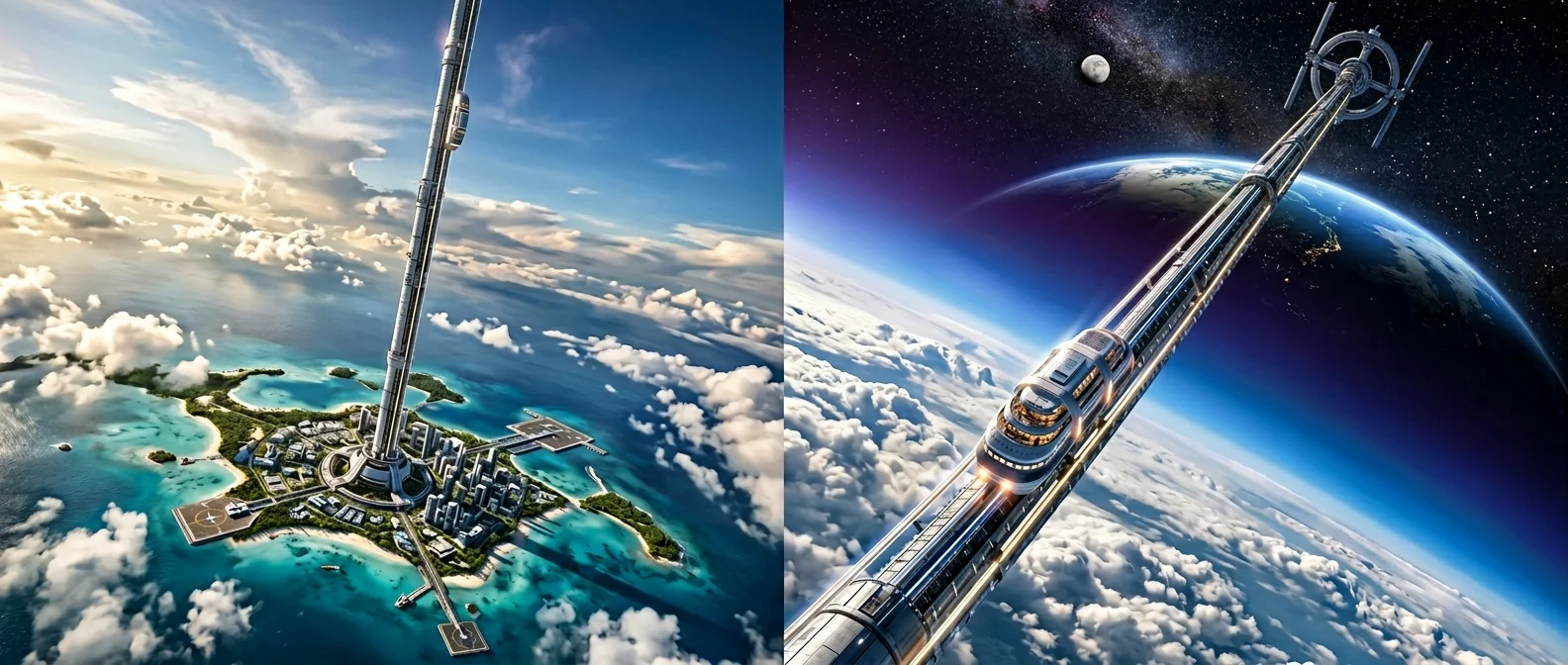
The principle is simple: an extremely strong cable (tether) connects a base on the equator to a counterweight beyond geostationary orbit, at an altitude of 35,786 kilometers. Mechanical climbers ascend the cable, carrying cargo and passengers into space.
The cable stays taut thanks to centrifugal force — exactly like a spinning rope. The base could be a floating ocean platform, allowing it to move to avoid space debris and extreme weather conditions.
According to a study by the International Academy of Astronautics (IAA) in 2013, the cost of sending cargo to geostationary orbit via elevator would be around $500 per kilogram. For comparison, rockets cost approximately $12,125 per kilogram (2022 figures). That's a cost reduction of over 95%.
🔬 The Material Problem
Here's the problem: For a cable tens of thousands of kilometers long to support its own weight plus the loads on it, it requires a material with unprecedented specific strength in engineering.
📖 Read more: Interplanetary Internet: Network from Earth to Mars
Carbon nanotubes (CNTs) are the leading candidate. Theoretically, they have a tensile strength of up to 130 GPa — more than enough. In practice, however, even a single atomic defect can drop the strength to 40 GPa, below the minimum 50 GPa threshold required.
Why specific strength matters: It's not enough for a material to be strong — it must be strong relative to its weight. Steel is tough but too heavy. A steel cable would collapse under its own weight long before reaching orbital altitude. Carbon nanotubes are 100 times stronger than steel in terms of strength-to-weight ratio.
Until recently, scientists could only produce nanotubes just centimeters long. The challenge of building a continuous cable tens of thousands of kilometers long seemed insurmountable — so much so that Google X in 2014 examined the project and shelved it, stating that nobody had managed to create a nanotube strand longer than one meter.
🧪 New Materials, New Hope
That's starting to change. In recent years, three promising alternatives have emerged:
- Graphene: A single-layer carbon material with exceptional specific strength. Bryan Laubscher of Odysseus Technologies is working on techniques to produce large graphene structures, aiming for a tether capable of handling the loads of an elevator.
- Diamond Nanothreads: Discovered in 2014 — extremely thin chains of carbon atoms in a diamond-like structure. Theoretically, they can achieve the required specific strength.
- Composite Nanomaterials: Combinations of nanotubes with polymer matrices that are steadily gaining strength over time.
The National Space Society noted in its Roadmap 2025: "New potential tether materials combined with detailed engineering designs increase prospects" for the space elevator.
🏢 Who's Working on It
Obayashi Corporation, a Japanese construction giant, announced in 2012 plans to build a space elevator by 2050. The proposal includes a carbon nanotube cable, capsules carrying 30 passengers, and an 8-day journey to geostationary orbit.
In the United States, ISEC (International Space Elevator Consortium) organizes annual conferences and coordinates technical research. At the 2023 conference, ISEC's Chief Architect presented a projection for operations beginning in the late 2030s, with the capacity to transport 30,000 tonnes annually to GEO — that's 14 tonnes per day.
📖 Read more: Starship Point-to-Point: London to Sydney in 1 Hour
"The space elevator can deliver payload with 70% efficiency — compared to just 2% for rockets. This fundamentally changes the economics of space access."
— ISEC Chief Architect, Space Elevator Conference 2023Even on a smaller scale, there's progress. In 2018, Japan launched the STARS-Me experiment — a miniature elevator model on a CubeSat. A small climber moved along a 10-meter cable in orbit. Small scale, but it proved the basic mechanics work in space.
📐 The Engineering Behind the Dream
American engineer Bradley C. Edwards produced the most detailed study in 2000. The proposal: a ribbon-shaped cable 100,000 kilometers long, thinnest at the base and thickest at geostationary orbit, powered by lasers. First, an initial “seed” weighing just 19,800 kilograms is launched, then 207 mechanical climbers gradually reinforce the cable until it can support 750 tonnes.
The construction is incremental: you start small, pull lightweight material up, then use the elevator itself to strengthen it. An elegant self-referential solution.
💰 Why It's Worth the Effort
Money drives the interest, not romance. Every kilogram of material in space costs a small fortune. Even with SpaceX's dramatic cost reductions, a rocket spends 98% of its energy breaking gravity — and only 2% goes toward useful payload.
📖 Read more: Von Neumann Probes: Self-Replicating Spacecraft
The space elevator reverses this equation. Using electrical power (likely solar), it transports cargo slowly but steadily, without the need to burn thousands of tonnes of fuel. This means large-scale structures in space — solar farms, space stations, even colonies — suddenly become viable options.
Cost per kilogram to GEO:
- 🚀 Rocket (2022): ~$12,125
- 🏗️ Space elevator (IAA estimate): ~$500
- 📉 Reduction: over 95%
🔮 What Comes Next
The critical decade is the one we're living in. If research teams manage to produce graphene or nanotube cables at industrial scale within the next 5-10 years, then construction could begin before 2040.
There are, of course, open questions: dealing with space debris, protection from lightning and radiation, and the regulatory authority that would approve a 100,000-kilometer cable above international waters. None of these are trivial.
Progress in materials — especially graphene and diamond nanothreads — suggests the hurdles aren't insurmountable. Clarke's fantasy has become an engineering challenge. Companies like Obayashi and groups like ISEC think they'll build one within decades.