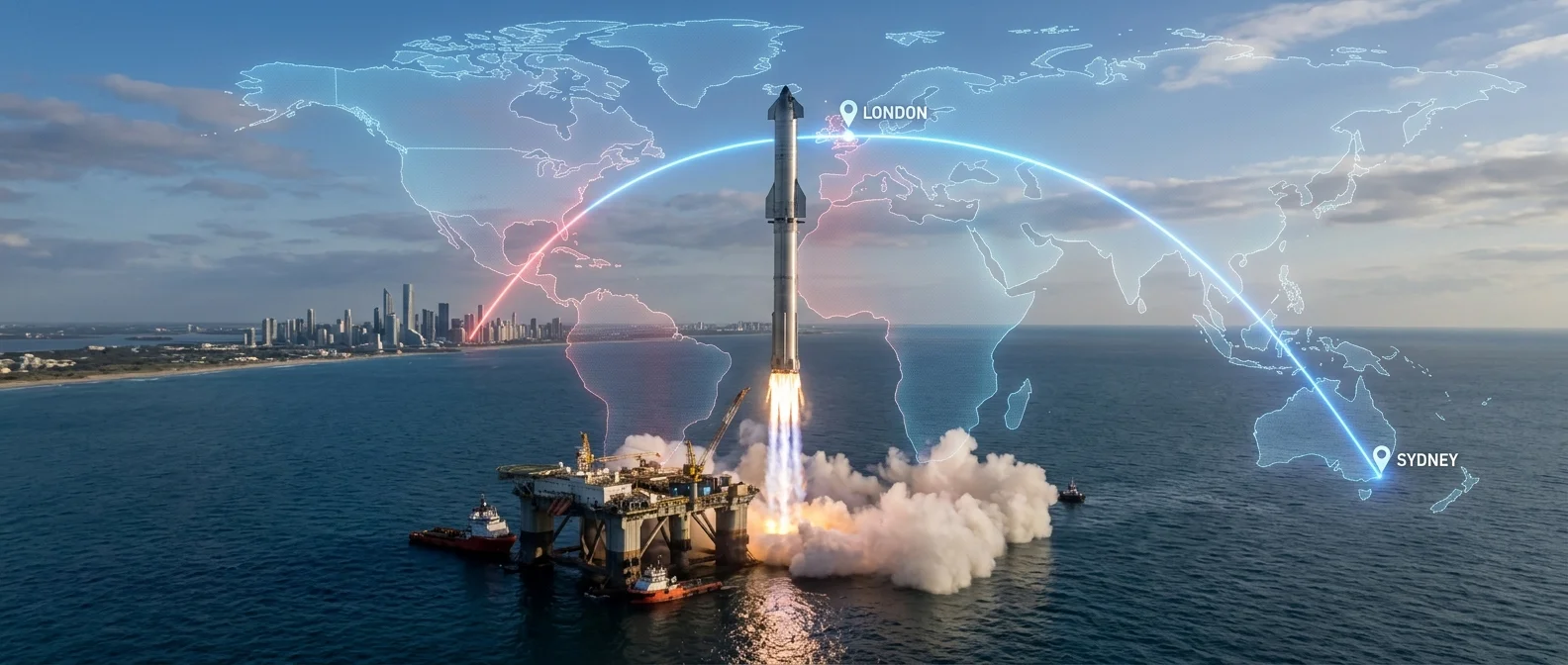
Board a rocket in London. Fifty-five minutes later, step off in Sydney. This isn't science fiction — it's SpaceX's Earth-to-Earth vision becoming reality. Starship, the largest rocket ever built, was designed for Mars missions, but the same technology could obliterate every assumption we have about intercontinental travel on our own planet.
What Makes Starship Point-to-Point Revolutionary
The concept is brutally simple: instead of enduring 20+ hour flights, you launch into suborbital space, arc across the planet at 27,000 km/h, and land vertically at your destination. SpaceX calls this "Earth to Earth" — suborbital flights connecting any two points on the planet in under 60 minutes.
Elon Musk first unveiled the concept in 2017 as part of the Interplanetary Transport System. Since then, SpaceX has conducted 11 Starship test flights with 6 successes, including the first-ever booster catch at the launch tower in October 2024 — a technological feat that rewrote the rules of rocket recovery.
📖 Read more: Aerotropolis: Cities Built Around Airports
📖 Read more: Aerotropolis: Cities Built Around Airports
The Engineering Behind the Revolution
Starship consists of two stages: the Super Heavy booster with 33 Raptor engines and the Starship spacecraft with 6 engines. Combined, they generate over 74 MN of thrust — nearly double the Saturn V that sent humans to the Moon. The Raptor engines burn liquid methane and liquid oxygen, achieving chamber pressures of 350 bar — a record for operational rocket engines.
The breakthrough is full reusability. Super Heavy returns to the launch tower and gets "caught" by hydraulic mechanical arms — the famous "chopsticks." Starship itself lands vertically at the destination. This complete recycling means launch costs could theoretically drop to $1 million — making point-to-point tickets competitive with business class flights.
Routes That Redefine Distance
The real power of Starship point-to-point lies in crushing multi-hour international flights. New York to Shanghai in 39 minutes instead of 15 hours. London to Sydney in 55 minutes instead of 22 hours. Tokyo to Dubai in 27 minutes. Each flight follows a ballistic trajectory through space at altitudes above 100 kilometers, reaching speeds exceeding 27,000 km/h.
For the business world, this means morning meetings in London and lunch in Sydney. For humanitarian missions, critical supplies delivered from one side of the planet to the other in under an hour. Our entire concept of distance is about to collapse.
New York → Shanghai
39 minutes instead of 15 hours. The world's busiest business route becomes a quick hop.
London → Sydney
55 minutes instead of 22 hours. The longest commercial flight becomes a brief commute.
Tokyo → Dubai
27 minutes instead of 11 hours. New pathways for international trade and tourism.
Humanitarian Aid
100 tons of supplies to any point on the planet in 60 minutes — a true breakthrough.
📖 Read more: Space Tourism: Vacations in Space
Military Applications: The Rocket Cargo Program
The U.S. Air Force was quick to recognize the potential. In January 2022, SpaceX won a $102 million contract from the United States Space Force for a five-year Rocket Cargo program. The goal: prove that a rocket can rapidly deliver cargo to any point on the planet.
The Department of Defense is planning point-to-point delivery (P2PD) tests with rapid deployment capabilities for up to 100 tons of supplies. Consider the implications: instead of taking days to transport equipment to a crisis zone, a single Starship could deliver everything in under an hour. This fundamentally changes global logistics strategy.
Did You Know?
Elon Musk stated that SpaceX will conduct hundreds of cargo flights before starting passenger transport. The recent success of the booster catch (October 2024) and precise ocean landing within 3 meters of the target prove the technology is maturing rapidly.
The Major Obstacles
The technology is advancing, but the obstacles remain formidable. First, safety: 5 of the 11 test flights ended in failure. A rocket carrying passengers must achieve 99.999% reliability — requiring thousands of successful flights.
Second, human endurance. Passengers will experience 3-4G during launch and again during deceleration. Elderly passengers or those with heart conditions may not tolerate the forces. Third, noise: a Starship launch creates acoustic waves that reach communities over 10 kilometers away — the first flight launched massive amounts of debris into the atmosphere.
Advantages
- Travel anywhere on Earth in <60 minutes
- Fully reusable system
- Costs potentially reaching $1M/flight
- Strategic value for military logistics
- Humanitarian aid in hours instead of days
Disadvantages
- Only 6/11 test flights successful
- Extreme g-forces for passengers (3-4G)
- Massive acoustic impact
- Need for specialized "spaceports" outside cities
- Regulatory framework nonexistent
The Economic Gamble
SpaceX has invested over $5 billion in the Starship program. The goal is ambitious: $1 million cost per launch, according to Musk. Today, a non-reusable Starship launch costs approximately $100 million — but with full reusability, costs will plummet.
If the math works, a point-to-point ticket could cost $5,000-$10,000 — comparable to first-class flights on long routes. With 100+ passengers per flight and multiple daily launches, economic viability looks realistic. However, Eurospace's Pierre Lionnet warns that customer pricing will be higher due to massive development costs.
Business Travel
Multinational executives will make same-day trips to other continents, changing global commerce dynamics.
Express Logistics
Urgent medical supplies, semiconductors, or spare parts to any corner of the planet in under 1 hour.
Defense Logistics
100 tons of military equipment to crisis zones without needing local air bases.
Tourism
The suborbital travel experience — minutes of zero gravity and Earth views — becomes the attraction itself.
Timeline and Reality Check
When will this become reality? The honest answer is nobody knows for certain. SpaceX hasn't achieved orbital flight yet — the first is expected with flight 13 (Block 3) in April 2026. Before hosting passengers for point-to-point, they need hundreds — possibly thousands — of successful flights.
SpaceX president Gwynne Shotwell stated they need at least 100 flights before transporting humans. The military Rocket Cargo program is expected to conduct the first point-to-point test sooner, possibly within the next 2-3 years. For commercial passenger flights, we're realistically looking at the 2030s.
Why It Will Succeed
- Booster catch proven feasible
- NASA and U.S. military investing billions
- Aviation market worth $800+ billion
- Each flight exponentially increases knowledge
Why It Will Take Time
- Regulatory: FAA has no framework for passenger rockets
- Building spaceports near major cities
- Public acceptance of "rocket" travel
- Environmental impact of launches
Bottom Line
SpaceX Starship point-to-point isn't a question of "if" but "when." The technology is advancing at rates that surprise even the most optimistic analysts — the booster catch and precise ocean landing were feats many considered impossible. The obstacles are massive: safety, regulatory frameworks, public acceptance. But if anyone has proven they can overcome "impossible" barriers, it's SpaceX. The era when a London-Sydney trip took an entire day may soon seem as archaic as sailing ships do today.