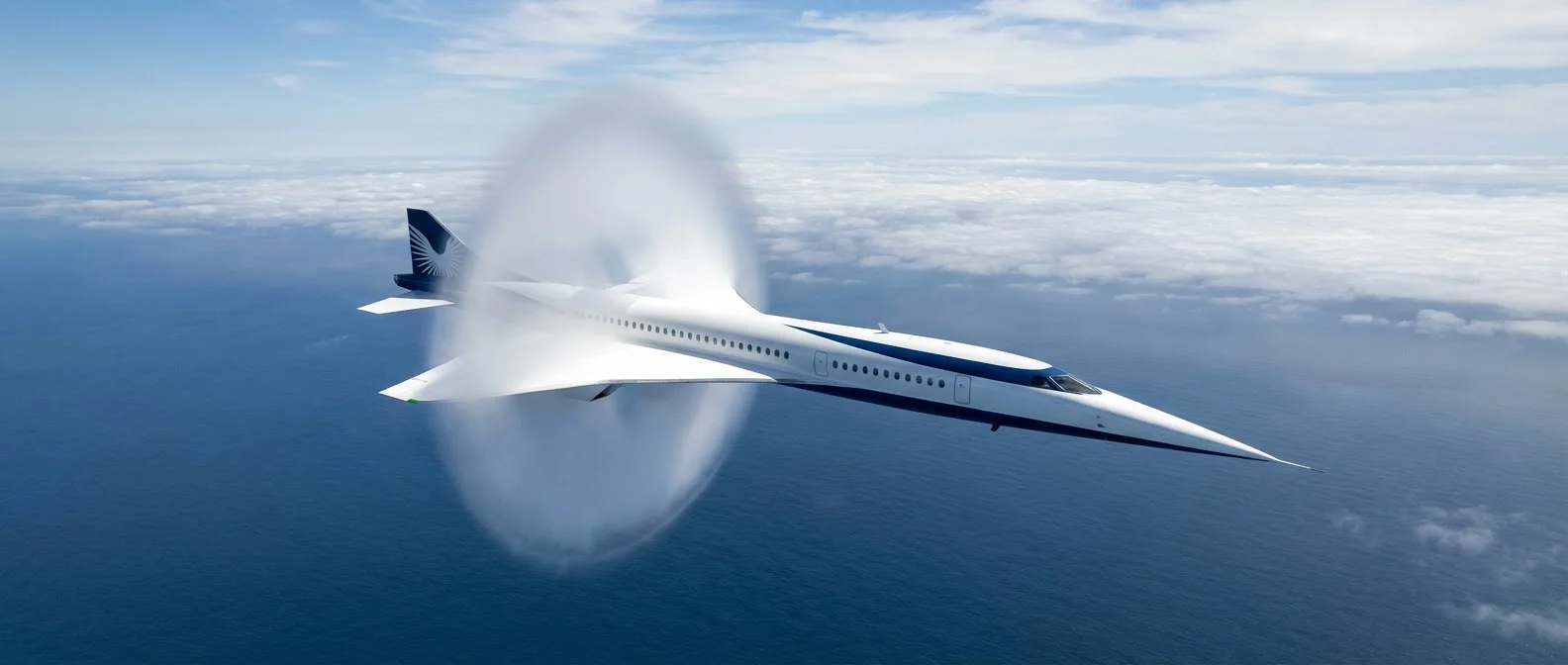
Supersonic passenger jets will return to the skies within a decade. More than 20 years after the retirement of the legendary Concorde, new aerospace companies like Boom Supersonic are designing aircraft that will travel at speeds exceeding Mach 1.7, dramatically reducing flight times. New York will be just 3.5 hours from London — and Athens could be just 2 hours from New York.
📖 Read more: Underwater Tunnels: Athens to Rome Under the Sea
🛫 The Legacy of Concorde
Concorde, the first successful supersonic passenger aircraft, made its maiden flight on March 2, 1969 and entered commercial service on January 21, 1976. It was jointly developed by British BAC and French Sud Aviation in a pioneering Anglo-French program. A total of 20 aircraft were built.
✈️ Pioneering Technology
First passenger aircraft with an analogue fly-by-wire flight control system, digital engine intake control, and carbon fiber brakes — technologies later adopted by all modern aircraft.
🔻 The Droop Nose
Concorde's iconic droop nose lowered 12.5° during landing to give pilots visibility, as the aircraft's high angle of attack would completely block the forward view.
🌡️ Flight Temperature
At Mach 2, the external surface temperature reached 127°C. The fuselage expanded by 300 mm (12 inches) due to thermal expansion. For cooling, it used its own fuel as a heat sink through the air conditioning system.
💔 End of an Era
The crash of Air France Flight 4590 on July 25, 2000 (109 victims + 4 on the ground), combined with the events of September 11, 2001, and high maintenance costs, led to retirement on October 24, 2003.
🚀 Boom Overture: The Successor
American company Boom Technology is developing the Overture, a Mach 1.7 supersonic aircraft designed to carry 60-80 passengers over distances of up to 7,870 km. With an estimated round-trip fare of ~$5,000 (New York-London), it will cost the same as a business class ticket on a conventional aircraft — but arrive in half the time.
| Feature | Concorde | Boom Overture |
|---|---|---|
| Speed | Mach 2.02 | Mach 1.7 |
| Passengers | 92-128 | 60-80 |
| Range | 7,222 km | 7,870 km |
| Length | 61.66 m | 61 m |
| Engines | 4× Olympus 593 turbojet | 4× Boom Symphony turbofan |
| Afterburner | Yes (takeoff/transonic) | No (supercruise) |
| Materials | Aluminum alloy | Composites (carbon fiber) |
| Fare (NY-London round-trip) | ~$21,000 (today's equiv.) | ~$5,000 |
| First flight | March 2, 1969 | 2027 (planned) |
🏭 Superfactory & Orders
Boom has built a “Superfactory” capable of assembling 33 aircraft per year (66 with a second line). It has already received major orders: United Airlines — 15 aircraft + 35 options (June 2021), American Airlines — 20 + 40 options (August 2022), Japan Airlines — 20 pre-orders (December 2017). Boom estimates a market of 1,000+ supersonic aircraft across more than 600 viable routes by 2035.
📖 Read more: Underwater Tunnels: Roads on the Seabed
🔧 Technology & Innovation
🔊 Symphony Engine
Boom is developing its own Symphony engine — a medium-bypass turbofan producing 40,000 lbf (180 kN) of thrust. In collaboration with Florida Turbine Technologies (Kratos), StandardAero, and GE Aerospace. Core testing is expected in 2026, with completion at the Colorado Air & Space Port.
🤫 Boomless Cruise
In 2025, Boom announced “Boomless Cruise” technology — supersonic flight without audible sonic boom on the ground. It relies on the Mach cutoff phenomenon: an autopilot selects the optimal speed based on atmospheric conditions so that shock waves cannot reach the surface.
🧪 XB-1 Demonstrator
The 1/3 scale demonstrator XB-1 “Baby Boom” first flew in March 2024 and on January 28, 2025 broke the sound barrier (Mach 1.122) — the first civilian supersonic flight with a turbojet engine since Concorde.
🌿 Sustainability
The Overture is designed for 100% sustainable aviation fuel (SAF). Without afterburners, with composite materials and improved aerodynamics, it promises lower fuel consumption than Concorde. However, mass SAF production remains a major challenge.
🛩️ NASA X-59 QueSST: Silent Supersonic
Alongside Boom, NASA is developing the X-59 QueSST (Quiet SuperSonic Technology) in collaboration with Lockheed Martin Skunk Works. The goal: prove that supersonic flight can exist over land without a disruptive sonic boom — something the FAA currently prohibits.
👁️ Flying Without a Windshield
The X-59's long, pointed nose completely blocks forward cockpit visibility. Instead of windows, the pilot sees through the External Vision System (XVS) — a 4K camera with a 33°×19° field of view showing real-time imagery. Community overflight test results will be delivered to ICAO and FAA in 2027, targeting revision of supersonic overland flight regulations by 2028.
📖 Read more: Aerotropolis: Cities Built Around Airports
🌍 The Competition
🔹 Spike Aerospace S-512
A 22-passenger design, Mach 1.6, range 11,500 km. Windowless cabin — replaced by panoramic displays across the entire interior surface. Self-funded project, still in development.
🔹 Exosonic
A 70-passenger Mach 1.8 design with 9,300 km range. In April 2021, the company won a contract to develop a supersonic Air Force One. Targeting commercial service in the 2030s.
🔹 Virgin Galactic Mach 3
In August 2020, Virgin Galactic partnered with Rolls-Royce to present a Mach 3 delta wing concept for 19 passengers — three times the speed of sound.
🔹 Hypersonic (Mach 5+)
Hermeus, Destinus, and Venus Aerospace are developing hypersonic aircraft at Mach 5-9. Boeing presented a Mach 6 concept (Atlantic in 2 hours, Pacific in 3) using turboramjet technology. NASA is working on Mach 4 concepts.
⏳ Supersonic Flight Timeline
⚡ Challenges & Obstacles
🔊 Sonic Boom
The sonic boom remains the #1 challenge. The FAA bans commercial supersonic flights over land in the US. Boomless Cruise technology (Boom) and X-59 data (NASA) will determine whether the ban is lifted.
⛽ Fuel Consumption
A supersonic aircraft consumes 5-7× more fuel per passenger compared to a subsonic jet (ICCT). New York to London: 6× economy class, 2× business class. SAF is the only solution but mass production doesn't exist yet.
🌍 Environmental Pushback
If 2,000 SSTs were flying by 2035, they would emit ~96 million tons of CO₂/year (ICCT) — equivalent to American + Delta + Southwest airlines combined. They would consume 1/5 of aviation's carbon budget for a 1.5°C trajectory.
🏗️ Engines & Cost
Rolls-Royce, Pratt & Whitney, GE, and CFM all declined to develop an engine for Boom due to high costs. The company was forced to build its own (Symphony). Development and certification is estimated at ~$6 billion.
📖 Read more: hydrofoil-boats-flying-ferries
🗺️ Potential Routes
Boom estimates over 600 viable routes worldwide. The primary targets are transatlantic and transpacific lines:
🌐 Estimated Flight Times
Newark → London: 3 hours 40 minutes (instead of 7+)
Newark → Frankfurt: 4 hours 15 minutes
Los Angeles → Sydney: ~6 hours (instead of 15+)
Tokyo → San Francisco: ~5 hours
Athens → New York (theoretical): ~3 hours (instead of 10+)
With over 72 million business/first class passengers on long-haul flights (2017), the demand exists — Spike projects estimates 13 million interested passengers by 2025 alone.
🌍 Global Perspective
🔮 The Future of Air Travel
Supersonic flight is no longer science fiction — it's an extraordinarily ambitious but technologically feasible plan. NASA already flew the X-59 for the first time (October 2025), Boom broke the sound barrier with a civilian aircraft (January 2025), and over $10 billion in orders make the project real.
If everything goes according to schedule, within the next 5-10 years we'll be able to fly from Athens to New York in 3 hours — exactly the time we need today just to get to the airport and clear security. The story of Concorde shows that technology can overcome obstacles — as long as the market and society are ready to embrace it.