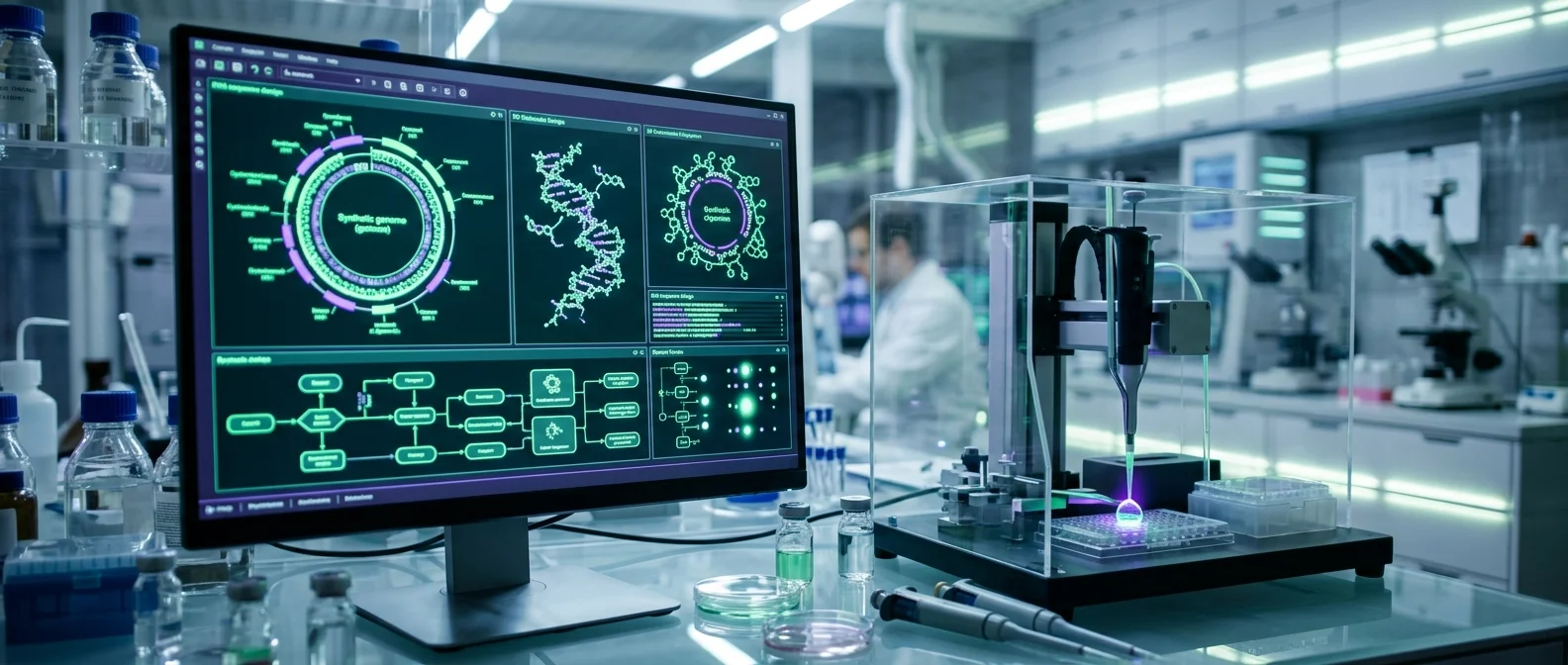
Picture a world where scientists don't just study life — they design it from scratch. Synthetic biology, a field merging biology, engineering, and computer science, promises exactly that: creating living organisms with genomes that never existed in nature. From artificial bacteria to bio-electronic robotic organisms, humanity stands at the threshold of a biological revolution.
What Is Synthetic Biology?
Synthetic biology (SynBio) applies engineering principles to biological systems. Instead of merely studying nature, it aims to design and construct new biological parts, devices, and systems — or redesign existing organisms for useful purposes. The term was first used in 1910 by Stéphane Leduc, but the modern era began with synthetic biological circuits in 2000, when two Nature publications demonstrated genetic switches and biological clocks in E. coli cells.
In 2003, Tom Knight invented BioBrick plasmids — standardized DNA parts that became central to MIT's iGEM (International Genetically Engineered Machine) competition. By 2016, over 350 companies across 40 countries were active in synthetic biology, with an estimated market value of $3.9 billion.
The First Artificial Genome: Craig Venter and JCVI-syn1.0
In May 2010, Craig Venter and his team at the J. Craig Venter Institute published what many consider the most significant discovery in modern biology: the creation of the first bacterium controlled by a chemically synthesized genome. JCVI-syn1.0, based on Mycoplasma mycoides, was a complete genome constructed from chemically synthesized DNA using yeast recombination.
The host cells could grow and reproduce normally, proving that a fully artificial genome could "boot up" a living cell. President Obama convened a special bioethics committee, which declared that while it was a significant technical achievement, it did not amount to "creating life". In 2016, Venter's team created Syn 3.0 with just 473 genes — the minimal genome capable of supporting life.
Xenobots: Living Robotic Organisms from Frog Cells
In 2020, scientists created the first xenobots — programmable synthetic organisms designed by artificial intelligence and built from frog cells (Xenopus laevis). These microscopic organisms, smaller than a millimeter, could move, communicate with each other, and perform simple tasks without any electronic components.
The most stunning development came in 2021: researchers discovered that xenobots can self-replicate — gathering loose cells from their environment and forming new xenobots. This "kinematic self-replication" is completely different from any known biological reproduction, creating possibilities for both research and practical use.
Artificial Bacteria
Craig Venter created bacteria with fully synthetic DNA, proving that life can be "programmed" from scratch
Xenobots
Living robotic organisms from frog cells, designed with AI, that self-replicate without DNA
CRISPR-Cas9
The "DNA scissors" technology that dramatically simplified genome editing in every type of organism
Protocells
Artificial cells constructed in vitro from lipid vesicles, pursuing self-maintenance and reproduction
CRISPR-Cas9: The Genome Editing Revolution
In 2012, Emmanuelle Charpentier and Jennifer Doudna published in Science the programming of CRISPR-Cas9 — a bacterial defense mechanism — for targeted DNA cutting. This discovery, honored with the 2020 Nobel Prize in Chemistry, transformed genetic engineering from a slow and expensive process into a fast and accessible tool. Top venture capitalists like Vinod Khosla called CRISPR more transformative than even artificial intelligence.
CRISPR technology now enables genome editing in bacteria, yeast, plants, animals, and human cells with unprecedented precision. Applications include treating genetic diseases, creating resistant crops, and improving productive strains of microorganisms for industry.
Did You Know?
In May 2019, scientists created a new form of artificial life — a variant of E. coli bacteria with a reduced number of codons from 64 to 59, encoding 20 amino acids. This was the first time an organism was "rewritten" to such a degree, proving that the genetic code can be radically redesigned without losing viability.
Applications That Are Changing the World
Synthetic biology isn't just theory — it's already transforming multiple sectors. In pharmaceuticals, genetically modified yeast produces artemisinin, a precursor to antimalarial drugs. In agriculture, modified rice produces β-carotene, addressing vitamin A deficiency that blinds 250,000–500,000 children annually.
In food, cellular agriculture uses biotechnology and tissue engineering to produce meat, milk, and other animal products without animals. In 2021, Japanese researchers created Wagyu-type meat using 3D bioprinting. In materials, photosynthetic microbes are used to produce spider silk — one of the strongest natural materials.
Biological Computers and Biosensors
A stunning application is designing biological computers — living cells that perform logical operations. Researchers built logic gates in bacteria and human cells, demonstrating analog and digital computation in living systems. In 2011, this technology was used experimentally to detect and neutralize cancer cells. In 2019, a perceptron (artificial intelligence neuron) was implemented in a biological system.
Meanwhile, biosensors based on modified microbes can detect pollutants, pathogens, or even buried landmines. Wearable biosensors, integrated into face masks, were developed for SARS-CoV-2 detection, showing how synthetic biology could transform disease detection.
Advantages
- Creating drugs impossible with conventional methods
- Meat without animal slaughter — sustainable nutrition
- Biofuels and bioplastics from modified microbes
- Restoration of contaminated soils and waters
- Personalized medicine through engineered cells
Risks & Challenges
- Potential uncontrolled spread of synthetic organisms
- Risk of misuse as biological weapons
- Ethical questions: "Are we playing God?"
- Threat to biodiversity if they spread
- Insufficient regulatory oversight in many countries
Medical Applications: From CAR-T to 3D Organ Bioprinting
Synthetic biology has already revolutionized medicine. CAR-T cells — immune cells genetically modified to target cancer cells — represent one of the most impressive applications. Modified bacteria like Bifidobacterium and Clostridium selectively colonize tumors and reduce their size, while genetically modified S. boulardii yeast treats Clostridioides difficile infections.
In 3D bioprinting, researchers constructed an artificial ear from human cells and successfully transplanted it (2022). Bionic pancreas with vascular systems was tested in large animals, while DTRA (Defense Threat Reduction Agency) aims to print micro-organs for drug testing, potentially eliminating animal testing. In 2023, researchers created the first synthetic human embryos from stem cells.
Biosafety, Bioethics and Regulatory Framework
The ability to design new life raises serious ethical questions. Over 100 environmental organizations, including Friends of the Earth and ETC Group, called for a global moratorium on commercial use of synthetic organisms until stricter regulations are established. The EU through SYNBIOSAFE identified key issues of biosafety, bioethics, and dual-use risk.
Built-in "intrinsic biocontainment" mechanisms include auxotrophy (dependence on non-natural substances), kill switches (self-destruction outside controlled environments), inability to reproduce, and use of xenonucleic acids (XNA) instead of DNA — making gene transfer to natural organisms impossible.
Pharmaceuticals
Artemisinin production, personalized CAR-T therapies, anticancer bacteria, and biotechnical drugs
Agriculture & Food
Cellular agriculture, golden rice, lab-grown Wagyu meat, and artificial starch synthesis from CO₂
Environment
Soil bioremediation, plastic-degrading microbes, biofuels, and hydrogen production
Space
NASA researches modified plant organisms for in situ resource utilization on Mars missions
The Future: From Xenobiology to "Mirror Life"
The next frontier is xenobiology — creating organisms with completely new biochemistry. Researchers are developing artificial nucleic acids (XNA), new amino acids, and expanded genetic codes. In 2014, the first organisms with "alien" DNA — artificial nucleotides d5SICS and dNaM — were created in E. coli.
Demis Hassabis's AlphaFold2 (2024 Nobel Prize in Chemistry) predicted the structure of nearly 200 million proteins, enabling understanding of antibiotic resistance and designing enzymes that decompose plastic. The Build-a-Cell initiative (2017) — an open-source global collaboration — aims to construct fully synthetic living cells "from the bottom up," while "mirror life" research explores organisms with reversed molecular chirality.
Conclusion
Synthetic biology fundamentally changes our relationship with life. From Venter's first synthetic bacterium (2010) to self-replicating xenobots and synthetic human embryos (2023), progress is exponential. With proper regulation, the ability to "write" new life can cure diseases, feed the planet, and open the frontiers of human understanding — but it requires vigilance, transparency, and global cooperation.
Sources:
- Wikipedia - Synthetic biology
- Science - Gibson et al. (2010), "Creation of a bacterial cell controlled by a chemically synthesized genome"