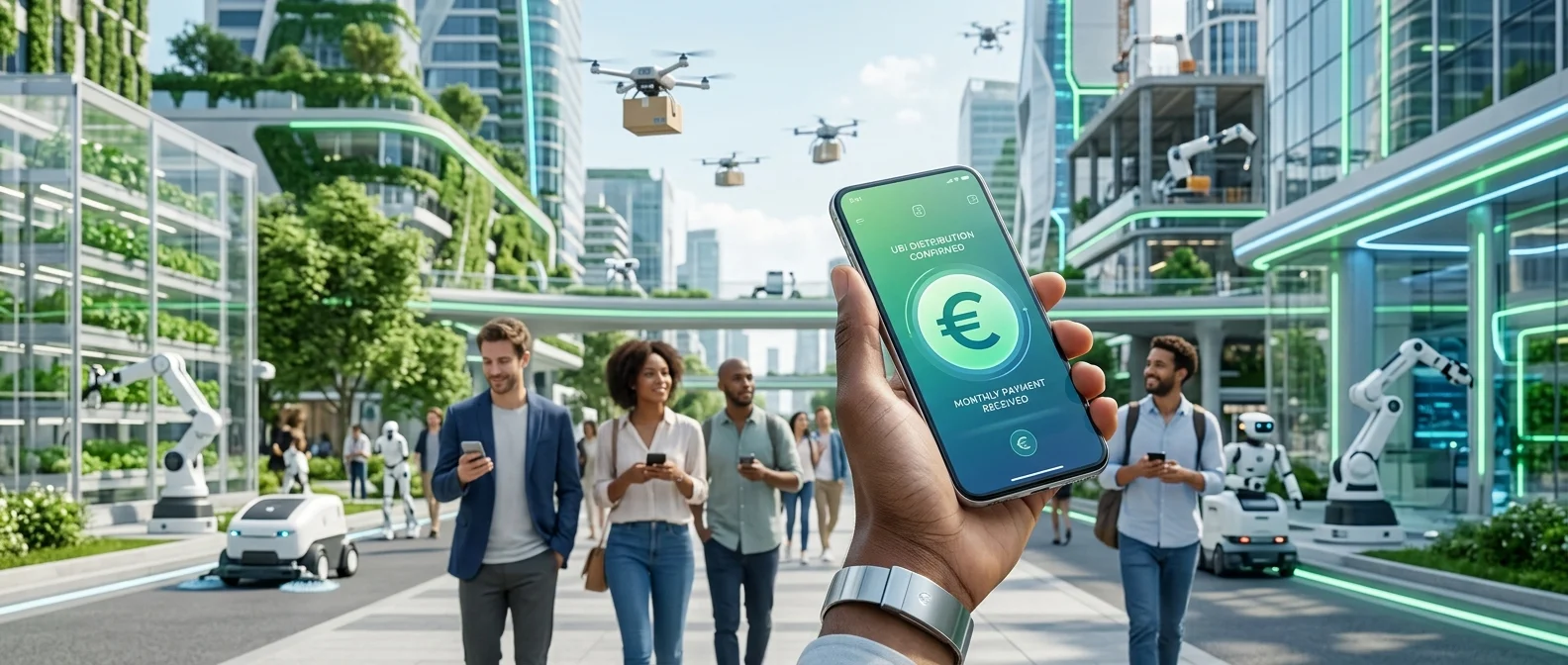
What Is Universal Basic Income?
The concept is deceptively simple: every citizen receives a fixed monthly payment from the government. No strings attached. No means testing. No requirement to prove you're job hunting. Thomas Paine, one of America's founding fathers, proposed something similar in 1795 — a "national fund" paying every adult £10 annually as "rent" for using land that belongs to everyone.
Today the logic remains identical, but the urgency has shifted. We're not just talking about poverty anymore. We're talking about automation. About AI systems trained on collective human knowledge replacing workers from accountants to graphic designers. The question isn't whether machines will take jobs — it's how fast, and what we do about it.
📖 Read more: Holograms: From Sci-Fi to Reality
📖 Read more: EHang: The First Flying Taxi Already Soars in China
📖 Read more: AI Gondolas: Autonomous Boats on Water
The Experiments That Changed Everything
The pilot programs upended conventional wisdom: recipients kept working. They work better. Finland handed €560 monthly to 2,000 unemployed citizens between 2017-2018. They didn't dramatically increase employment rates, but reported significantly lower stress, higher confidence, and better mental health.
Why AI Changes the Conversation
Until recently, UBI discussions centered on poverty. Now Geoffrey Hinton — the "godfather" of artificial intelligence, Nobel laureate — publicly states he advised the British government to support UBI. "AI will increase the gap between rich and poor," he warns.
The problem isn't just job elimination. Karl Widerquist, philosophy professor at Georgetown, explains: "Even if AI doesn't make you unemployed, it pushes you down the labor market ladder. Skilled workers start competing for gig economy positions." This means wage depression, insecurity, social instability.
Who Pays? The "Robot Tax" Idea
Rosanna Merola of the International Labour Organization has studied taxing companies that replace workers with AI. Possibilities include taxing profits from AI-driven processes, or data collection and sales that feed the models. The idea is "philosophically attractive" — practically, nobody has legally defined what constitutes a "robot" yet.
📖 Read more: Work 2040: How We'll Work in the Future
📖 Read more: AI Legal Rights: Should Robots Have Them?
Myths vs Reality
"Give people money without conditions and nobody will work." This phrase surfaces in every UBI discussion. The data tells a different story.
❌ Myth
People will sit on couches all day.
✅ Reality
In the Netherlands, participants with no job-seeking requirements found more stable, permanent positions. Cleo Goodman of think tank Autonomy puts it bluntly: "It's complete nonsense that there's a segment of society that just wants to sit on the couch drinking beer."
Cheeoni Hampton, a 47-year-old disabled grandmother from Atlanta, received $850 monthly through the "In Her Hands" program. Instead of becoming lazy, she took online courses, became a security guard, paid off debts, and bought a house. "A weight lifted from my shoulders," she says. "It motivated me to do something better for myself."
📖 Read more: Humanoid Robots in Factories: The H1 Era 2030
📖 Read more: AI Scientists: Discoveries Without Humans
How Would We Fund It?
The math is daunting. A national UBI program costs billions. What funding mechanisms are being discussed?
Automation Tax
Companies replacing workers with AI pay taxes proportional to eliminated positions. Supported by Bill Gates, but the legal definition of "robot" remains unclear.
Data Tax
AI models feed on data we generate. Taxing data collection, processing, and sales could partially fund UBI programs.
Tax Redistribution
According to think tank Autonomy, a modest UK UBI would be "cost-neutral" — cutting poverty in half without net tax increases through redistribution from the wealthy.
AI Companies
Futurist Nell Watson predicts "AI companies" without human staff, extremely profitable. Their gains — minus salaries — could fund basic income without government intervention.
Risks and Criticisms
Not everyone's convinced. Joe Chrisp, UBI researcher at the University of Bath, calls himself a "friendly skeptic." His concern: basic income might "facilitate the proliferation" of insecure jobs instead of pushing people toward stable employment. Other questions remain.
✅ Pros
- Reduces poverty and inequality immediately
- Boosts entrepreneurship (Kenya: +20%)
- Frees time for education and caregiving
- Safety net in automation era
- Improves mental health and confidence
❌ Cons
- Colossal cost at national scale
- Potential drop in motivation for difficult jobs
- Inflationary pressures if demand increases
- Politically difficult — "ideological resistance"
- Risk of eliminating existing social benefits
📖 Read more: Interplanetary Internet: Networks from Earth to Mars
📖 Read more: AI Teachers: How We'll Learn in the Future
What About Greece?
Greece has no UBI pilot programs. The Minimum Guaranteed Income (formerly KEA) is the closest policy — but it's far from universal: strict income criteria, bureaucracy, and regular checks required. It's neither "universal" nor "unconditional."
However, with Greek youth unemployment remaining among Europe's highest and AI beginning to impact sectors like tourism, services, and public administration, the question isn't whether it will be discussed, but when.
The Road Ahead
Neil Howard, researcher at the University of Bath, believes social justice alone justifies UBI: "Humanity's common wealth has been appropriated by the few. This forces the many to either struggle for survival or fail entirely." Technology accelerates this dynamic.
Bottom Line
UBI isn't a silver bullet. It won't solve inequality, poverty, or automation single-handedly. But pilot programs — from Finland to Kenya — show that giving people a basic safety net doesn't make them lazy. They start businesses, study, care for families. The real question isn't whether it works anymore — it's whether we'll have the courage to try it.