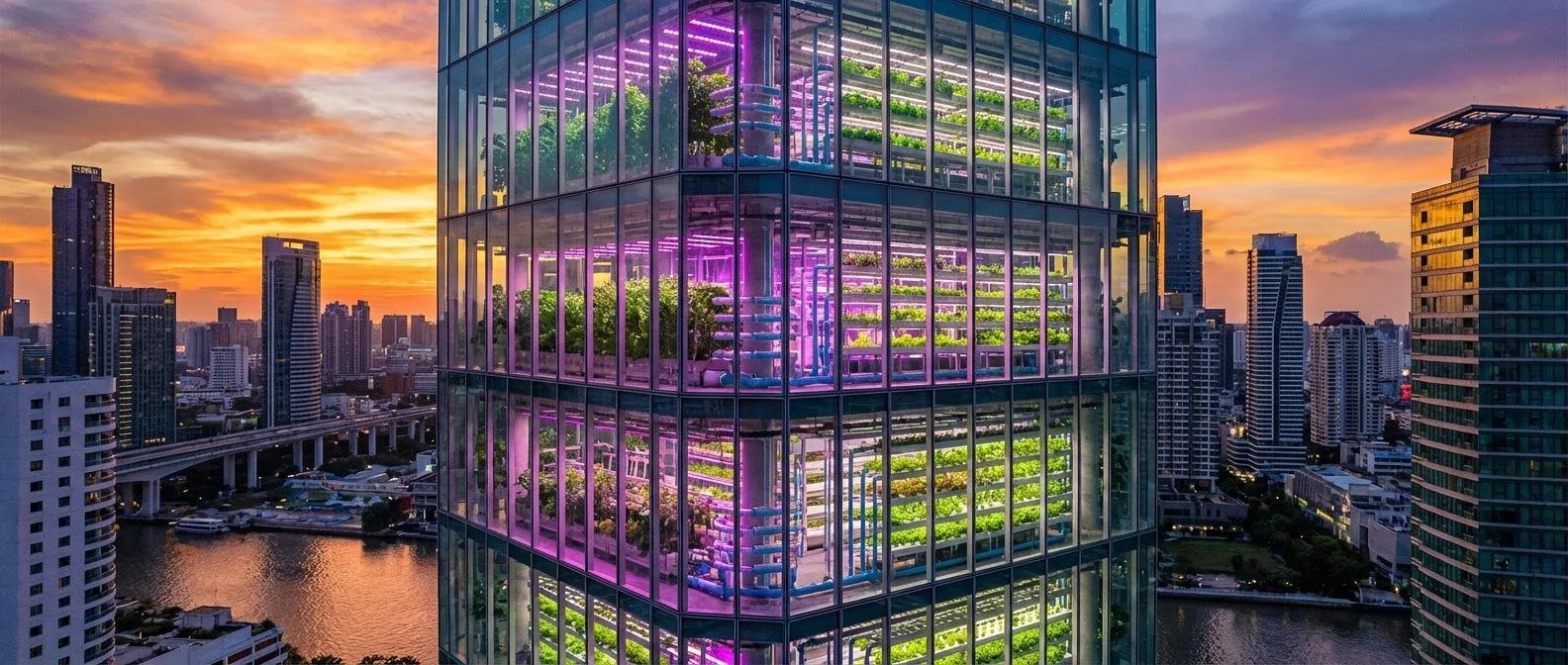
By 2050, the planet will need 60% more food — but arable land is shrinking. The solution? Skyscrapers packed with lettuce, strawberries, and herbs, 30 floors above city streets. Vertical farms: aeroponics, LED lighting, AI, and robotics in a controlled environment. They're already supplying supermarkets in Singapore, Dubai, and New York.
📖 Read more: High-Altitude Wind Energy: Power Kites
What Is Vertical Farming?
Vertical farming refers to growing crops in vertically stacked layers, inside buildings, containers, or underground tunnels. The modern concept was proposed in 1999 by Professor Dickson Despommier at Columbia University: a 30-storey skyscraper on one city block could feed 50,000 people.
💧 Hydroponics
Growing in nutrient-rich water, no soil. Used by most vertical farms. Saves 90%+ water.
💨 Aeroponics
Roots hang in air and are misted with nutrient solution. AeroFarms uses a patented aeroponic system — 90% less water, 230× less land.
🐟 Aquaponics
Fish + plants combined: fish fertilize the water, plants clean it. Circular system, zero waste.
💡 LED Lighting
Specialized red-blue spectrum LEDs replace sunlight. Chlorophyll doesn't need white light — just specific wavelengths. Nuvege in Kyoto produces 6 million lettuce heads/year in a windowless room.
📖 Read more: Humanoid Robots: Our New Roommates
The Major Players
Why We Need Vertical Farms
The Numbers That Matter
- Population — by 2048, +3 billion people, 80% in urban areas
- Waste — 30% of global harvest lost to spoilage/transport
- Weather — US floods 1993/2007/2008 cost billions in lost crops
- Water — traditional agriculture = 70% of global freshwater consumption
- Biodiversity — up to 20 units of farmland could return to nature per VF unit
📖 Read more: Lab-Grown Meat: Food Without Animals
Advantages vs Disadvantages
| Advantage | Disadvantage |
|---|---|
| 97% less water | Massive electricity cost (LEDs) |
| No pesticides/fungicides | $100M+ initial investment (60-hectare farm) |
| 365-day/year production | Only greens/small plants — can't grow wheat |
| Close to consumer = zero food miles | LEDs ~28% efficient (as of 2018) |
| Weather-independent | Jones Food Company UK: went bankrupt Apr. 2025 |
| 4-30× yield per acre increase | Needs CO₂ source (e.g., combustion) |
"Each floor will have its own watering and nutrient monitoring systems. DNA sensors will detect pathogens. A gas chromatograph will tell us when to pick. These technologies already exist — we don't have to invent anything new."
Types of Vertical Farms
🏢 Skyscrapers
The Despommier proposal: 30-storey building, hydroponics on upper floors, chickens/fish below. Equivalent to 1,000 hectares of conventional farming. Still theoretical.
📦 Shipping Containers
Freight Farms "Greenery": complete system in a 40×8-foot container. LEDs, hydroponics, climate control. Ideal for arctic regions: Churchill (Manitoba), Unalaska (Alaska) — fresh vegetables without planes.
⛏️ Abandoned Mines
"Deep farming" exploits consistent underground temperatures and nearby groundwater. Ideal for former coal mines repurposed as food factories.
🏙️ Mixed-Use Skyscrapers
Architect Ken Yeang (Menara Mesiniaga 1992): buildings combining residents + plants in open air. Smaller scale, but a living, breathing proposal.
📖 Read more: Megastructures: Constructions of Type II Civilizations
Timeline
Global Impact: Feeding the Cities of Tomorrow
- Drought-prone regions — Middle East, Mediterranean, sub-Saharan Africa: VF = 97% less water, independence from rainfall
- Island nations — Singapore, Japan, Caribbean: food security without massive imports
- Arctic communities — Churchill (Canada), Unalaska (Alaska): container farms replacing $15 lettuce heads
- EU Green Deal — subsidies for sustainable agriculture and pesticide reduction
- Energy synergy — solar panels + VF = self-sustaining food production in remote areas
The Future: 2030-2040
Vertical farming won't replace fields — but it will complement them. Leafy greens, herbs, strawberries, microgreens: these are the products that make sense in VF. Wheat, corn, rice? Still in the fields. The scale is growing, LED costs are falling, AI is optimizing every plant. By 2040, every major city will have its own vertical farms — and will serve lettuce that grew 3 floors above.