📖 Read more: Universal Basic Income: The Solution in the AI Era?
The Evolution of Work: From Factory Floors to Home Offices
In the 19th century, the average workweek exceeded 70 hours. By 1940, union struggles had reduced it to 40. In 1930, John Maynard Keynes predicted that technological advances would bring a 15-hour workweek within two generations. Nearly a century later, his prediction hasn't materialized — but we're watching the next transformation unfold.
AI and Automation: Which Jobs Are at Risk?
Carl Benedikt Frey and Michael Osborne's 2013 Oxford Martin School study put a number on the threat: 47% of US jobs face high automation risk. McKinsey estimates that 400-800 million jobs worldwide will be lost by 2030, while PricewaterhouseCoopers calculates 38% of US jobs, 35% in Germany, 30% in the UK, and 21% in Japan are at risk.
"Artificial intelligence is going to replace literally half of all white-collar workers in the U.S."
Jobs at Risk
🏭 Manufacturing & Production
Robotic automation in production lines, warehouses, and logistics. McKinsey estimates 82% of labor in the apparel industry is automatable.
💼 Administration & Office Work
Data entry, accounting, legal research, and basic programming face AI displacement. Entry-level jobs dropped 33% in the US/UK.
🚗 Transportation
Autonomous vehicles, robotaxis, and automated ports (e.g., Singapore) threaten millions of driver and operator positions.
🏪 Retail
Self-checkout, cashierless stores (Amazon Go), and AI chatbots cut staffing requirements. The sector is changing rapidly.
New Jobs Being Created
🤖 AI Supervisor
Oversight, training, and calibration of AI systems. A field that didn't exist 5 years ago, now essential in every major company.
🌱 Green Jobs
Renewable energy technicians, circular economy engineers, sustainability consultants — the green transition is creating millions of positions.
🧠 Prompt Engineering
Specialists in crafting AI instructions, AI workflow designers, and AI ethics officers. These positions now exist across organizations.
💆 Care & Empathy
Healthcare, psychological support, education — sectors where machines can't replicate human connection.
The 4-Day Workweek Revolution
The 4-day workweek has moved from dream to practice across dozens of countries. The "100-80-100″ model (100% pay, 80% time, 100% productivity) is being implemented successfully in pilot programs worldwide.
🌍 Countries Running Pilot Programs
Iceland, UK, Spain, Belgium, Japan, Scotland, Australia, New Zealand, France — and many more countries are considering or testing reduced workweeks. A University of Massachusetts study shows the 4-day week could reduce humanity's carbon footprint by ~30%.
Remote Work: The New Normal
The COVID-19 pandemic shattered the myth that “work must be done in the office.” Within weeks, millions of workers transitioned to full remote work — and many don't want to go back. Remote working is no longer a “perk” — it's a requirement.
🏠 Remote-First Companies
GitLab, Automattic, Zapier — companies with no offices and thousands of employees across dozens of countries. Proof that fully remote works.
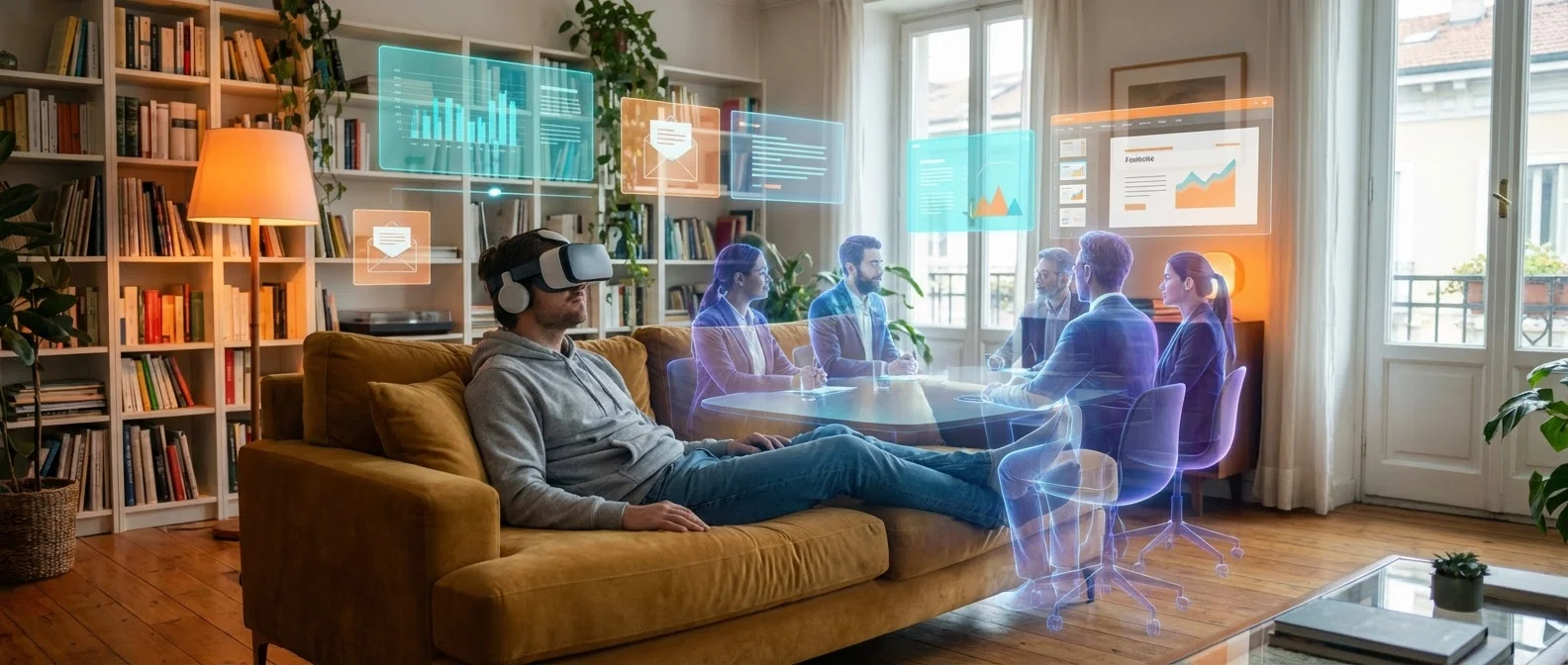
🔮 Holographic Meetings
Holographic video calls, VR offices, and AI avatars will transform collaboration. Microsoft, Meta, and Apple are investing billions.
🌍 Digital Nomads
Working from anywhere, without a permanent base. Countries like Portugal, Estonia, and Greece offer special digital nomad visas.
🤝 Hybrid Model
The hybrid model (2-3 days office, 2-3 home) already dominates at major companies. It requires redesigning workspaces from the ground up.
Gig Economy and Platform Work
The “gig economy” is expanding rapidly. Uber, Deliveroo, Upwork, Fiverr — platforms connecting workers with employers without permanent employment relationships. Freedom comes at a cost: insecurity, lack of insurance, and income uncertainty.
"There is no such thing as a stable job anymore. There are only stable skills."
Solutions for the Future
What Will a Typical Workday Look Like in 2040?
🕗 08:00 — Wake Up
You wake up without an alarm — your AI assistant woke you at the optimal sleep phase. You review your day's summary on AR glasses while getting ready.
🕘 09:00 — Holographic Meeting
A holographic meeting with colleagues in 4 countries. The AI assistant takes notes automatically, translates in real-time, and generates action items.
🕐 13:00 — Creative Work
You work on creative projects — repetitive tasks are handled by AI. You focus on strategy, relationships, and innovation.
🕓 16:00 — End of Day
The 6-hour workday is over. Tuesday marks the third working day this week — tomorrow is “off.” Time for lifelong learning, volunteering, or hobbies.
Global Impact
This work revolution won't hit every country the same way. Developing nations face the risk of “premature deindustrialization” — automation displacing jobs before these countries reach prosperity. A 2016 study by the Oxford Martin School and Citibank found that 77% of jobs in China, 69% in India, and 85% in Ethiopia are at risk of automation, compared to 47% in the US.
"The key to winning the race is not to compete against machines but to compete with machines."
Looking Ahead
Technological unemployment isn't a new phenomenon — Emperor Vespasian refused to adopt a cheap transport method to protect his hauliers' livelihoods. What's different today is the speed and scope: AI isn't just replacing muscle power, but cognitive work as well.
The answer lies not in fear, but in adaptation. Shorter workweeks, new skills, social safety nets, and human creativity — these are the tools that will shape the world of work in 2040. The question isn't whether everything will change, but whether we'll be ready.