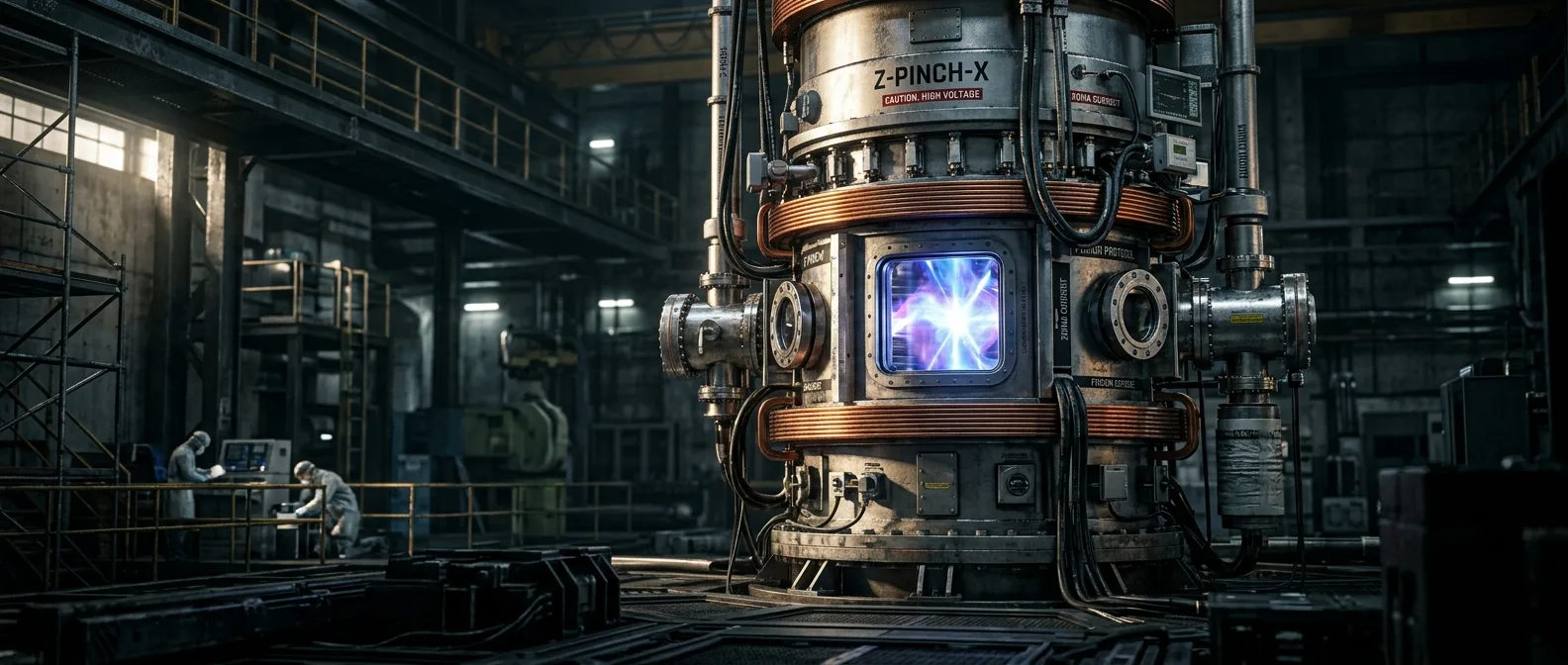
Twelve lightning bolts per minute strike inside a reactor just 12 feet long. In 2025, Zap Energy announced it achieved the highest plasma pressure record in Z-pinch fusion — 1.6 gigapascals, or 10,000 times greater than atmospheric pressure at sea level.
That doesn't just sound impressive — it is. Especially when the system that achieved it measures 12 feet long, not the massive buildings we usually associate with nuclear fusion. Zap Energy, a Seattle startup, is trying to prove you can do fusion without giant factories — though we're still talking about laboratories for now.
📖 Read more: AI Drug Discovery: New Drugs in 18 Months
🔬 The Z-Pinch Revolution: Lightning Instead of Magnets
We're used to imagining nuclear fusion with massive rings of superconducting magnets or bulky laser arrays. Zap Energy has a different idea. It uses sheared-flow-stabilized Z-pinch technology, which in plain English means squeezing plasma with electric currents instead of magnetic fields.
How does Z-pinch fusion work?
The system contains special hydrogen isotopes in a thin tube. When a massive electric current passes through, the gas becomes plasma and simultaneously creates a magnetic field that compresses it — the Z-pinch effect. The result? Extremely high pressures in a small space.
The 1.6 gigapascal record didn't come from nowhere. The company put in serious work to get here — and the key was adding a third electrode to its FuZE-3 system. While it previously used two electrodes to generate one power pulse, it can now send two different pulses and independently control plasma acceleration and compression.
The secret of dual pulses
As Zap spokesperson Andy Freeborn explained to TechCrunch, the new setup lets the team precisely control what happens inside the reactor. They first accelerate the plasma along the tube to stabilize it, then compress it when it reaches the conical end.
Of course, Zap admits it needs to increase pressure at least tenfold to reach scientific breakeven — the point where the energy produced by the reaction exceeds what's needed to start it. And that's just the beginning — it doesn't account for supporting systems' energy or the ability to extract useful power.
⚡ Century Platform: First Taste of the Future
Alongside pressure records, Zap Energy is working on something even more ambitious — the Century platform. This is the first fully integrated system combining three core technologies for future power plants: repetitive pulsed power supplies, flowing liquid metal walls, and electrode protection technologies.
Century works like an internal combustion engine — sending a high-voltage pulse every ten seconds for over two hours. In June 2024, it completed a test of 1,080 consecutive shots, showing the technology can operate steadily for extended periods.
Why liquid metals?
Flowing liquid metal walls aren't decorative. They absorb heat and neutrons from fusion reactions — exactly the energy we want to harness. Century uses 70 kilograms of liquid bismuth in its initial configuration, but the final version will circulate over a ton of metal.
The size is also impressive — Century's central stack is the size of a double-decker bus, close to what's planned for a 50 MW electrical generation unit. Future power plants will have multiple such units.
📖 Read more: Humanoid Robots: Our New Roommates
💰 The Funding: $130M and New Expectations
In October 2024, Zap Energy closed a $130 million funding round (Series D), led by Soros Fund Management. The company's total funding now exceeds $330 million, showing investors believe in the long-term viability of Z-pinch technology.
«The race to commercialize fusion has traditionally been thought of as a triathlon: science, then engineering, then commercialization. At Zap we're trying to swim, bike, and run at the same time.»
— Benj Conway, CEO of Zap Energy
This parallel approach isn't accidental. While most fusion market players focus on either science or engineering, Zap is trying to do both simultaneously. The money will fund parallel development of both plasma R&D and systems integration.
The DOE program
The company participates in the U.S. Department of Energy's Milestone-Based Fusion Development Program and hopes to achieve specific targets by year-end. What exactly those targets are? They haven't said yet, but participation in the program shows government authorities are taking Z-pinch technology seriously.
📖 Read more: Supersonic Planes: Athens-New York in 2 Hours
🧬 Z-Pinch Fusion Pros and Cons
The Z-pinch approach has clear advantages: cost, size, and construction simplicity. It doesn't need massive superconducting magnets or laser arrays costing billions. Ben Levitt, Zap's VP of R&D, puts it clearly: successes in systems that are a fraction of the size and cost of other fusion devices with similar performance.
Z-Pinch Advantages
- Dramatically smaller size
- Lower capital costs
- Simpler construction
- Faster development
Challenges
- Less mature technology
- Higher plasma pressures required
- Stability problems
- Commercial viability uncertainty
However, the technology is significantly less mature than classical tokamaks or inertial confinement fusion. The fact that it needs to increase pressure tenfold for scientific breakeven shows there's still road ahead.
Z-pinch also faces the classic plasma instability problem — something Zap is trying to solve with sheared-flow stabilization. How effective this will be at commercial production scale? Nobody knows yet.
🚀 The Future: FuZE-4 and Beyond
Zap isn't resting on its laurels. While FuZE-3 experiments continue, the company is already working on a next-generation device launching this winter. It's also developing a pulsed power capacitor bank that will feed future systems.
In 2025, the Century platform will gradually increase input power to 100 kilowatts — roughly the power consumed by 75 average American homes, concentrated in a water heater-sized chamber. Sounds scary, but it's just the beginning of what's needed for commercial fusion.
The battle of approaches
Zap Energy isn't alone in the market. Commonwealth Fusion Systems with its tokamaks, TAE Technologies with field-reversed configuration, Helion Energy with pulse reactors — all are trying to solve the fusion problem with different approaches.
And that's good. As TechCrunch notes, given the massive uncertainties around viability and timelines of different fusion approaches, the more players driving progress in this field, the better.
Zap's 1.6 gigapascal record may not mean immediate commercial fusion, but it shows there are multiple paths to the same destination. The question isn't whether we'll get there — but which approach will arrive first. And 2026 looks like it will be a defining year to find out.