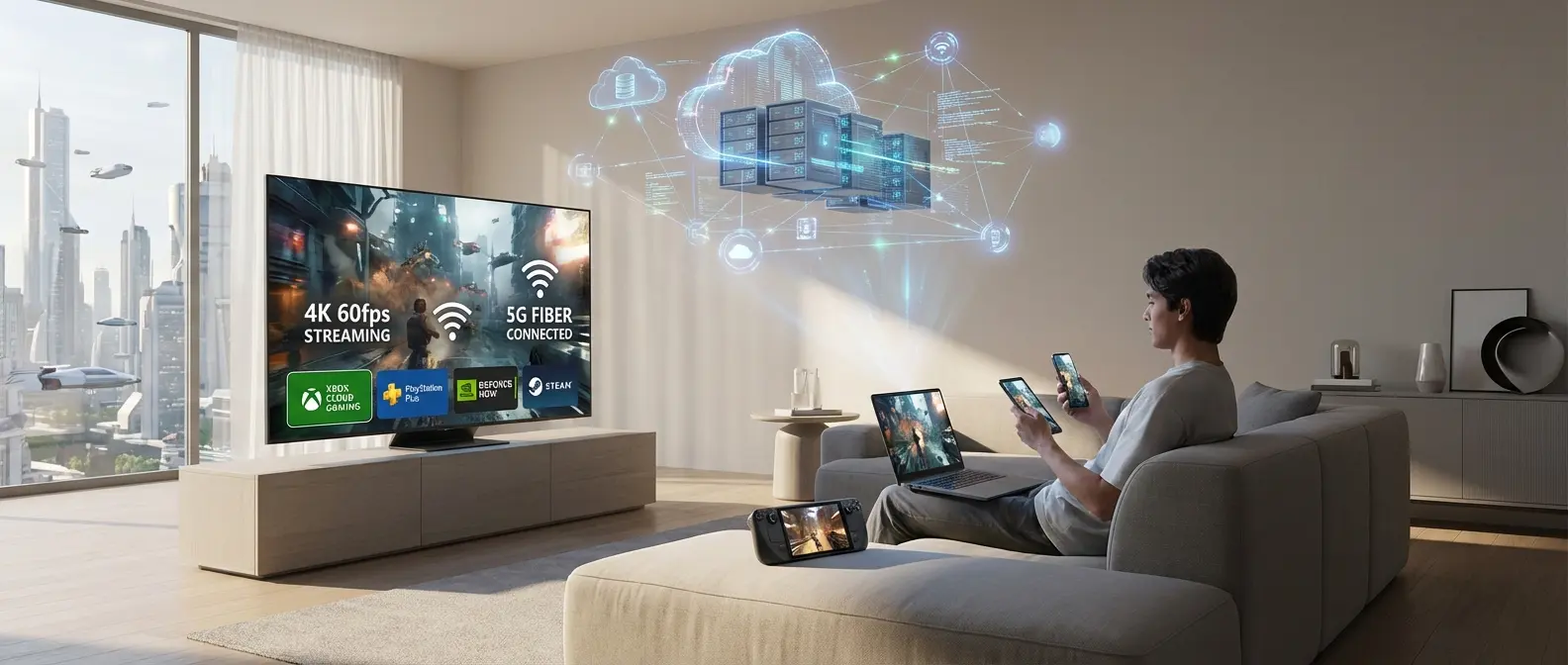
Remember the days when we waited hours to download a 100GB game? Or when you had to buy a €500 console just to play one exclusive? In 2026, those are starting to feel like distant memories. Cloud gaming has matured so much that it's now a genuine alternative to traditional gaming, with four major services — Xbox Cloud Gaming, PlayStation Plus Premium, GeForce Now, and Steam Cloud Gaming — delivering experiences that seemed impossible just a few years ago.
The concept is simple yet revolutionary: instead of the hardware sitting in your home, it's located in data centers hundreds of miles away. You send commands from your controller, the server runs the game, and streams the video back to you. All of this happens in milliseconds, at 4K resolution and 60fps. It sounds like magic, and in many cases, it is.
☁️ What Is Cloud Gaming?
Cloud gaming (or game streaming) lets you play demanding games on any device — smartphone, tablet, old laptop, Smart TV — without needing powerful hardware. The game runs on remote servers and the video is streamed to your device in real time.
🎮 Xbox Cloud Gaming: Game Pass Everywhere
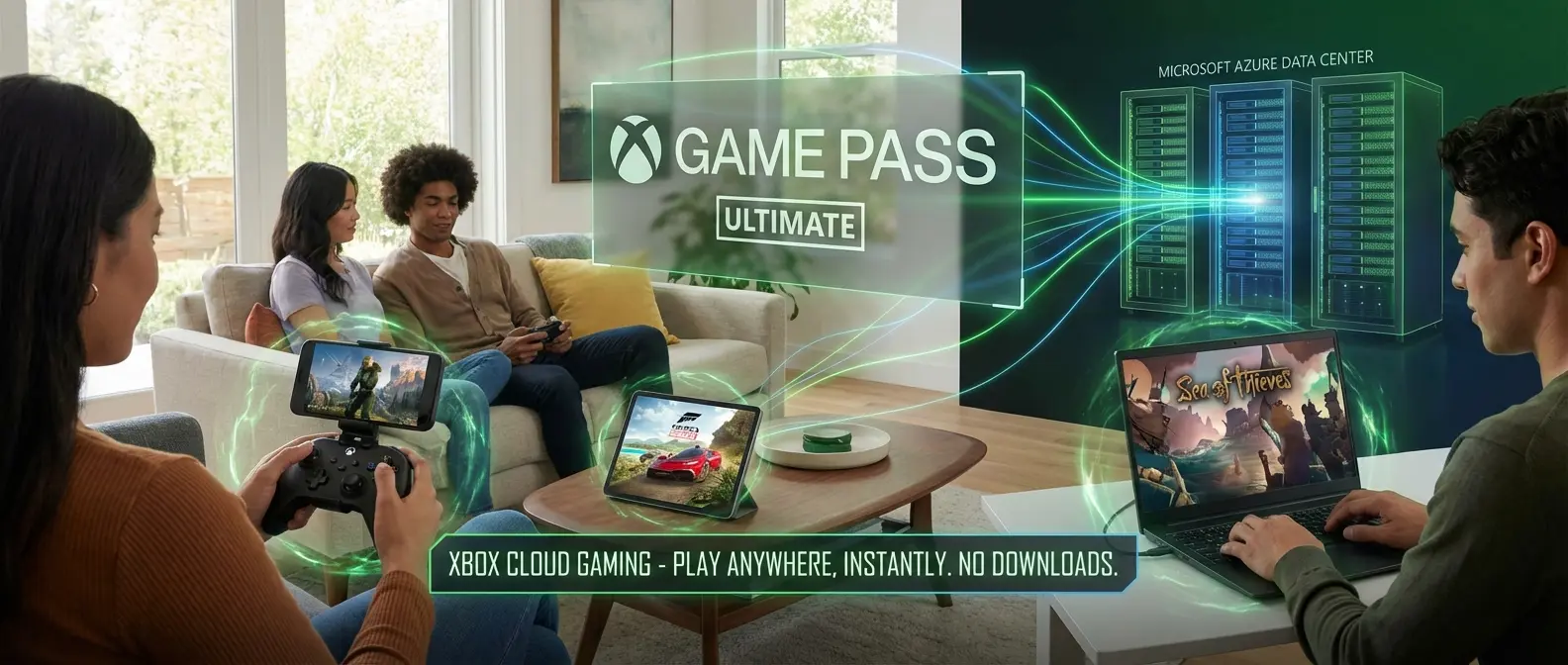
Xbox Cloud Gaming: Halo, Forza, and Xbox exclusives on any device via Game Pass Ultimate
Microsoft was one of the first companies to believe in cloud gaming, and in 2026 that investment is paying off. Xbox Cloud Gaming, which is included free with a Game Pass Ultimate subscription, has evolved into a remarkably reliable service. With Azure data centers expanding worldwide — now including Greece — latency has dropped to levels that make even competitive games playable.
Microsoft's greatest advantage is its library. With over 400 games available for streaming — from Halo Infinite to Forza Horizon 5, from Starfield to Bethesda and Activision Blizzard titles — there's no shortage of content. And the best part? Everything is included in the subscription at no extra cost.
💚 Xbox Cloud Gaming - Key Features
- Price: €14.99/month (Game Pass Ultimate)
- Library: 400+ games, day-one releases
- Resolution: Up to 1080p (4K in beta)
- Devices: Android, iOS, Windows, Smart TVs, Steam Deck
- Latency: ~25ms (Greece)
- Exclusives: Halo, Forza, Starfield, Elder Scrolls
The user experience is impressively seamless. You can start a game on your Xbox Series X in the living room, continue on your tablet in the kitchen, and finish on your phone on the subway. Saves sync automatically, and the transition is instant. What Microsoft calls “play anywhere” has become a reality.
🎮 PlayStation Plus Premium: Sony Enters the Cloud
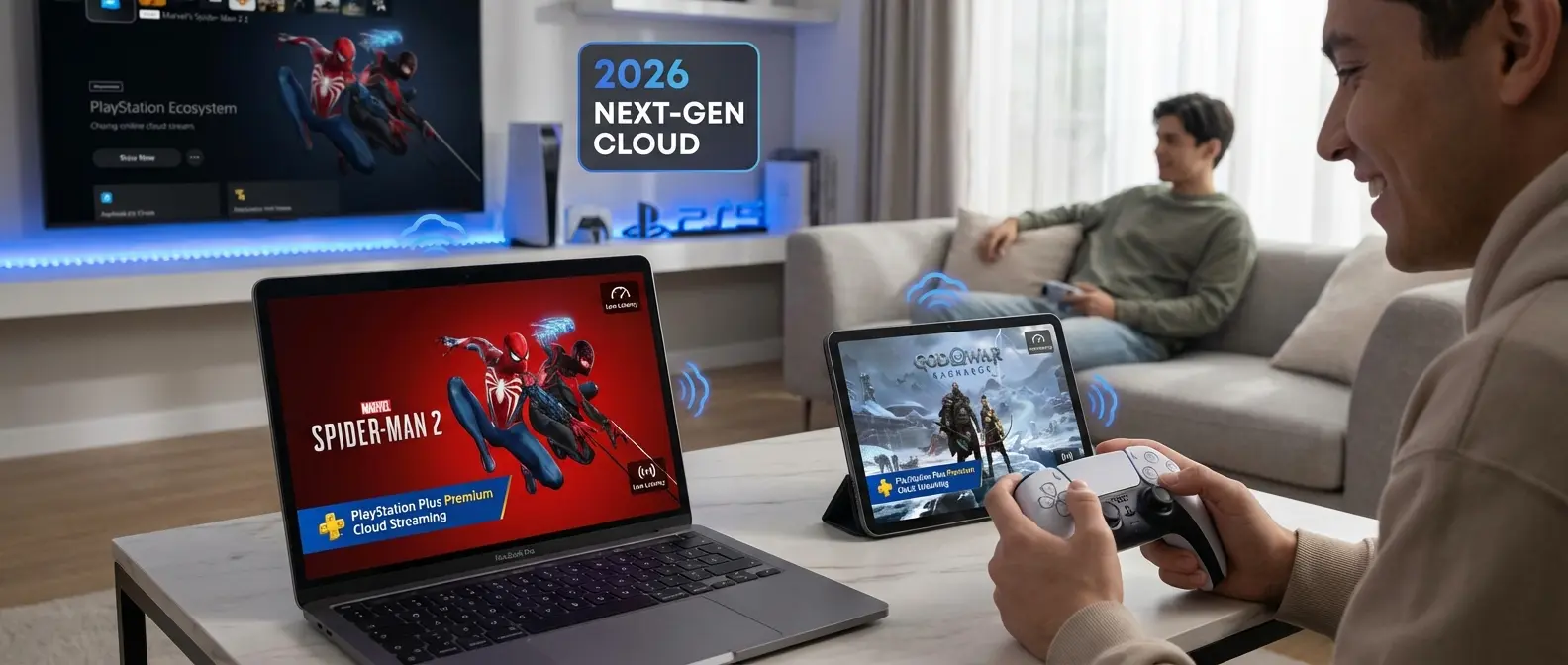
PlayStation Plus Premium: Spider-Man, God of War, and PS5 exclusives on MacBook, Android, and Smart TVs
Sony, traditionally more conservative about cloud gaming, has made enormous strides with PlayStation Plus Premium. The service once known as PS Now has been completely transformed, now offering cloud streaming not only of older titles but also of the latest PS5 exclusives.
In 2026, you can play Spider-Man 2 on a MacBook. God of War Ragnarök runs on your Android tablet. Horizon Forbidden West plays on your Smart TV without needing a PS5. This was unthinkable just a few years ago, when Sony insisted its exclusives had to be played only on PlayStation hardware. The strategic shift shows how seriously the company now takes cloud gaming.
💙 PlayStation Plus Premium - Key Features
- Price: €16.99/month (€134.99/year)
- Library: 700+ games (PS1 through PS5)
- Resolution: Up to 4K@60fps (PS5 games)
- Devices: PS4, PS5, PC, Mac, Android, iOS, Smart TVs
- Latency: ~30ms (Greece)
- Exclusives: Spider-Man, God of War, Horizon, Gran Turismo
A notable advantage of the service is DualSense controller support in cloud streaming. Haptic feedback and adaptive triggers work even when playing via streaming, adding an extra dimension to the experience. Of course, you need the DualSense connected to your device — an additional cost to keep in mind.
⚡ GeForce Now: RTX Power in the Cloud
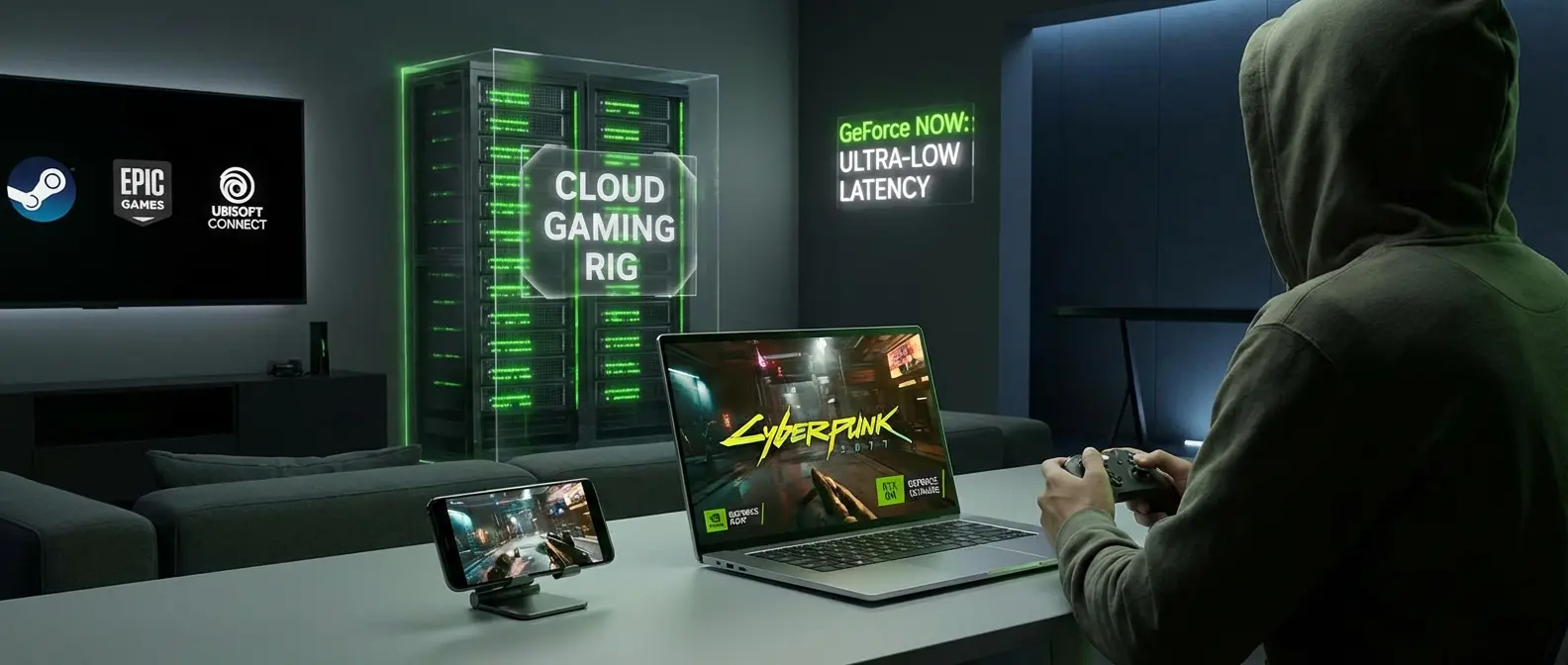
GeForce Now: RTX ray tracing and high-end games on modest devices via the cloud
If what you're after is the best possible graphics quality via cloud, NVIDIA's GeForce Now is the answer. The service uses RTX 4080 GPUs in its servers, delivering ray tracing and DLSS 3 even on old laptops or tablets. The result is stunning: games like Cyberpunk 2077 with full ray tracing run at 4K@60fps on devices that normally wouldn't even launch the game.
What makes GeForce Now unique is its approach to the game library. Instead of paying for games through the service, you connect your accounts from Steam, Epic Games Store, GOG, and Ubisoft Connect. Games you've already purchased become available for cloud streaming at no additional cost. This means your library isn't lost — you simply play it from the cloud instead of your PC.
💚 GeForce Now - Key Features
- Price: Free (1-hour sessions) / €9.99/month Priority / €19.99/month Ultimate
- Library: 2000+ supported games (your own from Steam/Epic/GOG)
- Resolution: Up to 4K@120fps (Ultimate tier)
- Devices: PC, Mac, Android, iOS, Smart TVs, Chromebooks
- Latency: ~22ms (Greece)
- Technology: RTX 4080, DLSS 3, Ray Tracing
For competitive gamers, NVIDIA has invested heavily in reducing latency. With the Reflex feature now working in the cloud as well, total input lag can drop below 40ms — comparable to many local setups. This makes games like Fortnite, Apex Legends, or Counter-Strike 2 enjoyable even for more competitive players.
🎯 Steam Cloud Gaming: Valve Enters the Game
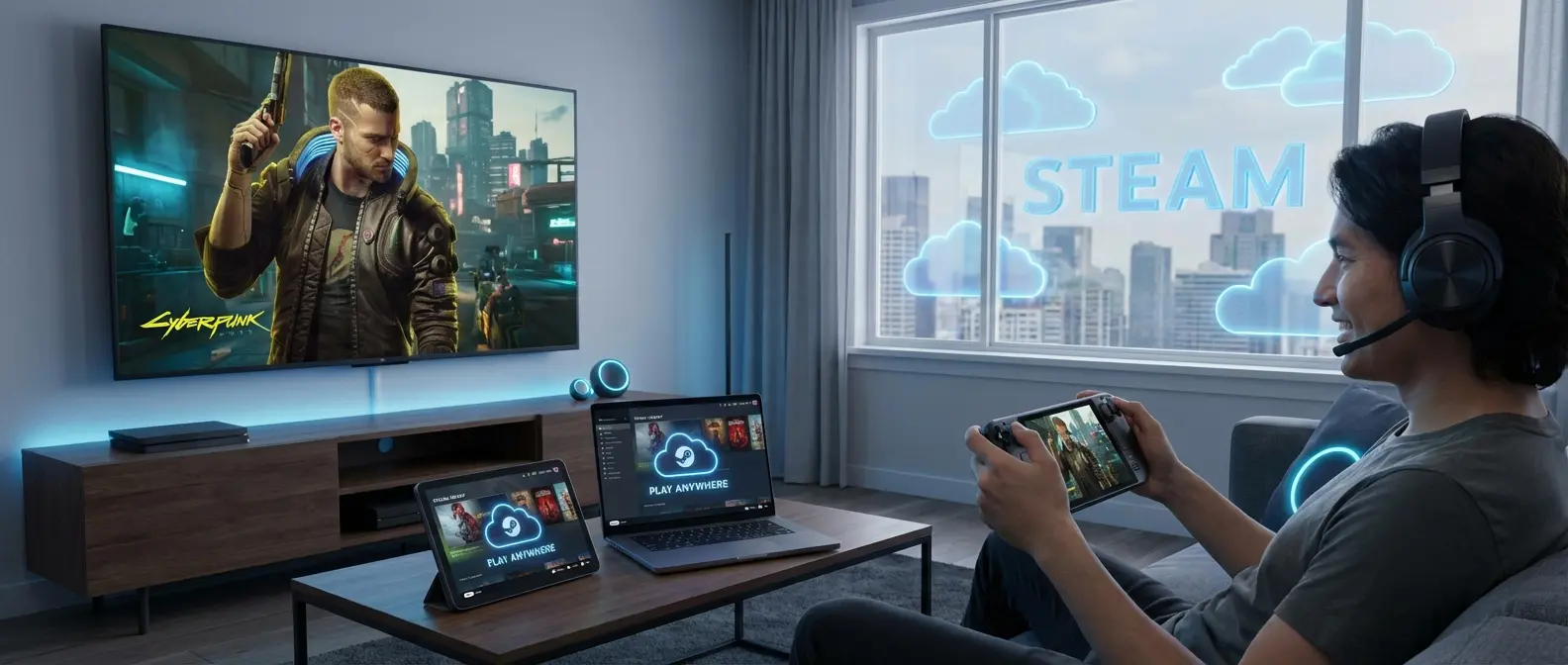
Steam Cloud Gaming: The massive Steam library accessible without downloads, seamless switching between devices
The big surprise of 2025–2026 was Valve's entry into cloud gaming with Steam Cloud Gaming. The company that dominates PC gaming decided to leverage Steam's massive library and make it accessible without downloads. The move came after the success of the Steam Deck, which proved that PC gamers want flexibility in where and how they play.
Valve's approach is different from the competition. Instead of a monthly subscription, Steam Cloud Gaming works with hourly credits you purchase with your Steam Wallet funds. This means you only pay for the hours you actually use the service — ideal for casual gamers who don't play every day.
🎮 Steam Cloud Gaming - Key Features
- Price: €0.15/hour Standard / €0.30/hour Premium (4K)
- Library: 10,000+ supported games (your own Steam library)
- Resolution: Up to 4K@60fps
- Devices: PC, Mac, Linux, Android, iOS, Smart TVs, Steam Deck
- Latency: ~28ms (Greece)
- Integration: Steam Workshop, achievements, friends list
The integration with the Steam ecosystem is seamless. Achievements, screenshots, the friends list, and even Steam Workshop all work normally. You can use mods on games running in the cloud, something no other service offers. For die-hard PC gamers, this is a massive advantage.
🏢 The Infrastructure Behind Cloud Gaming

Cloud Gaming Infrastructure: Data centers with GPUs, fiber optic, 5G towers - the infrastructure behind instant streaming
To understand how cloud gaming works, we need to look at what happens behind the scenes. In massive data centers around the world, thousands of servers equipped with the most powerful GPUs on the market simultaneously run games for millions of users. Each server can serve multiple gamers thanks to virtualization technology, reducing the cost per user.
But the key isn't just server power — it's the connection to the users. Companies have invested billions in edge computing, placing servers as close as possible to users to reduce latency. In Greece, the situation has improved dramatically with new data centers in Athens and Thessaloniki, as well as the expansion of fiber and 5G networks.
Technical Requirements for the Best Experience
To enjoy cloud gaming at its best, your internet connection plays a decisive role. Most services recommend at least 15 Mbps for 720p and 35 Mbps for 1080p. For 4K streaming, you need 50+ Mbps. But more important than bandwidth is stability and latency — a fast but unstable 5G connection can be worse than a slower but stable fiber one.
| Parameter | Minimum | Recommended | Optimal (4K) |
|---|---|---|---|
| Download Speed | 15 Mbps | 35 Mbps | 50+ Mbps |
| Latency (Ping) | <40ms | <20ms | <10ms |
| Packet Loss | <1% | <0.5% | 0% |
| Jitter | <30ms | <10ms | <5ms |
📊 Service Comparison: Which One Is Right for You?
With four different services offering similar features, the choice can be difficult. The answer depends on your priorities: what kind of games you play, how much you're willing to spend, and whether you already have a library on a particular platform.
| Service | Price | Best For | Latency GR |
|---|---|---|---|
| Xbox Cloud | €14.99/month | Microsoft exclusives, Game Pass value | ~25ms |
| PS Plus Premium | €16.99/month | PlayStation exclusives, retro games | ~30ms |
| GeForce Now | €9.99-19.99/month | Best graphics, existing Steam library | ~22ms |
| Steam Cloud | €0.15-0.30/hour | Casual gamers, massive library | ~28ms |
✅ Cloud Gaming Advantages
- Zero hardware cost
- Instant access — no downloads
- Play on any device
- Always updated games
- More eco-friendly (shared resources)
❌ Cloud Gaming Disadvantages
- Requires stable internet
- Input lag in competitive games
- You don't “own” the games
- Image quality vs local
- Monthly costs add up
🇬🇷 Cloud Gaming in Greece: The State of Play in 2026
For Greek gamers, the cloud gaming experience has improved dramatically in recent years. With the expansion of fiber networks from Cosmote, Vodafone, and Nova, along with 5G development, most users in urban centers can now enjoy cloud gaming without significant issues. The new data centers in Athens — from Microsoft Azure and Google Cloud — have brought latency below 30ms for most services.
However, if you live in rural areas or in a region with weak infrastructure, the experience may vary. ADSL is not suitable for cloud gaming, and even VDSL can deliver mediocre results. Before committing to a subscription, it's worth trying the free versions (GeForce Now free tier, Game Pass trial) to see if your connection is adequate.
🔮 The Future: Downloads vs Streaming
So we come to the big question: are downloads coming to an end? The answer, for 2026 at least, is “not yet.” Cloud gaming has become an excellent alternative, but it hasn't fully replaced local gaming. For hardcore competitive gamers, cloud latency — no matter how low it's gotten — remains an issue. For collectors and modding enthusiasts, the idea of not “owning” your games is a deal-breaker.
What we're seeing is a hybrid future. Most gamers will use a combination of cloud and local gaming, depending on the situation. You'll download your favorite competitive games for minimum latency, but play single-player adventures via cloud on your tablet before bed. The “end of downloads” isn't coming tomorrow — but the beginning of the end has already started.
🎮 Conclusion
Cloud gaming in 2026 is no longer an experiment — it's a viable option for millions of gamers. With four strong services competing, consumers win. If you have a good internet connection and aren't interested in competitive gaming at a professional level, cloud gaming can give you access to thousands of games without spending hundreds of euros on hardware.