📖 Read more: RTX 5090 vs RX 9070 XT: Ultimate GPU Comparison 2026
🔍 What Is Upscaling?
The idea is simple: the GPU renders at a lower resolution (e.g., 1080p) and an algorithm upscales the image to a higher resolution (e.g., 4K). The result? Much higher FPS with minimal quality loss. In some cases, the upscaled image looks even better than native rendering thanks to anti-aliasing techniques.
There are two approaches: spatial upscaling (analyzes one frame) and temporal upscaling (analyzes multiple frames + motion vectors). Both technologies (DLSS 4 & FSR 4) use temporal upscaling, but NVIDIA adds AI/ML models that run on Tensor Cores.
🟢 NVIDIA DLSS 4: Multi Frame Generation
The fourth generation of DLSS brings a revolutionary change: Multi Frame Generation (MFG). Instead of creating 1 extra frame (DLSS 3), it now creates up to 3 extra frames for each rendered frame. This means from 30 rendered FPS you get 90-120 displayed FPS.
🧠 Transformer AI Model
New AI model based on Transformers (instead of CNN). Better pattern recognition, fewer artifacts, sharper image. Runs exclusively on RTX 40/50 Tensor Cores.
⚡ Multi Frame Generation
Creates 3 interpolated frames between each rendered frame. Minimal latency overhead thanks to Reflex 2. Only on RTX 50 Series (Blackwell). RTX 40 Series keeps DLSS 3 (1 extra frame).
🎯 Super Resolution
Render at 1080p → output at 4K. Quality mode: minimal loss. Performance mode: more aggressive but still impressive. Ultra Performance for 8K upscaling.
📊 Ray Reconstruction
AI denoiser specifically for ray tracing. Replaces traditional denoising filters, providing cleaner RT with less performance cost. Makes a massive difference in RT titles.
🔴 AMD FSR 4: Open Source ML Upscaling
AMD with FSR 4 takes a massive leap: for the first time it uses machine learning (running on RDNA 4 AI accelerators). Quality significantly approaches DLSS. Meanwhile, FSR 3.1 (spatial + temporal, no ML) remains available for older GPUs.
🆓 Open Source
The code is open — developers can modify and optimize. This means faster integration in games and broader support.
🧠 ML-Based (RDNA 4)
New neural network model on AI accelerators. Significant improvement in temporal stability and detail preservation. Very close to DLSS Quality in many games.
⚡ Fluid Motion Frames
Frame Generation technology — creates 1 extra frame. Works on RDNA 2 and newer. Driver-level implementation, doesn't need game integration.
🔄 Backward Compatible
FSR 3.1 (non-ML) runs on any GPU — AMD, NVIDIA, even Intel. FSR 4 (ML) exclusively on RDNA 4. AMD covers every price point.
🔵 Intel XeSS: The Third Force
Intel shouldn't be ignored. XeSS 2 uses XMX AI cores on Intel Arc GPUs for ML-based upscaling. On non-Intel GPUs it runs DP4a fallback (lower quality). In budget builds with Arc B580, XeSS is an excellent option — delivering 40-55% performance boost without significant quality loss. Frame Generation is supported from XeSS 2 on Arc GPUs.
📊 Image Quality Comparison
💡 Head-to-Head 2026
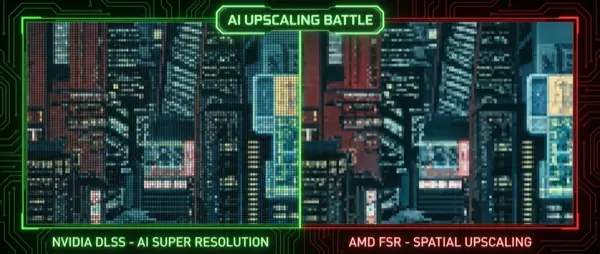
DLSS 4 Quality: top quality, nearly indistinguishable from native 4K. Minimal artifacts, excellent temporal stability. FSR 4 Quality (RDNA 4): very close, slight weakness in fine detail (hair, foliage). FSR 3.1 Quality: noticeably lower, ghosting in fast motion. XeSS Quality (Arc): between FSR 3.1 and FSR 4.
🏆 Static Scenes
DLSS 4 wins marginally. FSR 4 very close. Both deliver excellent results. The difference is hard to see without zoom-in.
🎬 Motion Quality
DLSS 4 excels in fast scenes — less ghosting, sharper edges. FSR 4 improved dramatically vs FSR 3 but still slightly behind.
📐 Fine Detail
Hair, fences, foliage, text: DLSS 4 handles exceptionally. FSR 4 sometimes loses ultra-fine detail but the gap shrinks with every update.
⚡ Performance Mode
In aggressive upscaling (Performance/Ultra Performance): DLSS 4 maintains significantly better quality. This is where Tensor Core power shows.
📈 Performance Gains: The Numbers
🎮 Supported Games & GPU Compatibility
Over 600 games support DLSS, ~400 FSR, ~200 XeSS. Most AAA titles support both technologies. Notable games: Cyberpunk 2077, Alan Wake 2, Hogwarts Legacy, Starfield, Baldur's Gate 3, Black Myth: Wukong, GTA VI.
🟢 NVIDIA RTX (DLSS)
RTX 20/30: DLSS 2 (Super Resolution). RTX 40: DLSS 3 (+ Frame Gen, Ray Reconstruction). RTX 50: DLSS 4 (+ Multi Frame Gen). Each generation adds features.
🔴 AMD Radeon (FSR)
Any GPU: FSR 3.1 (spatial+temporal). RDNA 2+: Fluid Motion Frames. RDNA 4: FSR 4 ML-based. The widest compatibility — even on NVIDIA GPUs.
🔵 Intel Arc (XeSS)
Arc GPUs: XeSS ML (XMX cores). Other GPUs: XeSS DP4a fallback. Arc B580/B770: full XeSS 2 + Frame Gen. Budget RT gaming technology.
💡 Which to Enable?
NVIDIA GPU → DLSS (always). AMD GPU → FSR 4 if RDNA 4, FSR 3.1 on older. Intel Arc → XeSS. On AMD GPUs you can run DLSS via mods (controversial).
🏁 Verdict: Which Is Better?
🎯 Final Verdict 2026
If you have NVIDIA RTX 50: DLSS 4 MFG is unbeatable — 4x performance, minimal latency, top quality. Nothing comes close. If you have AMD RDNA 4: FSR 4 is a massive improvement — very close to DLSS, open source, excellent value. If you have an older GPU: FSR 3.1 works everywhere, free performance. Bottom line: Both technologies are excellent. Upscaling is no longer a compromise — it's standard. Always enable it.