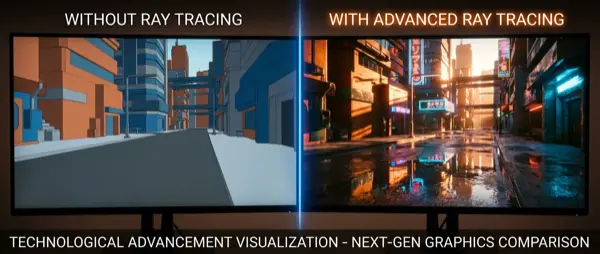
🔦 What Is Ray Tracing?
Ray Tracing is a rendering technique that simulates the physical behavior of light. Instead of using shortcuts and tricks like traditional rasterization, RT follows every ray of light as it bounces off surfaces, creating realistic reflections, shadows, and illumination.
The idea isn't new — it's been used in Hollywood since the 1980s for animation films (Pixar, DreamWorks). The difference is that in movies each frame can take hours to render, while games require real-time rendering at 60+ FPS. This became possible only with specialized hardware.
💡 Rasterization vs Ray Tracing
Rasterization (traditional): Converts 3D geometry into 2D pixels using mathematical shortcuts. Fast, efficient, but reflections/shadows are approximations. Ray Tracing: Fires millions of light rays, follows their path, calculates real interactions. More accurate, much more demanding on hardware.
🪞 How It Works: The 3 Core Elements
🪞 RT Reflections
Real reflections on every glossy surface — water, glass, metal, marble. Instead of screen-space reflections (showing only what's already on screen), RT reflects the entire scene, even objects outside the camera view.
🌑 RT Shadows
Soft, realistic shadows with proper penumbra (partial shading). Every light source creates accurate shadows — from the sun to a small candle. Soft shadows change based on distance, exactly like in reality.
☀️ Global Illumination (GI)
Light bounces between surfaces, illuminating areas indirectly. A red wall “casts” red light onto nearby objects. GI creates natural, warm lighting without artificial light probes.
🔍 RT Ambient Occlusion
Small shadows in corners, folds, and contact points. Adds depth and realism to every corner. More accurate than SSAO/HBAO+ — especially in scenes with complex geometry.
🖥️ RT Hardware: Which Card Do You Need?
Real-time ray tracing requires specialized hardware cores — the so-called RT Cores. Without them, the GPU computes rays with regular shader cores, with a massive performance penalty.
🟢 NVIDIA RTX 50 Series (2025)
The latest Blackwell generation: RTX 5070, 5080, 5090. 4th gen RT Cores with 2x performance vs Ada (RTX 40). DLSS 4 Multi Frame Generation support. The RTX 5090 runs full path tracing at 4K without compromise.
🟢 NVIDIA RTX 40 Series
Still an excellent choice. 3rd gen RT Cores, Ada Lovelace architecture. RTX 4070 Super and above run RT at 1440p comfortably. DLSS 3 Frame Generation dramatically increases FPS.
🔴 AMD RDNA 4 (RX 9070 XT)
Massive RT performance improvement. New Ray Accelerators with ~2x performance vs RDNA 3. Now competitive with NVIDIA in mid-range RT gaming. More affordable pricing.
🔵 Intel Arc B-Series
The budget option for basic RT. Arc B580 offers decent RT performance at 1080p. XeSS upscaling helps considerably. Ideal for entry-level RT gaming at €250-300.
🌈 Path Tracing: The Evolution
Path Tracing is the complete form of Ray Tracing — every light ray is followed through multiple bounces, creating 100% physically accurate illumination. Instead of computing reflections, shadows, GI separately, path tracing does everything together in one unified system.
Games with full path tracing: Cyberpunk 2077 (RT Overdrive), Alan Wake 2, Portal RTX, Minecraft RTX. The difference is stunning — Cyberpunk with path tracing looks like a photograph. Requires RTX 4080+ or RTX 5070+ with DLSS.
⚡ Performance Impact & DLSS/FSR Synergy
The biggest challenge of RT is the performance cost. Enabling RT can reduce FPS by 30-60%, depending on the scene and settings. This is where upscaling becomes essential:
🧠 NVIDIA DLSS 4
Multi Frame Generation: produces up to 3 extra frames per rendered frame. In RT titles it delivers 3-4x performance boost. Transformer AI model significantly improves image quality compared to DLSS 3.
🔴 AMD FSR 4
New ML-based upscaling (requires RDNA 4). Quality approaches DLSS in many scenarios. Frame Generation now on AMD GPUs too. Open source, cross-platform support.
📊 Practical Example
Cyberpunk 2077 at 4K RT Overdrive: Without DLSS = 15 FPS, with DLSS Quality = 40 FPS, with DLSS + Frame Gen = 90+ FPS. The difference is massive and makes RT playable.
⚖️ RT Settings Tips
Start with RT Reflections only — the biggest visual impact. Add RT GI if your FPS budget allows. RT Shadows are less noticeable. Full path tracing only on high-end GPUs.
🎮 Best Ray Traced Games (2026)
🏆 Cyberpunk 2077 RT Overdrive
The king of RT gaming. Full path tracing in Night City — every light, neon sign, wet road reflects realistically. The benchmark application for every new GPU.
⭐ Alan Wake 2
Path tracing in forest landscapes — light through the trees, lanterns in the fog. Perhaps the most atmospheric RT game. Remedy knows lighting.
🎮 GTA VI (2025-2026)
Full RT implementation expected on PC. Vice City with path traced lighting, neon signs, pools, ocean. Likely the new RT showcase title.
🔥 Indiana Jones & The Great Circle
MachineGames (id Tech engine) with excellent RT implementation. RT reflections in ancient temples, caves with GI, realistic torch lighting. Impressive.
🔮 The Future: Where Is Ray Tracing Going?
The next generation of GPUs (RTX 60 Series, RDNA 5) will bring even greater RT power. The goal is full path tracing at 4K 120FPS without upscaling — something that today requires a $2000+ GPU. The technology is evolving rapidly.
The PS5 Pro and Xbox Series X refresh consoles support improved RT, pushing developers to incorporate RT in every major title. Unreal Engine 6 will have path tracing as the default rendering pipeline. Unity follows with RT support. In 3-5 years, every new game will use some form of ray tracing.
🎯 Final Tips
If you want RT gaming in 2026: RTX 5070 or RX 9070 XT ensure an excellent experience at 1440p. For 4K path tracing, go RTX 5080 or above. Always enable DLSS/FSR — it's free performance. And remember: even partial RT (reflections only) makes a huge difference in the experience.