📖 Read more: The Blood of Dawnwalker: Dark Fantasy Vampire RPG
The History of the Styx Series
Styx first appeared as a secondary character in Of Orcs and Men (2012), an action-RPG in a dark fantasy setting developed by French studio Cyanide and published by Focus Home Interactive (now Focus Entertainment). In that game, the small goblin served as the stealth-oriented companion of an orc warrior, and his character chemistry won such affection that Cyanide decided to give him his own series.
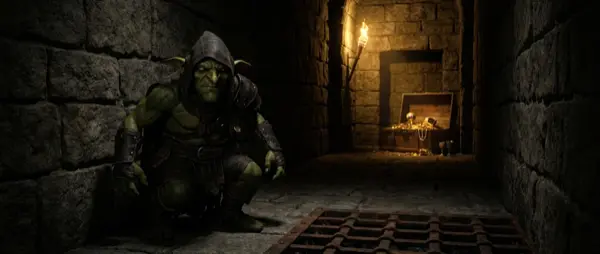
Styx: Master of Shadows (2014) was a purely stealth game that placed players in the role of a goblin — small, weak in frontal combat, but exceptionally cunning. Instead of fighting, you planned, hid, assassinated from the shadows, and used the magical properties of amber to create clones. The sequel, Shards of Darkness (2017), moved the experience to Unreal Engine 4, added co-op multiplayer, and achieved 72/100 on Metacritic.
Series Timeline
- 2012: Of Orcs and Men — Styx as a secondary character in an action-RPG
- 2014: Styx: Master of Shadows — standalone stealth title, World Tree, amber
- 2017: Styx: Shards of Darkness — UE4, co-op, dark elves, Korrangar
- 2026: Styx: Blades of Greed — new chapter, new mechanics
What Makes Styx Unique
In an era full of generic protagonists, Styx stands apart. He's a 200-year-old goblin with human intelligence, a venomous tongue, and a moral compass that permanently points south. He's not a hero — he's a thief and assassin, and he never tries to hide it. Unlike stealth games like Hitman or Dishonored, Styx isn't a superhuman assassin but a small creature that relies exclusively on cleverness.
"Styx: Shards of Darkness is a challenging stealth adventure with just as much snark as it has sneaking."
— Leif Johnson, IGN (7.8/10)The series is known for its fourth-wall breaks. Styx comments on enemies, mocks the player, references gaming clichés, and generally behaves as if he knows he's in a video game. This meta-humor, combined with his “mean-spirited” personality (as PC Gamer described it), makes him one of the most memorable characters in the stealth genre.
Gameplay: Stealth at Its Core
The Styx series is one of the most purely stealth-focused franchises in modern gaming. Unlike games that let you “go loud” if your stealth fails, Styx is nearly impossible to survive in open combat. This means every encounter must be planned:
Amber Clones
Create clones of yourself using amber. They can distract enemies, activate mechanisms, or scout ahead.
Invisibility
Temporary invisibility through amber. Limited use requires strategic thinking.
Silent Kills
Shadow assassinations, traps, poisons. Styx kills quickly but only with style.
Co-op Mode
A second player controls a Styx clone. Cooperative stealth at its most authentic.
In previous games, Styx used ropes, grappling hooks, and hidden passages to reach elevated positions — exploiting his small size to fit into places no enemy would ever look. The vertical level design was one of the series' strengths, with levels offering multiple routes and approaches.
Blades of Greed: What's New
Blades of Greed promises to evolve the formula in several areas without losing the series' stealth DNA:
New Theft System: The title “Blades of Greed” doesn't only refer to knives — Styx can now steal objects during gameplay that affect the flow of missions. Unlocking alternative paths, bribing NPCs, or using stolen documents for infiltration.
Upgraded AI: Cyanide promises enemies with more realistic behavior — shift changes, reactions to noise, search parties, and a “suspicious” state that doesn't immediately escalate to full alert.
Enhanced Crafting: Beyond amber abilities, Styx can now craft tools — smoke bombs, distractions, poison darts, improvised lockpicks — using materials gathered from the world.
📖 Read more: Tomb Raider Legacy of Atlantis: The Return of Lara Croft
Series Evolution
| Feature | Master of Shadows | Shards of Darkness | Blades of Greed |
|---|---|---|---|
| Engine | Unreal Engine 3 | Unreal Engine 4 | Unreal Engine 5 |
| Co-op | No | 2 players | 2-3 players |
| World | Tower of Akenash | Thoben & Korrangar | New cities & plains |
| Theft System | Basic | Improved | Full heist system |
Dark Fantasy World
Styx's world is one of the series' most interesting elements. It's a dark fantasy universe where goblins are considered vermin, humans and dwarves dominate politically, the dark elves hide secrets in their mountains, and a mysterious amber — the resin of the World Tree — plays a central role in every conflict.
In Shards of Darkness, it was revealed that the dark elves of Korrangar were slaughtering goblins to extract amber from their bodies using a machine built by the dwarves. Styx discovered the terrible secret, destroyed the slaughterhouse and amber reserves, and ended up in an uncertain relationship with the shapeshifting dark elf Djarak. Blades of Greed is expected to continue these narrative threads.
Political intrigue remains a central theme: dwarves against dark elves, human kingdoms negotiating with everyone, and Styx caught in the middle — in a world that treats him as “rakash” (vermin) but uses him when needed.
Co-op: The Big Draw
The co-op feature was one of Shards of Darkness's highlights. The second player controlled one of Styx's clones, creating authentic cooperative stealth gameplay. In Blades of Greed, Cyanide promises:
- Up to 3 players co-op: Styx and two clones, with distinct abilities per clone
- Coordinated heists: Missions designed for cooperation — one distracts, another steals, the third watches
- Local split-screen: Besides online, support for splitscreen local co-op
- Asymmetric gameplay: Each clone can specialize in different skillsets
Styx: The Character
Few characters in gaming talk as much — and as brilliantly — as Styx. The goblin is known for:
- Fourth-wall breaks: He looks at the camera, comments on your failures, mocks game over screens
- Sarcastic commentary: Every mission is accompanied by monologues full of snobbery
- Dark humor: His approach to death (both his and others') is subversive
- Anti-hero DNA: He does nothing without payment — usually in amber
In Blades of Greed, Cyanide promises to evolve the character without losing the core DNA. Styx will face a threat that can't simply be stolen from or assassinated — something that will force him to make choices with real moral consequences.
"A mean-spirited character leads a big-hearted game; you're unlikely to dwell on its lore but its features combine well to create a satisfying stealth experience."
— Jon Morcom, PC Gamer (79/100)Technical Features
The transition to Unreal Engine 5 is expected to bring significant improvements. The series always suffered slightly in the technical department — while the level designs were inventive, the graphics couldn't compete with AAA titles. With UE5 and technologies like Nanite (detailed geometry) and Lumen (dynamic GI), Styx's dark, atmospheric environments can finally shine.
Technical Expectations
- Unreal Engine 5: Nanite geometry and Lumen GI for realistic dark spaces
- PS5, Xbox Series X/S, PC: Next-gen only development
- Dynamic lighting: Critical for a stealth game — shadows need to be reliable
- Seamless co-op: Drop-in/drop-out without loading
- Larger spaces: Open-ended levels with multiple approaches
The Verdict: Worth the Hype?
The Styx series has earned a loyal cult following. It was never a mainstream success, but stealth fans know: few games give you such a true sense of “thievery” — that satisfaction when you complete an entire level without anyone spotting you, or when you plan an assassination with such precision it feels like art.
Blades of Greed brings the series into a new era: better technology, deeper gameplay, more co-op, and the same sarcastic Styx. If Cyanide can fix the minor stumbles in AI and combat mechanics that held previous games back, then we're possibly looking at the best stealth game in years.
Because in the end, nobody steals like Styx. 🗡️