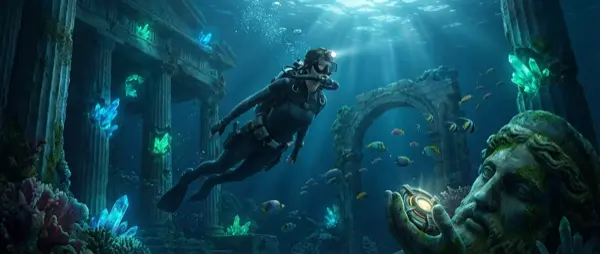
Thirty years after the legendary first Tomb Raider, Lara Croft returns to her roots. Tomb Raider: Legacy of Atlantis is a full reimagining of the original 1996 adventure — this time powered by Unreal Engine 5, with modern gameplay mechanics and a retelling that honors the original game's DNA. Revealed as a surprise at The Game Awards 2025, it's expected to launch sometime in 2026.
📖 Read more: Styx Blades of Greed: The Beloved Goblin Returns
A Legend Reborn
The original Tomb Raider launched in October 1996 and changed the entire gaming industry. Lara Croft — the daring British archaeologist — explored ancient tombs in Peru, Rome, Egypt, and ultimately the lost city of Atlantis, searching for the pieces of the Scion, an ancient artifact of immeasurable power. That game struck such a chord that it spawned an entire franchise with over 100 million copies sold.
Now, three decades later, Crystal Dynamics in partnership with Flying Wild Hog (Trek to Yomi, Shadow Warrior) is bringing that story into an entirely new era. This isn't a simple remaster — it's a complete re-imagining with modern mechanics, stunning Unreal Engine 5 visuals, and new surprises that respect the spirit of the original.
Why This Remake Stands Out
Unlike previous remasters (Tomb Raider I–III Remastered, IV–VI Remastered) that refreshed the graphics while keeping the same gameplay, Legacy of Atlantis rebuilds everything from scratch. New combat, new traversal, new narrative scenes — but the same soul: exploration of terrifying tombs, brain-bending puzzles, and the thrill of discovery.
What We Know About the Gameplay
Crystal Dynamics and Flying Wild Hog promise a blend of classic exploration, intricate puzzle-solving, and enriched storytelling. The reveal trailer showcased breathtaking environments: exotic locations lost to time, treacherous landscapes, deadly contraptions, and lethal predators.
Next-Gen Puzzles
The iconic puzzles from the original are redesigned with modern physics and environmental interaction. More complex, more satisfying.
Modern Traversal
Lara's movement is rebuilt for fluid, modern gameplay. Climbing, swimming, and athletic maneuvers across stunning environments.
Revamped Combat
The iconic dual pistols return, but with much more refined combat mechanics. Face deadly creatures and enemies.
📖 Read more: Lords of the Fallen II: The Soulslike Sequel of 2026
Enriched Storytelling
The original story gains new depth. More backstory, new scenes, deeper character development — always honoring the original DNA.
Game director Will Kersake from Crystal Dynamics explained that the reimagining adapts the difficulty for modern audiences: "Part of properly reinventing a game is adapting it to the tastes of modern players." This means the infamous instant-death scenarios from the original will be balanced out, without losing the challenge that defined the series.
Locations and Story
The story faithfully follows the outline of the original: Lara Croft sets out to locate the scattered pieces of the Scion — an artifact of immeasurable power belonging to the lost civilization of Atlantis. The mission begins in the snow-capped mountains of Peru, passes through ancient Roman catacombs and Egyptian temples, and ultimately leads to the depths of Atlantis itself.
The antagonist, the legendary Jacqueline Natla, returns as the central villain — the same enigmatic CEO who gave Lara her original mission in the first game. Their relationship promises to be explored in greater depth, adding new layers to one of the most iconic narrative arcs in gaming history.
The Pieces of the Scion
In the original game, the Scion was an ancient artifact of power split into three pieces — one in Peru, one in Rome, and one in Egypt. Each piece was guarded in tombs filled with traps and puzzles, ultimately leading to the lost city of Atlantis. In Legacy of Atlantis, the quest remains, but with a far richer presentation.
The Team Behind the Game
Legacy of Atlantis is a collaboration between two talented studios. Crystal Dynamics — the company that took the reins of the franchise after Angel of Darkness (2003) and created the acclaimed Legend and Survivor trilogies — oversees the creative direction. Flying Wild Hog, a Polish studio known for Shadow Warrior and Trek to Yomi, handles the core development.
📖 Read more: Kena: Scars of Kosmora - Ember Lab's Stunning 2026 Sequel
The publisher is Amazon Game Studios — the same company behind New World — which took on publishing rights for Tomb Raider after Embracer Group's acquisition of Crystal Dynamics. The technology is built on Unreal Engine 5, moving away from the proprietary Foundation Engine used through Shadow of the Tomb Raider.
"It's a love letter by fans, all of us, to fans. We knew the 30th anniversary was coming up and wanted to do something special to celebrate that moment — always honoring Core Design's original DNA and intent."
— Scot Amos, Head of Studio, Crystal Dynamics
A New Voice for Lara
One significant change: Lara Croft is now voiced by Alix Wilton Regan, known for her roles in Dragon Age: Inquisition, Cyberpunk 2077, and Mass Effect 3. Wilton Regan takes over from Camilla Luddington, who voiced Lara through the Survivor Trilogy (2013–2018). The new actress will star in both upcoming games: Legacy of Atlantis and Tomb Raider: Catalyst (2027).
The voice change signals a new era for the character — a more mature Lara who incorporates elements from every era of the franchise. Crystal Dynamics has explained that their goal was to “unify the timelines,” creating a Lara who reflects both the original daring explorer and the modern-day heroine.
The Tomb Raider Series So Far
The Tomb Raider franchise was born in 1996 from British developer Core Design. Over 30 years, it has gone through several distinct eras:
📖 Read more: Subnautica 2: Underwater Co-op Adventure on a New Planet
1996-2003: The Original Era
Six games from Core Design, from its triumphant debut to the troubled Angel of Darkness. Lara became a cultural phenomenon.
2006-2008: The Legend Trilogy
Crystal Dynamics takes over. Legend, Anniversary, and Underworld revitalize the series with modern controls and storytelling.
2013-2018: The Survivor Trilogy
A complete reboot with an origin story. Tomb Raider, Rise, and Shadow sold over 38 million copies combined.
2024-2026: A New Chapter
Remasters of the classic hexalogy, followed by Legacy of Atlantis — a reimagining that honors the roots while looking to the future.
Everything We Know So Far
- Platforms: PlayStation 5, Xbox Series X|S, and PC (Steam). No mention of last-gen consoles or Nintendo Switch.
- Release: Expected sometime in 2026. The exact date has not been announced yet.
- Single-player only: The game is exclusively single-player, with no multiplayer or co-op modes.
- Two games at once: Announced alongside Tomb Raider: Catalyst, an all-new adventure set in Northern India (2027).
- Price: Not yet announced. Given the scope, a full-price AAA title is expected.
- Performance: The use of UE5 promises Nanite, Lumen, and MetaHuman technologies for next-gen visuals.
Why We Can't Wait
Tomb Raider: Legacy of Atlantis isn't just another remake. It's a return to where it all began — but with the tools of 2026. The 2024-2025 remasters showed that love for the classic games remains very much alive, but a full reimagining elevates the possibilities to an entirely different level.
The Crystal Dynamics-Flying Wild Hog partnership seems ideal: the experience and franchise knowledge on one side, the technical expertise and fresh perspective of an external studio on the other. And the Game Awards announcement — revealing two games simultaneously — signals that Embracer Group and Amazon Games view Tomb Raider as the crown jewel in their portfolio.
For fans who grew up running through the caves of Peru with Lara, this game represents something magical: the chance to relive that very first adventure, but with fresh eyes. And for the younger generation of players, it's the perfect starting point to discover why Lara Croft has remained gaming's most iconic heroine for three decades.