📖 Read more: Digital Twins: Virtual Replicas of Industry
What Does AI in VR Mean?
When we talk about artificial intelligence in virtual reality, we're referring to a broad spectrum of technologies. Generative AI — the category that includes models like GPT, DALL-E, Stable Diffusion, and Sora — uses deep learning algorithms to create new content: text, images, video, audio, 3D models, and even complete worlds.
In the context of VR, this translates into three core pillars: (1) content creation — AI designs worlds, textures, and objects, (2) interaction — AI NPCs and voice agents that understand natural language, and (3) optimization — machine learning that adapts rendering, foveated rendering, and streaming in real time.
The first signs of this convergence have already appeared: Meta announced a full pivot to AI after $10+ billion in losses at Reality Labs, while Nvidia's Omniverse platform created an ecosystem of digital twins powered entirely by AI. The era of the “handcrafted” metaverse is ending — AI is taking over.
Generative AI: Worlds That Create Themselves
The idea of procedural generation — algorithmic content creation instead of manual design — isn't new. It started in tabletop RPGs with Dungeons & Dragons' random dungeons and moved to video games through roguelikes like Rogue (1980) and later Elite (1984), which used pseudorandom number generators to create galaxies from minimal memory.
Today, procedural generation has reached levels that would have seemed inconceivable a decade ago. No Man's Sky uses a single random seed to generate 18 quintillion planets, each with unique flora, fauna, climate, and geomorphology. Minecraft creates voxel-based biomes with different resources. Borderlands generates over one million unique weapons.
But the real revolution comes with the fusion of procedural generation and deep learning. Neural networks are now used to optimize procedurally generated content, while reinforcement learning automatically evaluates whether generated levels are playable and fair. Researchers are already exploring the connection of LLMs (large language models) with procedural generation, so that AI assets evolve dynamically based on real-time feedback.
Text-to-3D Worlds
AI models convert simple text descriptions into complete 3D environments. A prompt like “medieval castle on a mountain” is enough — the world is born automatically, ready for VR exploration.
AI NPCs with Natural Speech
Characters powered by LLMs can converse freely, remember previous interactions, and adapt their behavior in real time.
Voice Interaction
Speech-to-text and text-to-speech technologies (like WaveNet, Tacotron 2) are integrated into VR headsets, enabling natural voice interaction within virtual worlds.
Procedural Content
Algorithms automatically create textures, terrain, dungeons, quests, and loot using Perlin noise, fractal landscapes, and now neural networks for higher quality.
Nvidia Omniverse: The Digital Twins Platform
Nvidia didn't wait for anyone. With Omniverse — a real-time 3D graphics platform based on Pixar's Universal Scene Description (USD) format — the company created an ecosystem where AI, simulation, and collaboration converge. Omniverse is already used in industries for digital twins: faithful digital representations of physical spaces, factories, and cities.
The concept is simple but incredibly powerful: instead of designing a factory in the real world and discovering mistakes later, you create a digital twin inside Omniverse, test scenarios with AI-powered simulations, and only then implement. Companies like BMW, Siemens, and Mercedes-Benz are already using digital twins for their production lines.
With the integration of CAD tools (via connectors for Blender, Adobe, FreeCAD), Omniverse becomes a collaborative design hub. And as USD files are now an ISO standard (ISO/IEC 12113:2022), interoperability between tools continues to improve — something notably lacking in the consumer metaverse.
AI NPCs: Characters That Think
Traditional NPCs (Non-Player Characters) in video games follow predetermined scripts: press a button, they say a line, repeat. But AI-driven NPCs fundamentally change this model. Powered by large language models, these characters can respond to questions the designer never imagined, react to player actions, and even “remember” previous conversations.
In VR, the promise becomes even more enticing. Imagine entering a virtual bar in VRChat where every bartender has a unique personality, remembers what you drink, comments on the news. Or a historical education simulation where you speak with Socrates and he responds using the Socratic method — not a script, but through a reasoning engine.
📖 Read more: Eye Tracking in VR: How It's Changing the Experience
Google's RT-2 (Robotics Transformer) demonstrated that multimodal vision-language-action models can understand the physical world — “pick up the dinosaur” among animals and objects. The same logic is now applied to VR: AI agents that “see” the virtual world, understand context, and act autonomously.
Traditional NPC vs AI NPC
From Metaverse to AI-verse
The term “metaverse” was coined by Neal Stephenson in the novel Snow Crash (1992), describing a virtual universe where users interact through avatars in a 3D world. Three decades later, platforms like Second Life (2003), VRChat, Roblox, and Fortnite realized parts of that vision.
In October 2021, Facebook renamed itself Meta Platforms, committing billions to the metaverse. But the promise proved costly: over $10 billion in losses at Reality Labs, platforms like Decentraland with only 38 daily users, and in January 2026, Meta began laying off over 1,000 employees in the VR division, closing studios working on VR titles.
Zuckerberg announced the pivot from metaverse to AI in February 2023. Journalists and analysts declared the metaverse “dead,” replaced by AI as the new hot trend. But reality is more complex: AI doesn't replace the metaverse — it empowers it. Generative models make VR content creation faster, cheaper, and more immersive than ever.
"Artificial intelligence will make the metaverse work where human creation alone couldn't — scaling worlds, characters, and experiences to billions."
3D Content Creation: From Text to World
Generative AI doesn't just create images and text — it creates entire 3D objects. Text-to-3D, image-to-3D, and video-to-3D technologies automate the modeling of three-dimensional scenes. AI-based CAD assistants are already used in industrial design, while new tools promise the creation of complete VR environments with a single prompt.
GANs (Generative Adversarial Networks), introduced in 2014, were the first practical deep neural networks capable of producing complex data like images. Variational Autoencoders and Transformers followed, leading to breakthroughs like DALL-E (2021), Stable Diffusion (2022), and ChatGPT (November 2022). In video, text-to-video models like Sora (OpenAI) and Runway Gen-2 now achieve photorealistic results.
For VR, this means a creator no longer needs a team of 3D artists to build an entire environment. A text prompt, a photograph, or a video can suffice. The democratization of VR creation is underway.
Challenges and Ethical Issues
The convergence of AI and VR brings significant ethical concerns. Deepfakes — AI-generated media that mimic real people — can be used for misinformation, harassment, or even crimes within virtual worlds. Reports of sexual harassment on VR platforms like Horizon Worlds are already increasing.
Privacy is even more critical in VR than on the web: headsets collect biometric data, eye movement, voice — information far more sensitive than cookies. If AI leverages this data for targeted advertising (as Meta plans), surveillance becomes incomparably more invasive.
Copyright is also an issue: can an AI-generated world based on copyrighted assets be legally protected? The answer isn't clear — the US Copyright Office ruled that AI-generated works without human involvement cannot be copyrighted. Meanwhile, the energy consumption of generative AI models significantly increases carbon footprint, raising sustainability questions.
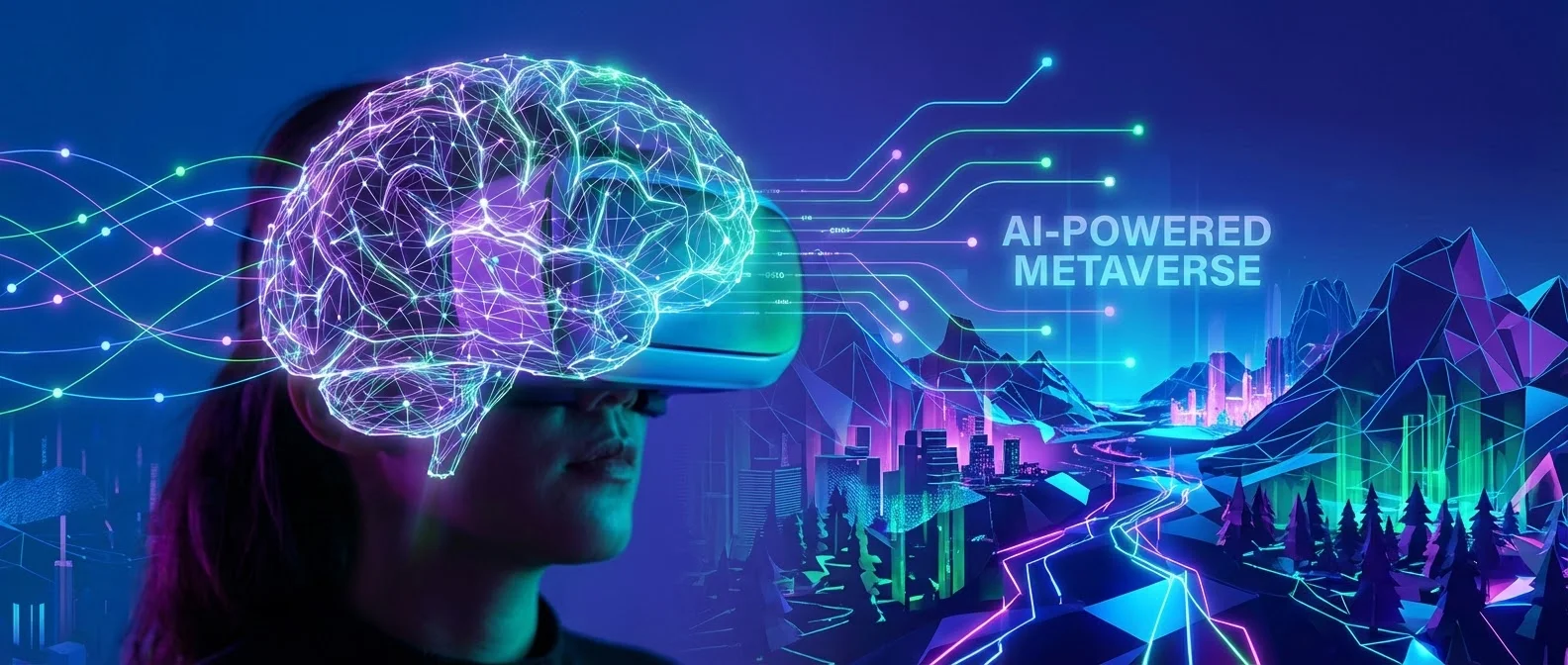
The Future: AI-Powered Metaverse
Looking ahead, the convergence of AI and VR will bring experiences that today belong in the realm of sci-fi. Autonomous AI agents will function as guides, teachers, and companions within virtual worlds. Entire cities will be created on-demand through text prompts. Education will move to immersive simulations with AI tutors that adapt to each student's pace.
Standardization through OpenXR (supported by Microsoft, Meta, HTC, Valve, Qualcomm) and the spread of the USD format are laying the foundations for interoperable metaverses. AI will fill these frameworks with life — worlds, characters, stories — at a scale no human studio can match.
Key Takeaways
- Generative AI (GANs, Transformers, LLMs) automatically creates 3D worlds, textures, characters, and dialogues for VR
- Procedural generation, from Rogue (1980) to No Man's Sky, is now evolving with deep learning and reinforcement learning
- Nvidia Omniverse unites AI, simulation, and USD format in a real-time digital twins platform
- AI NPCs powered by LLMs replace scripted dialogues with natural, dynamic interaction
- Meta went from metaverse ($10B+ losses) to AI-first strategy, but AI empowers VR rather than replacing it
- Text-to-3D and multimodal AI models democratize VR content creation
- Ethical issues — deepfakes, privacy, copyright, carbon footprint — require regulation before technology spirals out of control
- Standards like OpenXR and glTF/USD lay the foundation for interoperable metaverses that AI will bring to life
- The convergence of AI + VR promises autonomous agents, on-demand worlds, and personalized education in immersive environments