🔍 Google's Long Road Through VR
Google's relationship with wearable technology began long before Android XR. In 2013, the company unveiled Google Glass, a pair of “smart” glasses that promised to reshape how we interact with the digital world. The concept was revolutionary: a tiny display in the user's field of vision, running apps through voice commands. However, Glass faced fierce backlash over privacy concerns — its users were pejoratively dubbed “Glassholes” — and the company discontinued the consumer edition in 2015, keeping only an enterprise version for industrial applications.
Google co-founder Sergey Brin later admitted that Glass was “10 years too early.” And he may have been right — the technology wasn't mature enough, the public wasn't ready, and the AI tools that could have made them truly useful simply didn't exist yet.
Rather than abandoning the space entirely, Google tried more accessible approaches. In 2014 came Google Cardboard, a simple cardboard-and-lenses contraption that turned any smartphone into a primitive VR viewer. Low quality, but low cost — essentially a proof of concept. Building on that foundation, Google announced Daydream in 2016, a full VR platform integrated into Android. The Daydream View, a $79 headset (later $99 for the second generation), worked with compatible smartphones and offered a much better experience than Cardboard, complete with a controller, head tracking, and a dedicated VR Mode in Android Nougat.
But Daydream didn't take off either. Google admitted in 2019 that adoption “wasn't what we hoped” and pulled the headset from sale. No smartphone released that year was compatible, and Android 11 dropped support entirely. The reason? "Asking people to put their phone in a headset and lose access to the apps they use throughout the day causes immense friction," a company spokesperson explained.
🧪 Project Iris: The Failure That Led to Success
Despite these setbacks, Google never stopped experimenting. In January 2022, The Verge revealed that the company had been secretly working on an AR headset codenamed Project Iris, led by Clay Bavor. Google had already acquired North (a smart glasses manufacturer) in 2020 to support its ambitions, and began developing a specialized AR operating system. Simultaneously, the company acquired Raxium — an AR hardware startup — for approximately $1 billion, gaining cutting-edge microLED technology.
Then in June 2023, Apple announced the Vision Pro at $3,499 — and Google found itself in a difficult position. According to Business Insider reports, the announcement “shocked” Google employees, as Apple had leaped far ahead. Project Iris was cancelled as part of broader cost-cutting measures, Bavor departed, and Google decided to pivot its strategy: instead of building its own hardware, it would develop software to license to manufacturing partners.
As early as 2022, Google executives had realized how far behind they were compared to Apple. The solution? A strategic alliance with Samsung, Android's long-standing hardware partner. Samsung would build the hardware, Google would develop the operating system, and Qualcomm would supply the processors. The project's codename? Moohan — the Korean word for “infinity.”
📢 The Announcement: December 2024, New York City
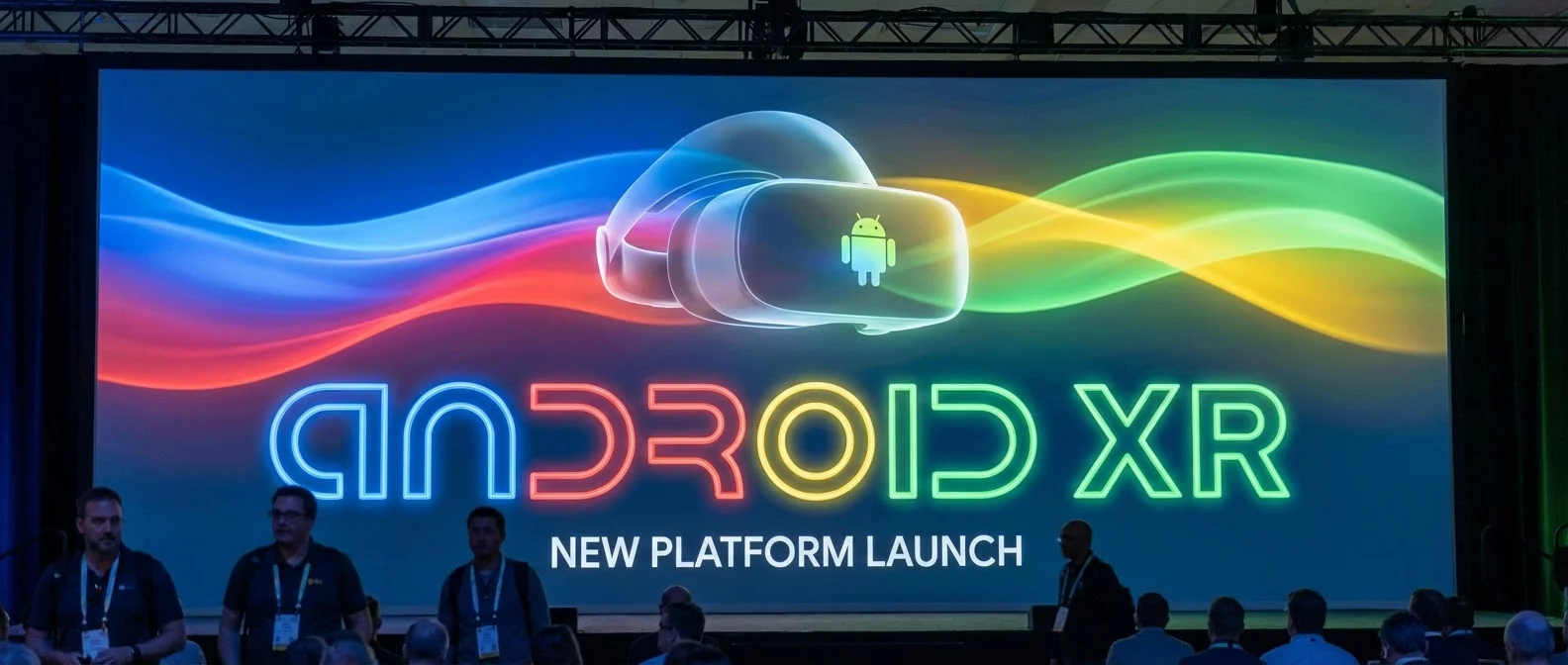
On December 12, 2024, Google officially announced Android XR at an event in New York City. The platform is an extended reality (XR) operating system built on Android, designed for both headsets and smart glasses. The first device would be the Samsung Galaxy XR, with an expected launch in 2025.
Shahram Izadi, head of Google's XR division, and Sameer Samat, Android's chief, emphasized Android XR's open-platform philosophy. In contrast to Apple's “walled garden” approach, Google offered an open ecosystem that any manufacturer could adopt — exactly the same playbook that made Android dominant in smartphones.
Victoria Song of The Verge, trying the prototype smart glasses running Android XR, compared the experience to J.A.R.V.I.S. — the fictional AI assistant from Iron Man in the Marvel Cinematic Universe. A comparison that shows just how far the technology has come since the clunky Google Glass of 2013.
Beyond the Samsung Galaxy XR headset, Google also showcased the Project Astra smart glasses — a new generation of eyewear equipped with Raxium's microLED technology, running Android XR and leveraging Gemini's AI capabilities. While no firm timeline was given for the glasses, they clearly signal that Google's vision extends well beyond headsets.
📱 Samsung Galaxy XR: What It Offers
The Samsung Galaxy XR launched on October 21, 2025, priced at $1,799 in the United States. It's a standalone mixed reality headset that directly competes with the Apple Vision Pro at a significantly lower price point. The device weighs 545 grams (without the battery) and stands out for its impressive displays: two micro-OLED panels with a resolution of 3,552 × 3,840 pixels each, totaling 27 megapixels, with a refresh rate of up to 90Hz.
Samsung Galaxy XR — Key Specifications
At the heart of the device sits the Qualcomm Snapdragon XR2+ Gen 2, with 16 GB RAM and 256 GB of storage. The sensor array is impressive: two 6.5 MP cameras for passthrough video, six tracking cameras, four eye-tracking cameras, a depth sensor, five inertial measurement units (IMUs), and a flicker sensor. The external battery pack (302g) delivers roughly 2 hours of general use or 2.5 hours of video playback.
A key advantage is compatibility with existing Android apps. According to Google, users can open their regular 2D Android applications in resizable windows arranged in three-dimensional space — meaning instant access to millions of apps without requiring specialized XR porting.
🤖 Gemini: AI as a Core Feature
If there's one thing that truly differentiates Android XR from the competition, it's the deep integration of artificial intelligence through Gemini, Google's AI chatbot. Unlike Siri on the Apple Vision Pro or Meta AI on the Quest, Gemini on Android XR isn't just an assistant — it's a core component of the operating system. It can “see” the user's environment, understand what's displayed on screen, and deliver contextually aware responses.
The Project Astra smart glasses, which Google presented alongside Android XR, leverage Gemini Ultra — Google DeepMind's most powerful AI model. Their multimodal understanding capabilities (text, image, voice, video) make them something genuinely futuristic: glasses that “see” the world alongside you and can help you in real time.
At Google I/O in May 2024, Sergey Brin called these glasses “the perfect hardware for artificial intelligence,” acknowledging that Google Glass had been ahead of its time. Now, with AI models reaching a level where they can actually process the world around us, the original vision finally makes sense.
⚔️ The Competition: Android XR vs. Everyone
The XR landscape in early 2026 is more competitive than ever. Apple holds the high-end position with the Vision Pro at $3,499, but adoption remains limited due to the steep price. Meta dominates the mass market with its Quest headsets, offering affordable prices and a large gaming library. And now Google + Samsung are entering the game the Android way: open platform, multiple manufacturers, massive app ecosystem.
The strategy mirrors what happened in smartphones: Apple created the category with the iPhone, but Android dominated market share because it was available from dozens of manufacturers at every price point. If Google can convince manufacturers beyond Samsung to adopt Android XR, the balance of power could shift dramatically.
For developers, the platform supports OpenXR, WebXR, and Unity, and Google also released the Jetpack XR SDK. Third-party applications have already been announced, including an MLB app with 3D player visualization and Adobe's Project Pulsar video editor. The ability to run standard Android apps in spatial windows provides a built-in advantage: millions of apps are available from day one.
Why It Matters
Android XR isn't just another operating system — it's Google's attempt to do for XR headsets what Android did for smartphones. If it succeeds, we'll see dozens of headsets and smart glasses at every price point within the next 2-3 years, making mixed reality accessible to millions of users worldwide.
🔮 What Comes Next: Glasses and the Age of Spatial Computing
Beyond headsets, Google is laying the groundwork for a smart glasses era. The Project Astra glasses aren't a commercial product yet — Google hasn't given a specific launch date — but the technology is there. Raxium's microLED displays enable “bright images without using a lot of power,” solving one of the biggest technical hurdles for compact wearable displays.
The shift from headsets to glasses represents the natural evolution of XR: from heavy devices you wear at home, to lightweight eyewear you can take anywhere. If Google manages to make that transition before Apple, it will gain a significant market advantage.
The decade-long journey from Google Glass — which was “10 years too early” — to Android XR shows that Google learns from its mistakes. This time, it's not going alone: it has Samsung for hardware, Qualcomm for processors, and Gemini AI as its “secret weapon.” The question is no longer whether Google can compete in XR, but how quickly the market will mature enough to embrace this new reality.