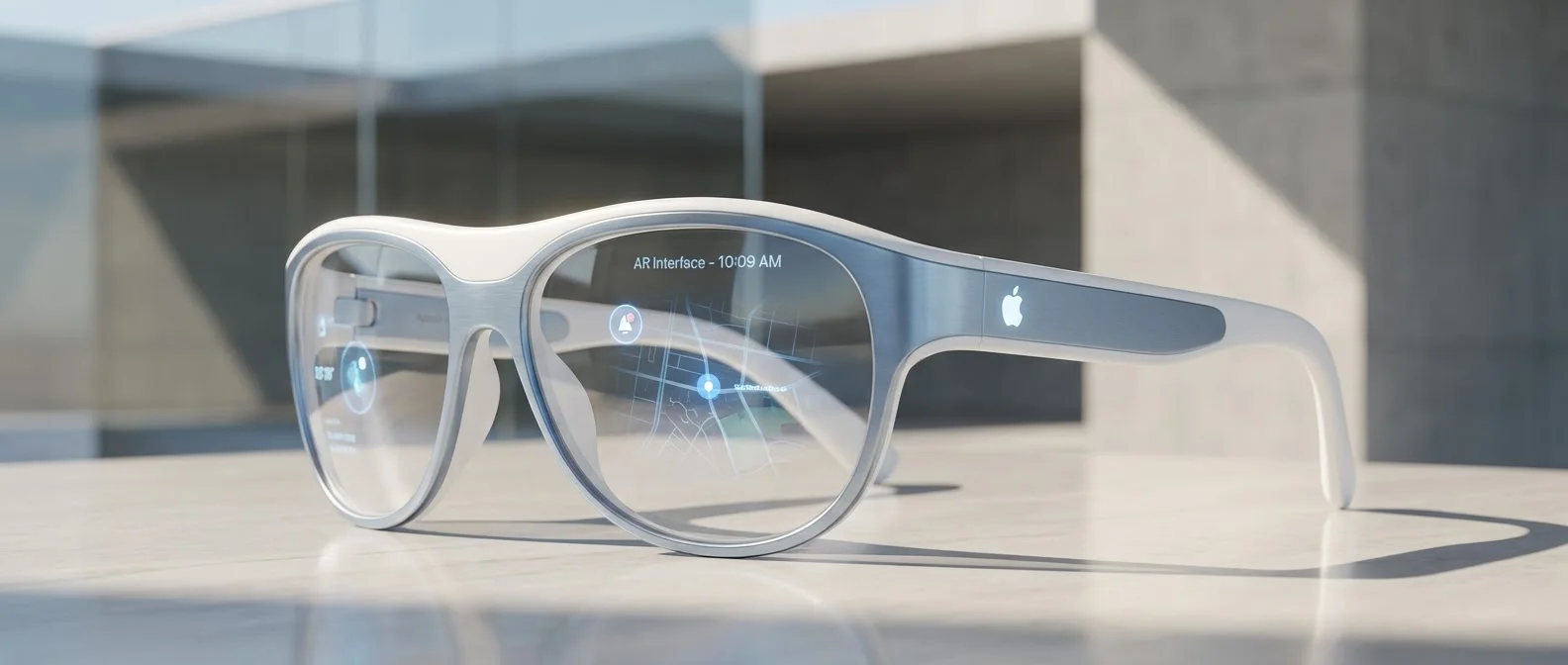
👓 What Are “Apple Glasses”
"Apple Glasses" is not an official name. It's the unofficial term used by analysts, tech journalists, and leakers to describe a pair of lightweight AR glasses — Apple's ultimate ambition in wearable computing. Unlike the Vision Pro, a 600-800 gram mixed reality headset with an external battery pack, Apple Glasses envision something entirely different: a pair of eyewear that looks almost normal but projects digital information directly into your field of view.
The idea isn't new — Google tried Google Glass back in 2013, Microsoft developed HoloLens, and Snap released its Spectacles. But no one has yet managed to combine small form factor, wide field of view, low power consumption, and elegant design into a mass-market product. Apple believes it can do it — but acknowledges the technology isn't ready yet.
🔬 The Journey So Far
Apple has been working on AR technologies for at least a decade. In May 2015, it acquired the German AR company Metaio, which had started as a Volkswagen spin-off. That same year, Apple hired Mike Rockwell from Dolby Laboratories, who formed a team called the Technology Development Group. This team developed an AR demo in 2016 and helped launch ARKit with iOS 11 in 2017.
In November 2017, Apple acquired the Canadian mixed reality company Vrvana for $30 million. The Vrvana Totem headset stood out because it could display fully opaque, true-color animations over the real world — technology that was ultimately incorporated into the Vision Pro. In June 2023, Apple also acquired Mira, an AR headset startup that held contracts with the U.S. Air Force.
According to Wikipedia, "Apple's extended reality headset is meant as a bridge to future lightweight AR glasses, which are not yet technically feasible." This means the Vision Pro isn't the end goal — it's the bridge to something far more ambitious.
⚙️ Technology & Challenges
Building lightweight AR glasses faces a series of technological hurdles that no company has fully overcome yet. The key challenges include:
Displays & Optics: Traditional VR headsets use micro-OLED displays (like the Vision Pro with 23 megapixels). But for normal-sized glasses, the technology must change radically. The dominant technologies for AR glasses are waveguides — optical components that carry light through the lens without a visible display. There are diffractive, holographic, and reflective waveguides, each with its own advantages and drawbacks. Apple is reportedly experimenting with microLED technology and waveguide optics at its secret lab in Santa Clara, California.
Processing Power: The Vision Pro uses an M2 chip (upgraded to M5 in October 2025) combined with the R1 co-processor for real-time sensor processing. A pair of glasses simply can't fit that much power. Possible solutions include wireless offloading to an iPhone or Apple Watch, or an extremely efficient custom chip designed specifically for AR.
Battery Life: The Vision Pro already received criticism for its short battery life, despite using an external 353-gram battery pack. A pair of glasses must operate autonomously for hours without external accessories.
Field of View (FoV): The Vision Pro offers approximately 100°×73° field of view. First-generation AR glasses typically offer much smaller FoV — one of the biggest obstacles to an immersive experience in glasses form.
"These companies know these aren't really the devices we want. They're all working toward building virtual experiences into something that looks more like a pair of regular eyeglasses. Until then, they're just messing with our heads."
🏁 The Competition
Apple isn't alone in the race for AR glasses. Competition is intensifying:
Meta Orion: In September 2024, Meta unveiled Orion, a prototype pair of AR glasses showing the direction beyond Quest headsets. The glasses look relatively normal and use holographic waveguides. While not commercially available, they represent a clear signal that Meta is targeting the same space.
Ray-Ban Meta Display: More immediately, Meta released new Ray-Ban Meta glasses with a built-in AR display in September 2025 — the first commercial smart glasses with a display from a major manufacturer. The partnership with Oakley (announced June 2025) shows Meta expanding into the sports sector as well.
Samsung Project Haean: Samsung is developing its own AR glasses codenamed “Project Haean,” in collaboration with Google and Android XR. Details remain scarce, but Google's involvement suggests an ecosystemic approach similar to Apple's.
Snap Spectacles: Snap continues to evolve its Spectacles, which serve as developer-focused AR glasses. While not aimed at mainstream consumers yet, they represent an important platform for AR app development.
It's worth noting that Google discontinued Google Glass Enterprise sales in March 2023, closing a chapter on an early AR glasses project. Its focus now shifts to Android XR as an operating system for third-party AR devices.
Keys to Competition
The race for AR glasses isn't just about hardware. Apple has 2+ billion active devices worldwide, a closed ecosystem (iPhone, Watch, AirPods), and $500+ billion committed to U.S. investments through 2029. Meta is fighting back with AI (Llama models) embedded in Ray-Ban Meta, while Samsung/Google bets on the open Android XR ecosystem.
💰 When & How Much
This is where uncertainty begins. In January 2023, according to a report by The Verge, Apple “reportedly shelved its plans to release AR glasses anytime soon” — focusing instead on the Vision Pro as an intermediate step.
Bloomberg's Mark Gurman, one of the most reliable Apple leakers, regularly references a team called the Exploratory Design Group (XDG) inside Apple — a “moonshot” team similar to Alphabet's X lab. XDG works on advanced technologies like glucose monitoring for Apple Watch, but is reportedly also involved in AR optics.
In January 2026, Apple acquired Q.ai, an Israeli AI startup specializing in imaging and machine learning, for nearly $2 billion — the company's second-largest acquisition ever. This move may be directly related to computer vision technologies essential for AR glasses. Simultaneously, the partnership with Google Gemini for AI-powered Siri (January 2026) shows Apple is bolstering its AI capabilities — critical for AR experiences that rely on environmental understanding.
Realistic estimates place a potential Apple Glasses release after 2027, most likely 2028-2030. The price is expected to start above $1,000, though no one can predict accurately here — Apple could surprise, as it did with the original Apple Watch at $349.
🔮 What It Means for the Future
The transition from headsets to glasses isn't just a size reduction — it's a paradigm shift. The Verge's Nilay Patel noted in his Vision Pro review that the device "may have inadvertently revealed that some of these core ideas are actually dead ends" — suggesting that only lightweight glasses can truly bring spatial computing to the mass market.
Apple already has a proven pattern: it introduces a “premature” first-generation product, learns from the mistakes, and then delivers a consumer version that defines the category. It did it with the iPod, the iPhone, the Apple Watch. The Vision Pro may be the first generation — Apple Glasses, the ultimate goal.
One thing is certain: with over 5,000 patents, dozens of acquisitions, 166,000 employees, annual revenue of $416 billion (2025), and a clear strategic trajectory, Apple is not going to abandon the race for AR glasses. The only question isn't “if” — it's “when.”