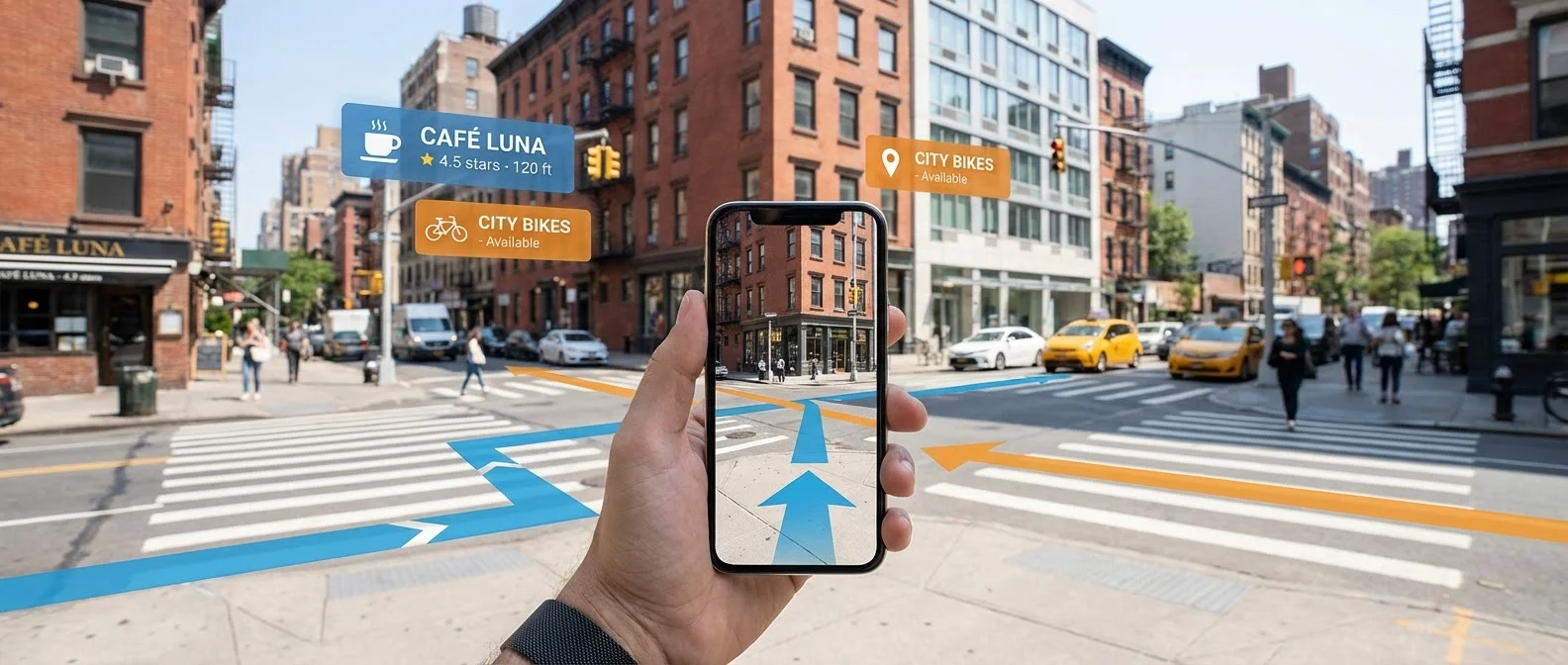
In this article, we explore 10 practical AR uses that are changing how we live, work, and learn — from street navigation to the operating room. All based on real applications already functioning in 2026.
📍 1. Real-Time Navigation
AR navigation is arguably the most widespread everyday use. Google Maps Live View, which started as a pilot program on Pixel phones in 2019, has now expanded to over 50 cities worldwide. You point your phone camera at the street ahead and see massive digital arrows, directional signs, and street names hovering over the real-world image.
The latest Lens in Maps feature, expanded to 50 new cities in October 2023, recognizes shops, restaurants, and transit stations through the camera and displays information such as hours, reviews, and prices in real time. With the integration of Gemini AI into Google Maps (November 2025), AR navigation has become even smarter, featuring hands-free voice commands while driving.
Beyond Google, AR Head-Up Display (HUD) technology in cars projects navigation information directly onto the windshield. Companies like Mercedes-Benz and BMW already offer AR-HUD in premium models, with directional arrows appearing on the actual road ahead.
🛋️ 2. Shopping & Product Try-On
In 2017, IKEA launched IKEA Place, an AR app that allowed users to virtually place furniture in their real living space through their smartphone camera. The catalog includes over 2,000 products at true-to-life scale — sofas, tables, bookshelves — that you can “try out” in your room before buying.
The technology spread rapidly. Shopify integrated AR Quick Look starting in 2018, enabling hundreds of thousands of small merchants to offer 3D product previews inside the Safari browser. Apple created the USDZ format (Universal Scene Description) — a 3D file standard that works immediately on any iPhone and iPad running iOS 12 or later.
Platforms like Wayfair, Houzz, and Amazon followed suit, while the fashion industry experiments with virtual try-on — testing sunglasses, watches, or clothing through your camera without visiting a physical store.
🎓 3. Education & Training
AR in education is one of the fastest-growing sectors. Medical students can now study anatomy by placing 3D organ models on their desk instead of relying on textbooks. According to a World Economic Forum report (2022), 85% of first-year medical students at Case Western Reserve University said mixed reality for teaching anatomy was “equivalent or better” than the in-person classroom.
The ARKit (Apple) and ARCore (Google) SDK platforms provide spatial scanning, object tracking, and 3D rendering tools leveraged in educational apps: from chemistry (rotating molecules in your hand) to astronomy (viewing the solar system on your desk).
AR in Education — Key Facts
Systematic reviews report improved learning outcomes with AR, particularly in STEM subjects and hands-on training. The technology enables step-by-step virtual tutorials overlaid on real equipment, reducing errors and training time in industrial settings.
🌍 4. Real-Time Translation
Word Lens, acquired by Google and integrated into Google Translate, was groundbreaking: you point your camera at a foreign sign, menu, or notice and the translation appears automatically over the text, as if it were originally written in your language. The technology now works in more than 100 languages.
Beyond text, experimental AR translation systems offer real-time subtitles during conversations — wear AR glasses and see what your conversation partner says translated as floating text. This capability is expected to go mainstream with the spread of AR glasses in the coming years.
🏥 5. Healthcare & Surgery
AR in medicine dates back to the early 1990s at USAF laboratories with the Virtual Fixtures system (1992), which demonstrated how virtual overlays improve human performance in remote manipulation tasks. Thirty years later, the technology has matured dramatically.
Surgeons use headsets like Microsoft HoloLens to view virtual X-rays, CT scans, and MRI overlays positioned on the patient during procedures. Siemens, Karl Storz, and IRCAD developed a system for laparoscopic liver surgery that reveals tumors and blood vessels beneath the surface — essentially a digital “X-ray vision.”
In neurosurgery, AR helps with precise target localization, while in orthopedics it guides implant placement. The technology also reduces PPE usage in infectious cases, as doctors can monitor patient data through AR without physically touching screens.
📐 6. Measurements & Spatial Planning
AR measurement apps — like Apple's built-in Measure app — use LiDAR and ARKit/ARCore for accurate distance, area, and volume measurements without a tape measure. Mark two points in space through the camera and instantly see the measurement in centimeters or inches.
Contractors, architects, and interior designers use AR apps to measure rooms, design layouts, and preview how a wall color or floor material will look before starting work. The technology doesn't replace precision tools at the professional level, but makes quick estimates accessible to everyone.
🎮 7. Gaming & Entertainment
Niantic's Pokémon Go (2016) was the mass awakening of public awareness for AR. With over 1 billion downloads, it proved that augmented reality could become mainstream entertainment. Users hunted virtual creatures on real streets, parks, and landmarks.
Snapchat filters represent another everyday AR experience: they apply masks, effects, and animated designs to your face in real time. Since 2017, the platform introduced “Sky Filters” that transform the sky into starry nights or sunsets through AR.
More ambitious games like WallaMe let users hide messages at real-world locations that only other AR users can discover — a kind of digital hidden treasure.
🏭 8. Industry & Maintenance
AR in industry isn't the future — it's the present. Boeing pioneered AR use on assembly lines, with digital guides appearing step by step on actual hardware. BMW and Volkswagen followed, incorporating AR headsets for quality control and process optimization.
Maintenance technicians see through AR headsets the internal structures of large machinery — as if looking with X-rays — pinpointing faults without disassembly. The technology reduces repair time and errors while enabling less experienced technicians to perform complex tasks by following digital instructions.
Production Lines
AR overlays guide step-by-step assembly of complex components, reducing errors by an estimated 25-40%.
Remote Support
Experts guide technicians in real time via AR, drawing digital annotations directly on the real equipment.
Digital Twin + AR
Digital twins of machines connect with AR interfaces, allowing operators to see real-time data overlaid on physical equipment.
🏠 9. Real Estate & Interior Design
The real estate market increasingly leverages AR for virtual tours. Instead of visiting ten houses, you can see through AR how a space will look after renovation, wall color changes, or furniture placement. Apps like Houzz and RoomPlan (Apple) scan rooms with LiDAR and create three-dimensional floor plans in seconds.
For interior designers, AR bridges the gap between concept and reality. They can show clients how a space will look before any work begins — testing colors, textures, lighting, and furniture positions within the actual room.
✈️ 10. Travel & Cultural Experiences
Museums, archaeological sites, and tourist destinations are incorporating AR experiences that bring historic monuments to life. Point your camera at ruins and see what they looked like in antiquity. Turn your tablet toward a museum exhibit and watch 3D animations, narrations, and information appear.
Google Maps Immersive View, available in dozens of cities worldwide (including Athens), uses AI and neural radiance fields to create photorealistic 3D representations of locations — both exteriors and interiors — with real-time weather, traffic, and crowd information.
"Augmented Reality doesn't replace the real world — it makes it more understandable, more navigable, and more interesting."
📊 The Top AR Applications of 2026
Top AR Apps — Comparison
🔮 What Comes Next?
The AR market is projected to reach $215 billion by 2035. AR glasses — such as Meta Orion (2024 prototype), Samsung Galaxy XR (launched October 2025 with Android XR), and the anticipated Apple Smart Glasses — promise to move all these experiences from the smartphone to your face.
The integration of AI (particularly models like Gemini and GPT) into AR adds intelligence: instead of simply seeing digital overlays, the system understands what you're looking at and provides contextual information. Point at a plant and it tells you what species it is. Turn toward a building and learn its history.
Once lightweight AR glasses become sufficiently light, affordable, and standalone, Augmented Reality won't just be “something you use on your phone” — it will be an invisible layer of information on the world around you, always active, always available.