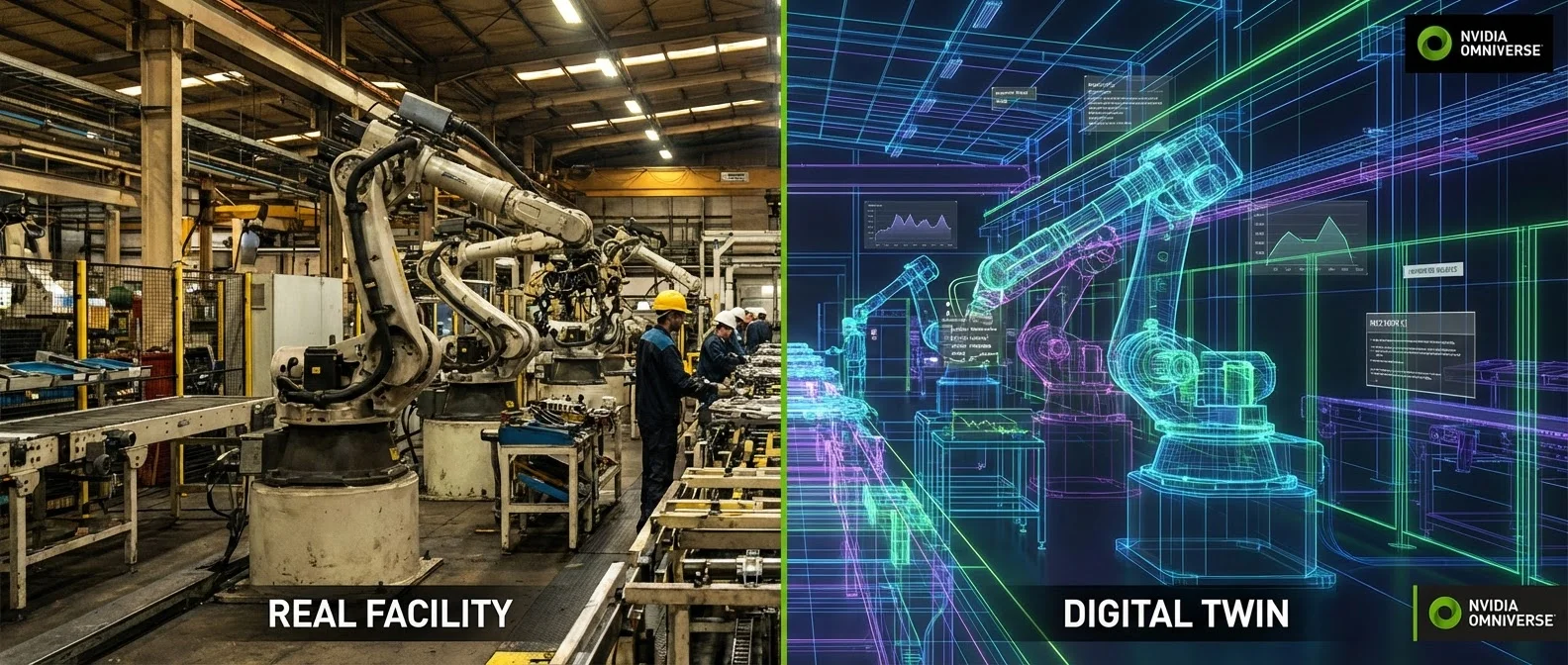
Imagine an entire factory — every machine, every production line, every sensor — existing digitally in the cloud, updating in real time, and allowing you to predict failures before they happen. That's a Digital Twin: a virtual replica of physical objects that is revolutionizing industry, cities, and healthcare.
📖 Read more: 360° Photography: Complete VR Camera Guide 2026
What Are Digital Twins?
A Digital Twin is a digital model of an actual real-world physical object, system, or process. It serves as a digital counterpart for purposes of simulation, integration, testing, monitoring, and maintenance. The idea isn't new — it started at NASA during the 1960s for modeling the Apollo missions. NASA engineer John Vickers coined the term “digital twin” in 2010.
The core architecture of a digital twin consists of three parts: the physical object, its digital representation, and the communication channel between them — the so-called “digital thread.” Through IoT sensors, data flows continuously from the physical to the digital object, enabling real-time monitoring, predictive analytics, and automated decision-making.
Digital Twins in Industry 4.0
Design and Prototyping
In the design phase, a Digital Twin Prototype (DTP) is created before the physical product even exists. 3D scanning technologies like LiDAR and structured-light scanning capture the precise geometry of existing facilities, creating detailed point clouds that form the foundation of the digital model. This way, an entire production line can be tested virtually — identifying bottlenecks, optimizing machinery layout, and validating automation before any equipment is installed.
Production & Operations
IoT sensors monitor force, temperature, vibrations, and power consumption. The data feeds the digital twin in real-time for automated quality control and defective product detection.
Predictive Maintenance
Instead of waiting for a machine to break, the digital twin analyzes vibration and temperature data to predict failures in advance — dramatically reducing unplanned downtime.
Performance Optimization
By aggregating data from an entire fleet of machines (Digital Twin Aggregate), manufacturers learn how their products perform under different real-world conditions.
Virtual Commissioning
Entire production lines are tested virtually before installation. In critical processes like welding, the twin simulates heat distribution and material properties.
Digital Twins in Cities and Buildings
Geographic Digital Twins are transforming urban planning. These digital twins create interactive platforms for visualizing and analyzing real-time 3D/4D spatial data in urban environments. The recent Smart Cities movement uses digital twins combined with Augmented Reality (AR) to create augmented maps — buildings and data feeds projected onto tables for collaborative viewing by engineers and urban planners.
Example: Sheremetyevo Airport
In 2019, Sheremetyevo Airport created a digital twin to forecast and plan all operations. Even at pilot level, it saved over 1 billion rubles ($120+ million) and made the airport the world leader in On-Time Performance — despite complex climate challenges.
Building Information Modeling (BIM) technology forms the basis for building digital twins. In the UK, the Centre for Digital Built Britain published the “Gemini Principles” — guidelines for developing a “national digital twin” for the entire built environment. Building digital twins support real-time control of HVAC, lighting, shading, and renewables, contributing significantly to carbon footprint reduction.
📖 Read more: AR Apps: 15 Must-Have Apps 2026
Digital Twins in Healthcare
In healthcare, digital twins are created from medical imaging data — CT scans and MRIs. Surgeons use virtual patient models to plan complex procedures, simulate different surgical approaches, and anticipate potential complications — in a risk-free virtual environment before entering the operating room.
By 2025, applications expanded to include real-time AI-driven patient monitoring, personalized surgical simulations, and predictive diagnostics using multimodal data (imaging + wearables). In the future, digital twins will enable fully personalized medicine — suggesting treatments based on each patient's unique “digital twin.”
NVIDIA Omniverse — The Digital Twins Platform
NVIDIA Omniverse is the leading platform for creating digital twins at industrial scale. It's a real-time 3D collaboration platform that uses the Universal Scene Description (USD) format — an open standard originally developed by Pixar. Omniverse enables the creation of photorealistic simulations of entire factories, warehouses, and urban environments.
NVIDIA Omniverse Applications
Digital Twins and Renewable Energy
The renewable energy industry increasingly adopts digital twins for monitoring and optimizing wind farms, solar installations, microgrids, and battery storage systems. Recent studies show that combining digital twins with predictive analytics in smart energy systems can reduce energy consumption by 30% through optimized load balancing and proactive maintenance.
A UK-based demonstrator project used a digital twin for voltage control simulations in a microgrid, achieving a 56% reduction in renewable curtailment during typical operation. Utilities and technology providers worldwide are piloting twin platforms to anticipate turbine maintenance, improve battery storage usage, and simulate grid behavior under extreme conditions.
"A digital twin operating without real, continuous data from its physical counterpart is widely considered a marketing-oriented interpretation — authoritative definitions consistently require dynamic synchronization with the real system."
The Future: Autonomous Vehicles, Heritage and AI
In the automotive industry, digital twins allow engineers to analyze how a car is driven in real-world conditions and suggest new safety features in record time. Entire mobility systems — drivers, pedestrians, autonomous vehicles, traffic networks — are getting their own digital twins on edge/cloud servers for real-time decisions.
In cultural heritage, 3D scanning and photogrammetry technologies create high-fidelity digital archives of endangered monuments. Twins can serve as virtual tours of significant monuments, combining heritage preservation with virtual tourism — attracting people to urban centers through technology.
Why Do Digital Twins Matter for VR?
Connecting digital twins with VR/AR headsets transforms static data into immersive experiences. Engineers can “walk through” a digital factory, architects can explore a building before it's built, and surgeons can interact with 3D patient models. NVIDIA Omniverse already supports VR visualization for interactive walkthroughs of industrial digital twins.