Six thousand dollars per VR headset. Hundreds of articles about the coming revolution. Over 90% of companies in 2024 still had enterprise XR stuck in pilot program purgatory. What changed in 2026 to flip this equation?
The picture isn't pilot programs gathering dust in innovation labs anymore. Companies in the mid-2020s closed their first testing phase and started asking different questions: "Where do we actually invest, and when will we see measurable results?"
In this equation, AR glasses business applications play the starring role — not because they're flashier than VR headsets, but because they work alongside daily workflows. Meanwhile, business technology now has enough years of field testing to know what actually works.
💼 From Proof-of-Concept to Production Infrastructure
The biggest shift isn't the technology — it's the mindset. IT departments now treat enterprise XR like any other endpoint: with security criteria, lifecycle management, and integration into existing infrastructure.
This means MDM/UEM compatibility, SSO integration, and encryption standards. Might sound boring to anyone waiting for sci-fi interfaces, but it's exactly this approach that unlocks scaling. When AR glasses can be managed like tablets and VR headsets like laptops, the "too complex for deployment" argument disappears.
Reality Check: According to PwC research, 66% of companies using XR chose VR over AR — mainly for training scenarios where environmental control matters more than workflow integration.
🎯 Where Enterprise XR Investment Goes in 2026
Money flows to four core areas: training that costs too much in the physical world, remote assistance where expert shortages create bottlenecks, maintenance workflows with high error costs, and collaboration on complex projects where spatial understanding makes the difference.
VR Training: End of "Dangerous" Lessons
VR training found its sweet spot in scenarios that are risky, expensive, or hard to scale. New employees practice complex procedures without touching real equipment. Managers assess competency consistently across different locations.
In manufacturing, workers can run hundreds of repetitions of a maintenance procedure that would cost thousands per attempt in reality — and need weeks of scheduling to happen.
AR on the Production Line: The Missing Information Layer
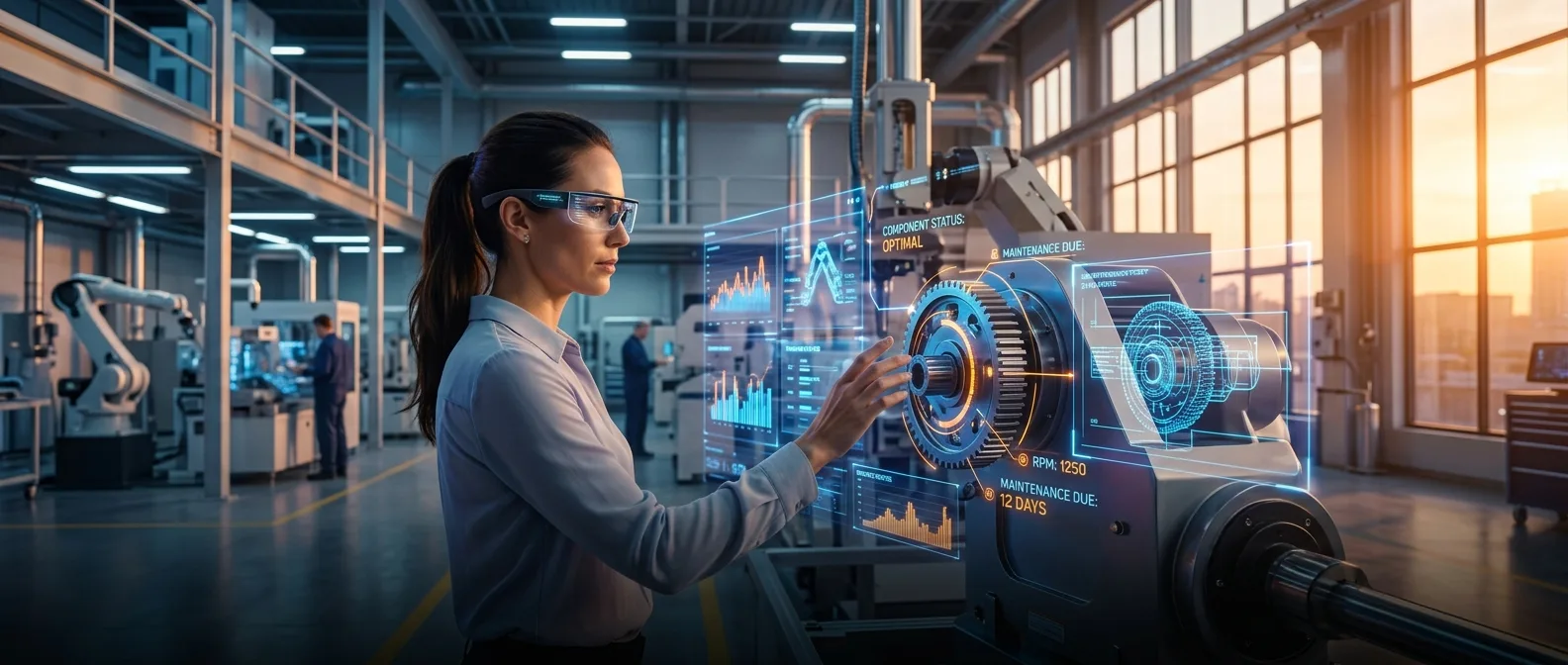
AR glasses business deployments solve a different problem: switching between tools, manuals, and screens. Instead of stopping work to find instructions or check specifications, everything appears in the field of view.
On the front line, this translates to fewer errors, shorter completion times, and improved first-time fix rates. Not revolutionary, but operationally significant.
⚙️ The Technical Side: Integration with Existing Systems
Here's where successful deployments separate from isolated pilots. Business technology that actually delivers connects to systems already in use.
A VR training module that doesn't talk to the company's LMS remains a toy. An AR workflow that doesn't pull data from the ERP system is just a fancy manual. A mixed reality collaboration tool that doesn't integrate with Teams/Zoom is another application users have to remember.
What's Changing: Smart Glasses for Daily Use
In 2026, smart glasses gain momentum for one simple reason: they're more wearable for frequent, short tasks. Unlike VR headsets designed for extended sessions, AR glasses work for burst usage.
Microsoft HoloLens 2 finds application in MR/assisted-reality deployments requiring spatial mapping and enterprise controls. Vuzix and similar vendors expand into lightweight enterprise wearables prioritizing comfort and battery life.
"The question isn't 'is XR technology ready?' anymore. It's 'where does it fit in operational workflow and when do we see measurable ROI?'"
UC Today Analysis 2026
📊 Mixed Reality: When You Need Spatial Understanding
Mixed reality covers a specific gap: shared spatial understanding for complex 3D work. Teams can review designs together, manipulate digital twins, and troubleshoot systems as if co-located.
Value emerges when better spatial decisions reduce rework, cut approval cycles, or prevent downstream errors. Not for every company, but for those working with complex 3D systems or facility planning, it can be a breakthrough.
Assisted Reality: The Underrated Technology
Assisted reality — hands-free guidance and remote expert support through lightweight glasses — often delivers the most immediate benefits. Workers can follow step-by-step instructions, capture images/video, and connect with experts without stopping work.
In environments where expertise is scarce and response time matters, this reduces downtime and limits travel-heavy support models.
🏭 Industries Leading XR Adoption
Manufacturing
Machine operation training, safety procedures, assembly simulations. Employees practice in risk-free environments before handling real equipment.
Healthcare
Procedural demonstrations, anatomy visualization, patient care simulations. Medical professionals gain practical exposure before real-world practice.
Construction
Structural layouts, safety drills, complex site operations. Teams understand projects in virtual replicas before implementation.
Energy & Utilities
Equipment maintenance, safety inspections, site-specific training in controlled virtual setups with AR-based remote assistance.
💡 Governance: What Makes XR Scalable
In 2026, companies start XR evaluations with governance questions, not headset comparisons. Secure provisioning, content ownership, data policies, device lifecycle planning — these separate cool pilots from sustainable programs.
CIOs position enterprise XR alongside endpoint management, collaboration platforms, and cybersecurity strategy. Governance isn't the obstacle — it's the enabler of scale.
Data & Analytics: Measuring Performance, Not Usage Stats
Another difference between enterprise and consumer XR is measurement. In business environments, XR must produce performance data leaders can act on — not just usage statistics.
Time-to-competency and skill progression. Task accuracy and procedural compliance. First-time fix rates and escalation frequency. Training assessment results and competency validation. ROI becomes something you can prove, not hope for.
🚀 What's Changing in the Market
AI integration makes XR more adaptive, digital twin technology creates realistic simulation environments, and reduced development costs make adoption more accessible to mid-size companies.
Meanwhile, hardware becomes lighter, faster, and easier to use. You don't need tech-savvy users for an enterprise XR deployment to work in 2026.
Sounds optimistic — and companies that started pilots in 2022-2023 have already navigated the learning curve of rookie mistakes. The test now: which applications deliver measurable value versus which remain impressive demos.
What Buyers Need to Evaluate
Successful XR programs focus on outcomes, not devices. Where do errors, rework, or delays happen most often? Which training processes don't scale across multiple sites? Where are experts overstretched or unavailable?
Which systems must XR integrate with — LMS, UC platforms, EAM, analytics, IAM? What governance controls are required for security, lifecycle, and data policies?
At the end of the day, corporate VR and enterprise XR generally work when treated as infrastructure, not innovation projects. When they become part of the digital workplace stack instead of standalone tools. And when decisions are based on business cases with concrete ROI, not hype cycles.
Sources: