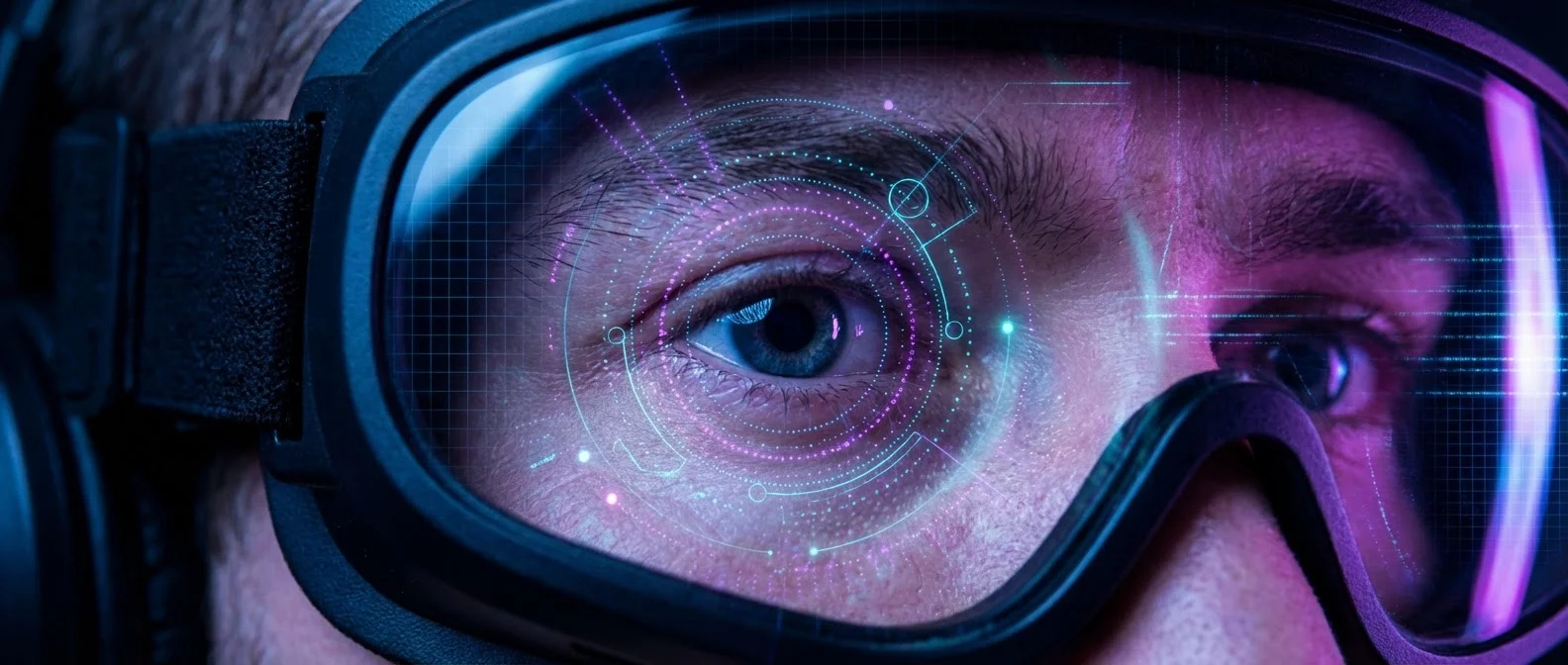
The human eye is an extraordinary paradox. While our visual field extends roughly 200 degrees, the area where we actually see sharply — the fovea — covers barely 2-3 degrees of that. Everything else is blurry, peripheral, a “sketch” that our brain completes and presents as a unified image. In the real world, this doesn't matter — our eyes move constantly, and the fovea scans what interests us. But in VR, graphics cards don't know where you're looking. They render everything at the same resolution, wasting millions of pixels you'll never actually perceive. Eye tracking changes exactly that — and much more.
👁️ What Is Eye Tracking in VR
Eye tracking is the technology that allows a headset to know exactly where your eyes are looking at any given moment. It works through a combination of infrared cameras and illuminators that monitor corneal reflections, pupil position, and the movement geometry of both eyes.
Modern systems achieve accuracy of less than 1 degree — meaning the headset knows your gaze point with a margin smaller than the width of your fingertip at arm's length. Advanced implementations run at 120Hz or higher, capturing every micro-movement (saccade) of your eye in real time.
Eye tracking in VR isn't new as an idea — research dates back decades. But only in recent years has the technology become precise, fast, and cheap enough to be integrated into consumer devices.
🔬 Foveated Rendering — The Performance Revolution
The most important application of eye tracking in VR is foveated rendering. The concept is simple: since only 2-3 degrees of visual field need full detail, the GPU renders that small area at maximum quality and progressively reduces the resolution of everything around it.
Michael Abrash, Chief Scientist at Meta Reality Labs, has called foveated rendering "an order of magnitude" reduction in rendering workload — meaning up to 10× fewer pixels the GPU needs to shade. This isn't a theoretical number: it's the direct consequence of the fact that the fovea covers less than 2% of total visual field area, yet traditional rendering treats 100% of pixels equally.
Foveated rendering exists in two variants: fixed (renders the center of the lens at higher quality, without eye tracking) and dynamic (adjusts quality based on where the eye is actually looking). The fixed version was added to Meta Quest's SDK in December 2019 and offers a noticeable improvement. But the dynamic version, with real eye tracking, is where the real benefit lies — especially for wireless streaming, where bandwidth is limited.
📱 Which Headsets Have Eye Tracking
In 2026, eye tracking has become a key feature of mid-to-high-end headsets. Each implements the technology differently, with varying priorities:
PlayStation VR2 (2023): Sony's headset was the first consumer device to use eye tracking for foveated rendering on a mass scale. Through infrared cameras on each lens, PSVR2 tracks gaze and dynamically adjusts resolution — a key reason titles like Horizon Call of the Mountain run at high quality on relatively modest PS5 hardware. Some games also use gaze as an interaction mechanic.
Apple Vision Pro (2024): Apple took eye tracking a step further, making it the primary input method. In visionOS, you look at an element and pinch your fingers to select it — a paradigm shift in user interfaces. The system is so precise that it replaces traditional controllers entirely. The approach validated eye tracking as a UI tool, not just a rendering optimization.
Meta Quest Pro (2022): Meta's first headset with eye tracking, designed primarily for professional use. It supports foveated rendering and face/eye tracking for social VR avatars. While the Quest Pro didn't achieve mass consumer success, its technology became the foundation for future Meta headsets.
Valve Steam Frame (2025): Valve's approach is unique. The Steam Frame uses eye tracking for what it calls "foveated streaming" — a variation where instead of reducing render quality, it varies the bit rate during wireless streaming. The area you're looking at gets maximum bandwidth, while the periphery is compressed more aggressively. What's remarkable is that this happens at the encoder level, not in software — making the optimization nearly invisible. As one PC Gamer reviewer wrote: "I tried to trick the Steam Frame's clever eye tracking and failed, miserably."
Pimax Crystal Super: Pimax integrates eye tracking for Dynamic Foveated Rendering (DFR), a critical feature for a headset with 3840×3840 per eye resolution. Without DFR, even the most powerful GPUs would struggle with that pixel count. The eye tracking module enables playable frame rates that would otherwise be impossible.
🎯 Beyond Rendering — New Ways of Interaction
Eye tracking's potential extends far beyond performance optimization. As the technology matures, entirely new interaction paradigms are emerging:
Gaze Interaction: Apple Vision Pro demonstrated that eye gaze can replace controllers for UI navigation. This approach is expanding to other VR and AR platforms — look at a menu, a button, an object, and interact with it through complementary gestures. It's the most natural form of interaction: you look at what interests you.
Social VR and Eye Contact: In social applications, eye tracking enables realistic eye contact between avatars. When you look at someone in a virtual meeting, their avatar sees you looking at them. This seemingly simple thing dramatically changes the sense of presence — eye contact is one of the most fundamental human communication cues.
Education and Research: Eye tracking reveals where students look during a training simulation, which areas of a 3D model draw their attention, and what they miss. For research, it's an invaluable tool for understanding visual perception, design evaluation, and cognitive load measurement.
Medical Applications: Eye movement analysis (saccade analysis) can help detect neurological conditions, monitor fatigue, and assess cognitive health. VR headsets with eye tracking are beginning to be used as diagnostic tools, not just entertainment devices.
🔬 Tobii × Prophesee: Event-Based Eye Tracking
In May 2025, Swedish eye tracking leader Tobii (supplier for HTC Vive Pro Eye, PSVR2, Pimax Crystal) partnered with Paris-based Prophesee, which develops event-based neuromorphic sensors. Unlike conventional cameras that capture full frames, event-based sensors record only changes — similar to how the human retina works.
The result: >1,000Hz sampling rate, <1ms latency, <1° accuracy, and power consumption of just <2mW — with 5× less data than conventional image-based systems. This technology is the key to bringing eye tracking into lightweight AR glasses and standalone headsets, where every milliwatt and every square millimeter counts.
🔮 The Future: Eye Tracking as Standard
Looking toward 2027 and beyond, eye tracking is transitioning from a premium feature to a baseline expectation. There's a simple reason: as display resolutions keep increasing (4K per eye is already here, 8K is coming), GPU power can't keep pace without foveated rendering. Eye tracking isn't a luxury — it's becoming a necessity for next-generation visual quality.
Its impact extends beyond VR headsets. AR glasses — from companies like Meta, Apple, and Samsung — will absolutely need eye tracking for both interaction and power management. And as event-based sensors from the Tobii-Prophesee partnership make the technology smaller and more efficient, integration into everyday eyewear becomes viable.
Eye tracking may be the most underappreciated technology in VR today. It doesn't make headlines like resolution bumps or new controllers. But it quietly solves one of VR's biggest challenges: delivering stunning visuals without demanding impossible computing power. And it opens interaction methods we're only beginning to explore.