📖 Read more: Meta Shuts Down VR Productivity Service Workrooms February 2026
📖 Read more: Meta Pivots Strategy: Puffin Headset 2026 Instead of Quest 4
🔮 Puffin: When VR Becomes Wearable
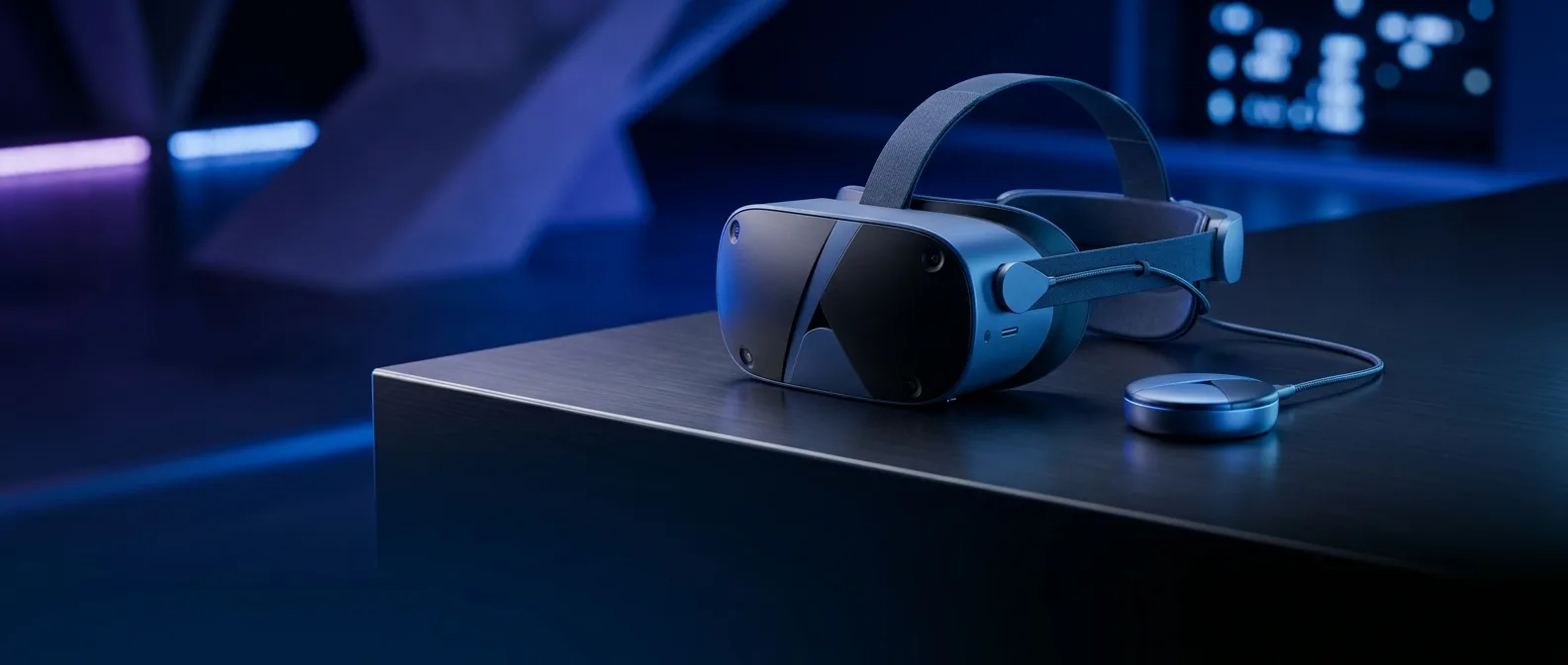
Forget everything you know about VR headsets. Meta Puffin isn't just lighter — it's a complete rethink of where computing power should live. Instead of cramming processors, batteries, and cooling into a head-mounted device, Puffin splits the load: ultralight glasses on your face, compute puck in your pocket. The weight difference is staggering. Quest 3 clocks in at 515 grams. Puffin targets under 110 grams — roughly the weight of designer sunglasses. That's not an incremental improvement. That's the difference between "I need a break after an hour" and "I forgot I was wearing this."Compute Puck: Pocket-Sized Powerhouse
The tethered puck handles all the heavy lifting — literally. Processors, battery, thermal management, and most of the connectivity live in a device Meta hopes will slip into your pocket without creating an unsightly bulge. This isn't entirely new territory. Magic Leap tried external compute units. HTC has external trackers. But Meta thinks they can nail the consumer experience where others stumbled. The question is whether "pocket-sized" means iPhone-sized or something closer to a portable battery pack. The cable becomes the critical component. Too thick and it's annoying. Too thin and it breaks. Too long and it tangles. Too short and it restricts movement. Meta's engineers have to thread a very specific needle here.📖 Read more: VR Quality Labels 2026: Steam Frame vs Quest vs PSVR2
📖 Read more: Pico Swan vs Quest 4: Micro-OLED Battle at 4000 PPI
⚡ Tech Stack: Eyes and Fingers Replace Controllers
Meta Puffin ditches controllers entirely. No Touch controllers, no hand-held devices, no button-mashing. Instead, it relies on eye-tracking and hand-tracking using gaze-and-pinch interaction — the same approach Apple pioneered with Vision Pro.Horizon OS: Same Apps, Different Hardware
The good news? Puffin runs the same Horizon OS as current Quest headsets. That means access to the same app ecosystem — from Meta Horizon Workrooms to Netflix VR. Of course, many apps will need updates to work well without controllers. Some games simply won't make sense on an ultralight headset designed for comfort over performance. But the foundation is there. This compatibility could be Puffin's secret weapon. Instead of launching with a barren app store, it inherits years of Quest development. Users get immediate access to hundreds of apps, even if not all of them are optimized for the new form factor.📖 Read more: The Future of VR/AR Control Through Muscle Signals
📖 Read more: Meta Quest 4: Everything We Know About the Next Generation
📊 Quest 4 Cancelled: The Strategic Pivot
Here's where the story gets interesting. Two Quest 4 candidates — codenamed Pismo Low and Pismo High — got axed. Instead of the expected Quest 4 in 2026, Meta is going all-in on Puffin. This isn't just a product delay. It's a strategic pivot away from traditional all-in-one headsets toward something completely different. Meta is betting that the future of VR is ultralight and tethered, not heavier and more powerful. The timing makes sense when you look at Reality Labs' financials. Quest sales dropped 6% year-over-year in Q1 2025. Despite the Quest 3S launch momentum, growth stalled throughout the year. Meta needs something to reignite interest in VR.But cancelling Quest 4 creates a gap. Traditional VR enthusiasts who want more power, better displays, and familiar controllers might feel abandoned. Meta is betting that Puffin's comfort advantages outweigh the loss of raw performance. Third-party manufacturers like Asus and Lenovo are developing their own Horizon OS headsets. The Asus ROG model promises eye-tracking and better displays than Quest 3. These might fill the enthusiast gap that Puffin leaves behind."We're always working on multiple headsets in parallel, at various stages of development, and most of them end up getting cancelled."
Andrew Bosworth, Meta CTO
📖 Read more: Valve Steam Frame VR Headset: Countdown to Standalone Gaming Revolution
📖 Read more: Pico Project Swan: 4000 PPI Displays and Dual-Chip Power
🎯 Market Position: Puffin vs Vision Pro
Meta Puffin positions itself as a direct Vision Pro competitor — but with more practical pricing and better everyday usability. While Vision Pro costs around $3,500 and weighs 650 grams, Puffin targets $800-$1,200 and under 110 grams.Ultra-Light Design
Under 110g means hours of comfortable wear without fatigue
Virtual Displays
Unlimited virtual screens for productivity and entertainment anywhere
Intuitive Controls
Eye-tracking and hand gestures instead of complex controllers
Tethered Freedom
Compute puck in your pocket for maximum power without head weight
The Tethered Trade-off
Tethered design has clear advantages and obvious drawbacks. The headset stays incredibly light and runs cooler (all the hot components are away from your head). But a dangling cable can be annoying, and the compute puck adds bulk to your pocket. Meta needs to solve the ergonomics and aesthetics. Even the perfect headset will fail if users feel self-conscious wearing it in public spaces. The cable management and puck design become as critical as the display quality. Early reports suggest Meta is exploring multiple display approaches at different price points. This could mean multiple Puffin models, or that the company hasn't settled on final specifications yet.📖 Read more: Valve Steam Frame: The New VR Headset of 2026
🚀 Timeline: Development Continues
According to recent reports, Puffin targets a late 2026 launch. But anyone who follows Meta hardware knows: projects can get cancelled at any stage. The company has a graveyard of ambitious VR concepts that never saw daylight. Andrew Bosworth has detailed Meta's hardware development stages: • **Pre-Discovery**: Teams build prototypes for "the craziest stuff" • **Discovery**: Small number of concepts advance to practical examination • **Prototyping**: Integrated hardware and software with ~10x more people • **Engineering Validation Test**: Half of prototypes reach here, half of those actually ship Puffin appears to be in Prototyping or EVT stage, which means decent odds — but nothing is guaranteed. Meta's willingness to cancel Quest 4 shows they're not afraid to scrap projects, even advanced ones.Multiple Display Options
Interesting detail: Meta is evaluating multiple display approaches for Puffin at different price points. This could mean we'll see multiple models, or that the company hasn't decided which technology to use. Options likely range from LCD and OLED displays to more advanced micro-OLED or even holographic optics — though the latter sounds more sci-fi than practical for 2026. If Puffin succeeds, it could mark the beginning of a new era in VR headsets — one where comfort and wearability matter as much as performance. But if it fails, it'll just be another expensive experiment that stayed on the drawing board. And Meta knows all about failed VR projects. The real question isn't whether Meta can build Puffin. It's whether consumers are ready for tethered VR, and whether the comfort gains justify the cable trade-offs. We'll find out in 2026.Sources: