🔧 Specifications
The Quest 3S launched on October 15, 2024, under the codename “Panther,” as Meta's entry-level offering in the third generation of Quest headsets. Despite the lower price, the core specs are impressive — it's essentially a Quest 3 with the Quest 2's lenses and display.
The Snapdragon XR2 Gen 2 chipset paired with 8GB of LPDDR5 RAM is identical to the Quest 3 — meaning every game and app that runs on the Quest 3 runs just as well on the Quest 3S, with zero restrictions. Storage comes in 128GB ($299) and 256GB ($399) options. Connectivity includes Wi-Fi 6E and Bluetooth 5.2, and it runs Meta Horizon OS based on Android 14.
🎮 Design & Ergonomics
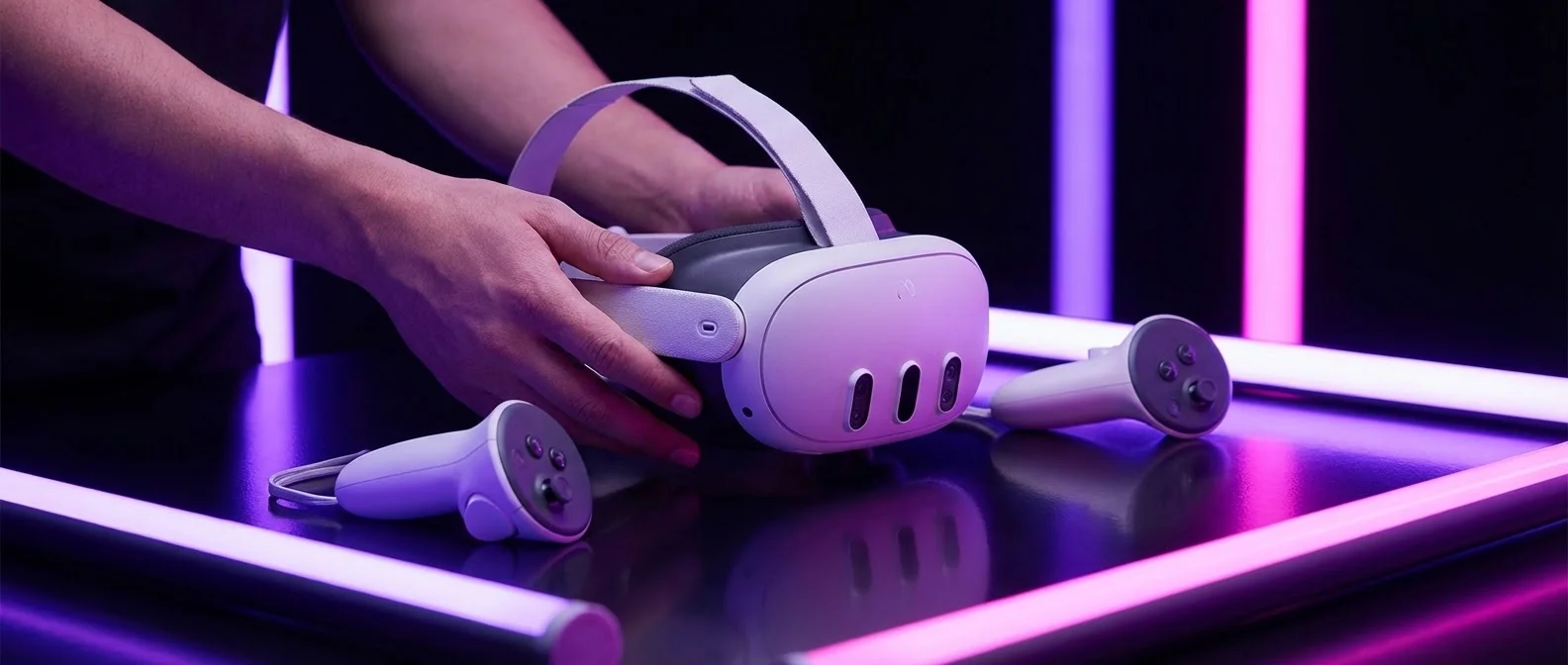
In terms of design, the Quest 3S follows Meta's familiar approach: a standalone, wireless headset with a modular design that lets you easily swap the strap, facial interface, and controller grips. It weighs 514 grams — one gram lighter than the Quest 3 — and ships with a fabric Y-shaped strap.
In practice, the default strap has its usual shortcomings: it rests against the tops of your ears, doesn't provide enough rear support, and for extended gaming sessions you'll almost certainly want a third-party elite strap — like the widely recommended BoboVR M3 Pro. The good news is that most Quest 3 accessories, and several Quest 2 ones, are compatible.
Because the Quest 3S uses thicker Fresnel lenses instead of the Quest 3's thin pancake lenses, it adds about 10mm of depth. However, it's still 20mm slimmer than the Quest 2 — a noticeable improvement. The revamped facial interface feels considerably more comfortable than previous generations, though lens fogging can occur in humid environments.
Exclusive: MR Toggle Button
The Quest 3S is the first Quest headset with a dedicated mixed reality toggle button on the bottom edge, next to the volume rocker. Instead of the unreliable double-tap on the side (used by other Quest models), you can switch between VR and passthrough mode instantly — perfect for when someone needs your attention mid-game.
It's worth noting that the Quest 3S lacks a 3.5mm headphone jack — USB-C only. The built-in speakers on the lateral arms deliver solid audio for gaming, but if you need privacy you'll need Bluetooth or USB-C headphones.
👀 Display & Lenses
This is where Meta made its primary concession to hit that $299 price point. The Quest 3S uses the same Fresnel lenses and LCD panel as the Quest 2: 1,832 × 1,920 pixels per eye at 90-120Hz, with a pixel density of 773 PPI and 20 PPD (pixels per degree).
Compared to the Quest 3's pancake lenses, Fresnel lenses have a smaller “sweet spot” — only the center of the field of view is perfectly sharp, with increasing blur toward the edges. The field of view is limited to 96° horizontal and 90° vertical, compared to the Quest 3's impressive 110° — a significant difference that shouldn't be understated.
The resolution gap versus the Quest 3 is akin to the difference between 1080p and 1440p gaming: noticeably lower, but far from bad. If you've never tried a Quest 3, you'll likely be perfectly satisfied. If you plan to work in VR with lots of text and fine details, however, investing in the Quest 3 is well justified.
IPD (interpupillary distance) adjustment uses a physical mechanism with three presets: 58mm, 63mm, and 68mm — the same system as the Quest 2, unlike the Quest 3's continuous adjustment. If your IPD exceeds 72mm, you may experience discomfort.
🕹️ Controllers & Hand Tracking
This is where the Quest 3S makes no compromises whatsoever. The Touch Plus controllers are identical to those of the Quest 3 — more compact and elegant than the Quest 2's Ring controllers, with tracking LEDs embedded in the body rather than on an external ring. Each controller runs on a single AA battery that lasts roughly two months of regular use.
Hand Tracking
Improved hand tracking over every previous Quest headset, especially in low light conditions thanks to new IR illuminators — a feature exclusive to the 3S.
Body Tracking
Inside-Out Body Tracking: the headset monitors your torso, shoulders, and arms without external sensors, enabling more realistic avatars and in-game movement.
Dark Room Tracking
Two IR illuminators on the front — exclusive to the Quest 3S — enable full hand and controller tracking even in completely dark rooms of smaller size.
The Quest 3S cameras are arranged in two triangular arrays on the front — different from the Quest 3's three “pills.” Meta uses AI algorithms to predict hand position based on arm and shoulder movement, compensating for any gaps in optical tracking. Under normal lighting, tracking accuracy is essentially identical to the Quest 3.
🌐 Mixed Reality & Games
Going from the Quest 2's grainy black-and-white passthrough to the Quest 3S's full-color 4MP cameras is transformative — like switching from a 1950s black-and-white TV to color HDTV. It doesn't match the passthrough quality of an Apple Vision Pro or even the Quest 3 (due to the Fresnel lenses), but the upgrade completely changes how you use the headset.
Mixed reality games like Starship Home (which turns your living room into a spaceship), Drop Dead: The Cabin, or even tabletop board games with friends via MR, showcase the real potential of this technology.
For pure VR gaming, the Quest 3S has access to the complete Meta Quest Store library — thousands of titles, including Quest 3 exclusives like Batman: Arkham Shadow (bundled free with purchase through end of 2026), Skydance's Behemoth, Alien Rogue Incursion, and Metro Awakening. PC VR via Air Link or Quest Link is fully supported for a premium experience.
"Meta has once again surpassed all expectations of what a standalone VR headset can be for just $299. There are surprisingly few compromises at this price."
Horizon OS receives regular updates with new capabilities, including automatic room mapping and object identification that make MR setup effortless. On the Quest 3S, this scanning takes about 7 seconds longer than on the Quest 3 — a negligible difference.
🔋 Battery Life
The 4,325mAh battery delivers roughly 2.5 hours of use — slightly better than both the Quest 3 and its predecessor, the Quest 2. More demanding titles like Batman: Arkham Shadow bring that figure down to around 2 hours.
Battery life is admittedly the weakest link of any standalone headset. The most practical solution is an elite strap with built-in battery pack: improved ergonomics, better weight distribution, and nearly double the battery life (4-5 hours) — an accessory that most Quest owners consider practically essential.
🆚 Quest 3S vs Quest 3: Which Should You Choose?
This is the million-dollar question. The answer depends entirely on your intended use:
Quest 3S vs Quest 3 — Full Comparison
In short: if you want the best possible visuals, a wider field of view, and plan to work in VR with text-heavy applications, the Quest 3 justifies the price difference. If you're after VR gaming and mixed reality at an accessible price without major compromises in processing power, the Quest 3S is the smarter pick.
✅ Is It Worth Buying in 2026?
Pros
Outstanding value ($299) · Same processor as Quest 3 · Full-color mixed reality passthrough · Exclusive IR illuminators for dark room tracking · Dedicated MR toggle button · Massive game library · Touch Plus controllers with Body Tracking
Cons
Quest 2-era lenses and display · Limited 96° FOV · No 3.5mm audio jack · Mediocre default strap · Noticeable screen door effect · No hardware depth sensor · IPD limited to 3 presets
As of February 2026, the Meta Quest 3S remains the best entry-level VR headset on the market. The competition is limited: the PSVR 2 at $399 requires a PS5 and a cable, the Pico 4 can't match the Quest ecosystem's game library and software maturity, and smart glasses (XREAL, Viture) offer an entirely different experience.
If you're new to VR or upgrading from a Quest 2, the Quest 3S is a no-brainer — the same processor as the Quest 3 at half the price, full access to every game, and MR capabilities that fundamentally change the experience. If you already own a Quest 3, there's no reason to switch. And if you're looking specifically for productivity or working in VR, the investment in a Quest 3 — or even more premium options — is worth the extra money.
With a 4/5 rating from Android Central, positive reviews from Road to VR, TechRadar, and The Verge, and millions of units sold worldwide, the Meta Quest 3S sets the standard for value-for-money in virtual reality.