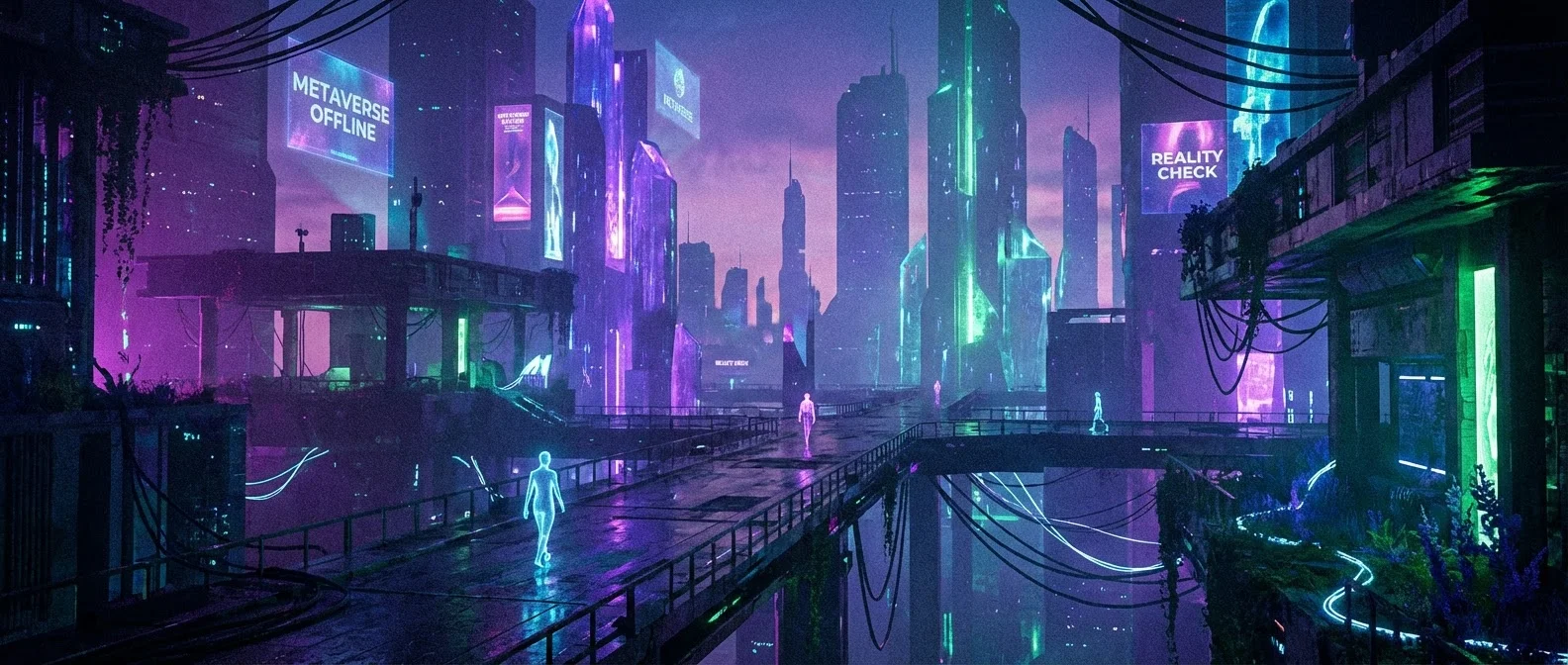
In 2021, Mark Zuckerberg renamed Facebook to Meta and promised the Metaverse would change the world. Billions of dollars were invested, millions of headlines were written, and the word “metaverse” entered the everyday vocabulary. Four years later, what happened to the big promise? The answer is far more nuanced than a simple “it failed” or “it succeeded.”
Meta's Big Pivot
In October 2021, Zuckerberg unveiled an ambitious vision: virtual worlds where we'd work, play, and socialize. The company changed its name to Meta Platforms, signaling a new era. Within 12 months, the Reality Labs division had already lost over $10 billion. The bold bet was looking increasingly uncertain.
Reality hit hard. Horizon Worlds — Meta's flagship social VR platform — launched with graphics reminiscent of 2005 video games, legless avatars, and not nearly enough content to retain users. By February 2023, Zuckerberg quietly announced a pivot toward artificial intelligence as the company's new priority. The metaverse dream wasn't dead, but it was clearly no longer the main event.
"Meta's pivot from the Metaverse to AI doesn't mean they abandoned everything — it means they realized the technology wasn't ready for mass adoption."
In January 2026, Meta laid off over 1,000 employees from its Reality Labs division and shut down studios working on VR titles. According to CNBC, the decision underscored “Zuckerberg's massive pivot to AI.” The company hasn't fully exited VR — Quest headsets continue to sell — but AI is now unmistakably the primary growth engine.
What Worked: The Metaverse Wins
Despite the high-profile stumbles, several areas saw genuine metaverse-related success:
VR Gaming
Titles like Beat Saber, Half-Life: Alyx, and Asgard's Wrath 2 proved that VR gaming can deliver truly unique experiences. The Meta Quest 3 and Quest 3S posted solid sales figures, establishing a viable — if still niche — gaming platform.
Social VR
Platforms like VRChat, Rec Room, and Resonite built genuine communities from the ground up. Millions of users spend hours daily creating worlds, meeting people, and having experiences impossible in the physical world — virtual concerts, language schools, comedy nights, and more.
Enterprise VR
Education, healthcare, architecture, and manufacturing widely adopted VR technology. Surgeons train in virtual operating rooms, engineers review 3D designs collaboratively, and workers undergo safety training in risk-free simulated environments.
Entertainment & Events
Virtual concerts inside Fortnite, community events on VRChat, and live virtual festivals attracted millions of attendees. Entertainment in virtual spaces proved not just viable, but capable of reaching audiences traditional venues never could.
What Failed: The Spectacular Flops
Conversely, some of the most hyped metaverse sectors collapsed entirely:
The 2022-2023 crypto crash dragged every blockchain-based metaverse project down with it. Decentraland, once valued in the billions, was reported by The Verge to have just 38 daily active users. The platform itself disputed the number, claiming around 8,000 — but even that figure was embarrassingly low for a supposedly “global metaverse.”
The Platforms That Survived
While corporate projects floundered, community-built platforms thrived:
VRChat
The most popular social VR platform, with millions of monthly users. Free world creation, custom avatars, and a vibrant community that organizes events, comedy nights, and even virtual language schools. VRChat proved the metaverse works when users build it themselves.
Rec Room
Started as a VR mini-game platform and evolved into a cross-platform community with millions of users on VR, PC, mobile, and consoles. Particularly popular with younger audiences, Rec Room showed that accessible design trumps cutting-edge graphics.
Roblox
While not a “metaverse” in the strict sense, with 70+ million daily users it comes closest to a practical virtual world: user-created games, a functioning economy, a thriving community, and virtual events from brands like Nike and Gucci.
Fortnite
Epic Games uses Fortnite as a platform for virtual experiences — from Travis Scott concerts to LEGO worlds. Without requiring a headset, it reaches a far larger audience than any VR-only platform ever could.
The Numbers Behind the Bubble
To understand what really happened, the numbers tell the story:
Why the Promise Didn't Materialize
The metaverse hype failed to deliver for several converging reasons:
Premature Hardware
The VR headsets of 2021-2023 were heavy, expensive, and limited in resolution. The average consumer wasn't willing to strap on a bulky device for a digital marketplace. Even Intel's Raja Koduri stated that a true metaverse would require “a 1,000-times increase in computational efficiency” — technology that simply didn't exist yet.
Wrong Priorities
Instead of building experiences people actually wanted, companies focused on selling “virtual land” and NFTs. The center of gravity was speculation, not user experience. People don't pay for empty digital spaces — they pay for compelling content and meaningful social connections.
No Interoperability
Every platform was a walled garden. You couldn't carry your avatar from Horizon Worlds to VRChat, or your assets from one virtual world to another. This killed the vision of a “unified metaverse” that the original hype promised. Without standards, there was no meta- in metaverse.
The Crypto Crash
The collapse of FTX, the Bitcoin downturn, and the deflationary phase of NFTs pulled the rug out from under every blockchain-based metaverse project. The speculative fever that funded platforms like Decentraland and The Sandbox evaporated practically overnight.
Realistic Outlook: 2026-2030
What can we realistically expect in the coming years?
Spatial Computing
The Apple Vision Pro and similar devices are shifting the goal from “metaverse” to “spatial computing” — mixed reality that enhances the real world rather than replacing it. This more pragmatic framing may succeed where the metaverse hype failed.
AI + VR Convergence
Artificial intelligence will enable AI-generated virtual environments, realistic NPCs, and automated 3D content creation — dramatically lowering the cost of building virtual worlds. The marriage of AI and VR could finally make immersive content financially viable at scale.
Education & Healthcare
Enterprise VR applications — medical training, industrial simulation, PTSD therapy — will continue growing at a quieter but steady pace. These practical applications don't need consumer hype to justify their existence.
Gradual Evolution
Instead of one massive “Metaverse,” we'll see many smaller, specialized virtual environments serving specific needs — gaming, socializing, work — without pretending to be “one unified world.” The future is modular, not monolithic.
"The Metaverse didn't die — it was never born. What we'll see is a gradual evolution of virtual worlds, without the megalomania of 2021."
What We Learned from All This
The metaverse hype saga taught us several enduring lessons.
First, technology follows its own timeline — you can't force adoption by building a platform before demand exists. Second, users ultimately decide what they want: VRChat was built bottom-up by its community, while Horizon Worlds was imposed top-down by Meta. The contrast in their outcomes speaks volumes. Third, speculation through NFTs and crypto proved fleeting — but real applications in gaming, education, and healthcare persist and grow.
Ultimately, the word “metaverse” may fade from public discourse, but the idea behind it — immersive digital worlds — will continue to evolve. The difference is that nobody expects a sudden revolution anymore. The evolution will be gradual, practical, and free from the grandiose promises of 2021. And that might just be a good thing.