📖 Read more: Quest 3 Setup: Complete Installation Guide
What Is Mixed Reality?
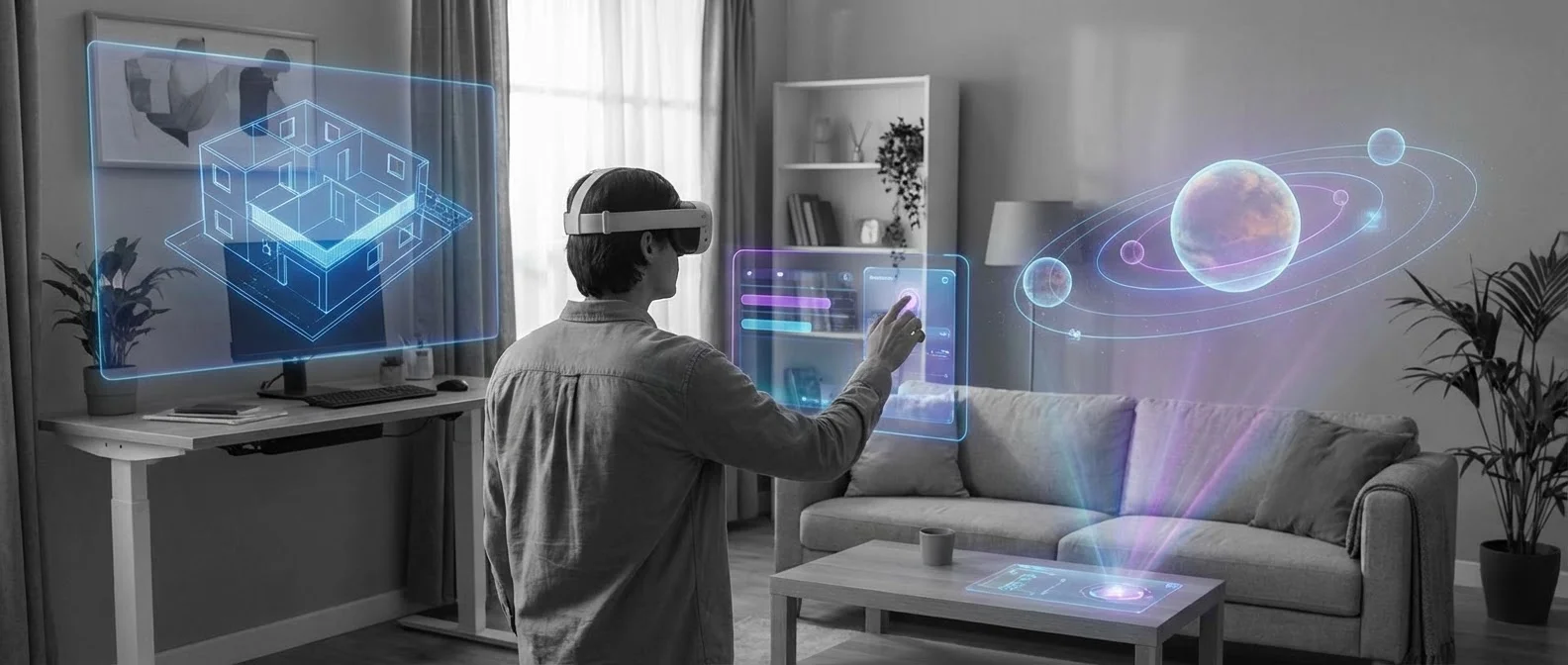
Mixed Reality (MR) is the technology that unites the physical world with the digital, creating an environment where real and virtual objects coexist and interact in real time. Unlike Virtual Reality, which completely replaces the real world, MR enriches it — you can see your actual space while simultaneously interacting with digital elements.
In 1995, Paul Milgram introduced the reality-virtuality continuum, a scale that places the purely physical world on one end and the fully virtual on the other. Mixed Reality sits in between, encompassing both Augmented Reality (digital overlaid on real) and Augmented Virtuality (real elements inside a virtual world).
Video See-Through (VST)
Cameras on the outside of the headset capture the real world, the processor adds digital elements and the result is displayed on the internal screens. Used in Quest 3, Apple Vision Pro and PSVR2.
Optical See-Through (OST)
Semi-transparent lenses allow light to reach your eyes while projecting digital elements on top. Used in HoloLens 2 and the Meta Orion AR glasses.
How Passthrough Works
Passthrough is the technology that allows a VR headset to display the real world through its cameras. In practice, front-facing cameras capture footage in real time, the signal is processed and displayed on the internal screens — creating a window into the real space without removing the headset.
Modern MR headsets use multiple sensors: the Quest 3 features 2 RGB cameras at 4MP for color passthrough, 4 IR cameras for tracking and a structured light depth sensor at the center. The Apple Vision Pro employs 12 cameras in total, 5 sensors and LiDAR for depth. The critical metric is motion-to-photon latency — the time from head movement to image update. Below 12ms is considered acceptable, while above 20ms causes nausea.
Scene Understanding
SLAM (Simultaneous Localization and Mapping) algorithms map the space in 3D, recognizing walls, floors, furniture and objects for precise placement of digital content.
Occlusion
Digital objects can hide behind real ones (e.g., a virtual character behind the couch), creating convincing integration with the physical space.
Depth Estimation
Depth sensors (structured light on Quest 3, ToF/LiDAR on Vision Pro) measure distances for realistic placement, shadows and natural virtual-real interaction.
📖 Read more: VR Cinema: Movies in Virtual Theaters
Hand Tracking
IR tracking cameras detect your hands without controllers, enabling natural gestures — pinch, grab, swipe — for interacting with digital objects.
Passthrough MR Headsets 2026
The MR device landscape is changing rapidly. In 2019, the Quest 2 offered only grayscale low-resolution passthrough — enough only to see whether you were about to walk into a wall. Today, flagship headsets offer high-quality, full-color passthrough sufficient for reading a text message on your phone.
MR Headset Comparison
The biggest difference lies in passthrough quality. The Quest 3 offered a major upgrade from the Quest 2 — color instead of grayscale, sharp enough for basic tasks, but still blurry for fine text. By contrast, the Apple Vision Pro raised the bar to its highest point: passthrough so clear that Apple decided not to call the device a VR headset at all, instead branding it a “spatial computer.”
MR Applications and Games 2026
Mixed Reality is no longer just a tech demo — today there are full-fledged experiences that leverage your physical space. From gaming to productivity, MR apps are changing how we use VR headsets.
First Encounters (Quest 3)
The free demo that showed the world what MR means — alien robots appear inside your room, break through your walls and make you interact with your actual space.
Spatial Computing Workspaces
Virtual screens placed around you in your real office — multiple windows, browsers and apps on floating panels. Ideal for working without physical monitors.
Interior Design MR
Apps like IKEA Place in MR — place virtual furniture in your actual room, at real-world scale, before you buy.
📖 Read more: XREAL Air: Real-Time 3D AR Glasses
Medical Training MR
Surgeons practice with holographic anatomy overlaid on physical models. 85% of medical students at Case Western Reserve found MR training equivalent or superior.
The Technology Behind MR
For passthrough MR to work properly, precise registration between the real and virtual world is required. This means that if a digital object is placed on your table, it must stay exactly there even as you move your head.
Headsets use Visual-Inertial Odometry (VIO) — software that combines camera imagery with inertial measurement unit (IMU) data to calculate precise position and orientation in space. SDKs like ARKit (Apple) and ARCore (Google) form the foundation, while Meta Presence Platform, OpenXR passthrough extensions and Qualcomm Snapdragon Spaces give developers tools for scene understanding, spatial anchors and mesh generation.
A major technical challenge is dynamic range: cameras must simultaneously handle bright windows and dark room corners, something even the best headsets struggle with — especially in indoor spaces with mixed lighting.
"Mixed Reality bridges the physical and virtual worlds, creating an environment where real and digital objects interact in real time."
The Future of Passthrough MR
Passthrough MR evolution is one of the fastest-moving areas in VR/AR technology. Just 3 years ago, passthrough was grayscale and blurry — a safety feature. Today, flagship headsets use it as a core function.
AI plays a pivotal role in the future: neural radiance fields (NeRF) and Gaussian Splatting can reconstruct spaces in 3D in real time, far beyond what cameras alone capture. Meta Orion AR glasses (2024 prototype) show that Meta is aiming for lightweight AR glasses with optical see-through instead of video passthrough — devices that will look almost like regular eyeglasses.
Apple calls its strategy “spatial computing” — a world where digital objects integrate so naturally into the environment that the confusion between real and virtual becomes a feature, not a bug. With every new generation of headsets, passthrough resolution increases, latency decreases and AI-powered scene understanding models grow more precise.
Key Takeaways
- Mixed Reality (MR) merges the real and virtual worlds into a unified environment
- Passthrough uses cameras to display the real world through a VR headset
- Two types: Video See-Through (Quest 3, Vision Pro) vs Optical See-Through (HoloLens, Orion)
- Critical metric: motion-to-photon latency below 12ms
- Quality ranges from grayscale (Quest 2) to color 4MP (Quest 3) to 12 cameras (Vision Pro)
- SLAM, depth sensors and AI drive spatial mapping
- Applications: gaming (First Encounters), work (spatial computing), design, medicine
- The future: lightweight AR glasses, NeRF, AI scene understanding