📖 Read more: Samsung Galaxy XR: The Android XR Headset
📦 What the Pico 4 Ultra Offers
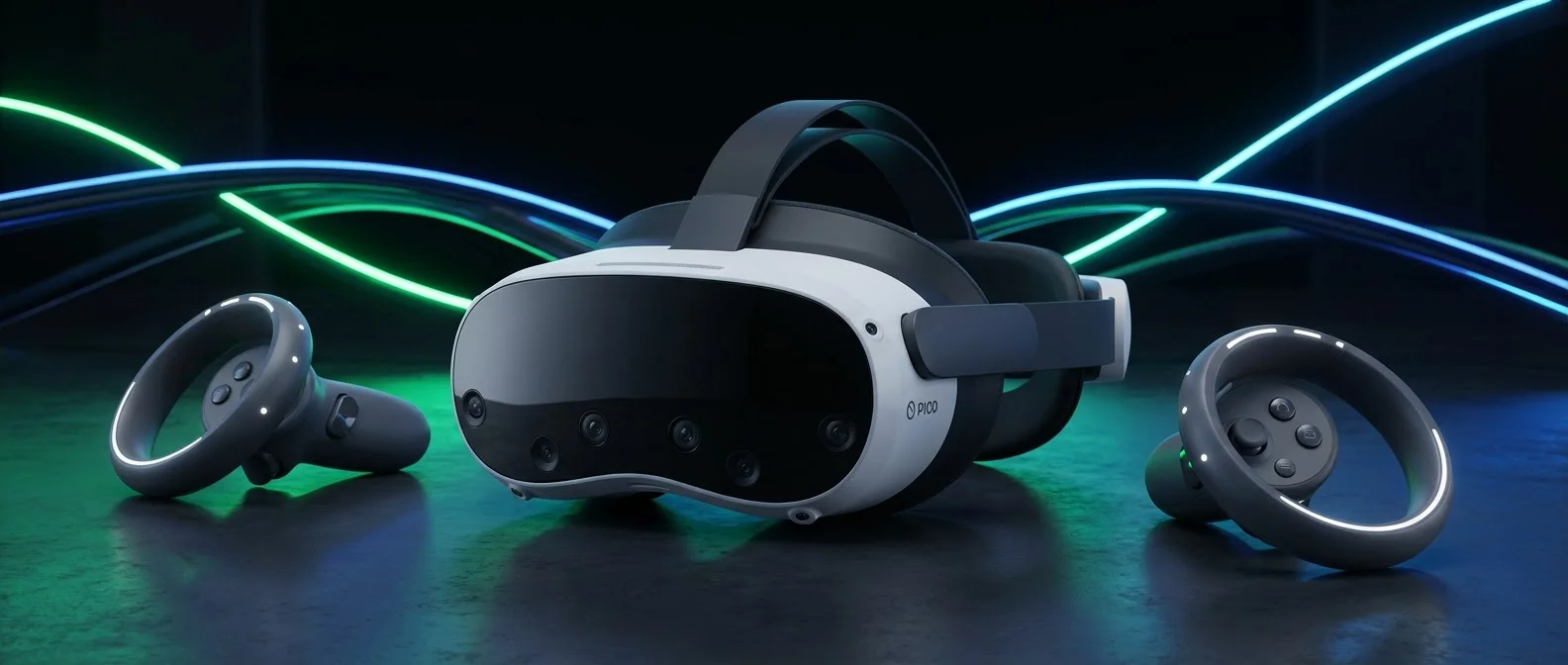
The upgrade from the original Pico 4 is substantial on the hardware side. The processor jumps from the Snapdragon XR2 to the Snapdragon XR2 Gen 2 — the same chip Meta uses in the Quest 3. RAM increases from 8 to 12GB, while storage comes in a single 256GB option.
The most visible external change is the camera setup on the front: an iToF depth sensor and two 32MP cameras replace the original Pico 4's single 16MP camera. This upgrade enables mixed reality passthrough and spatial video/photo capture. Additionally, the new controllers drop the tracking ring — sleeker and lighter.
For connectivity, the Ultra steps up to Wi-Fi 7 (from Wi-Fi 6) and Bluetooth 5.3 (from 5.1). Battery capacity grows slightly to 5,700 mAh (from 5,300) with 45W fast charging, but weight remains at 580 grams — 65g heavier than the Quest 3.
🔍 Displays and Optics: The Achilles' Heel
This is where the problems start. Despite the hardware upgrades elsewhere, the Pico 4 Ultra appears to use the same lenses and displays as the original Pico 4: two 2.56″ Fast LC (LCD) panels at 2160×2160 pixels per eye, running at 90Hz with pancake lenses.
The resolution numbers are comparable to the Quest 3 (2064×2208), but lens quality makes all the difference. According to MIXED Reality News' review, the Quest 3 delivers excellent edge-to-edge clarity — no matter where users look, the image stays sharp. On the Pico 4 Ultra, clarity exists only within a narrow sweet spot. The moment you move your eyes toward the edges, the image becomes noticeably blurry.
On top of that, high-contrast scenes reveal prominent ghosting — a mirrored “ghost” of images moving slightly offset from the originals. There are also unwanted reflections: if there's a light source behind the user, part of it bounces into the lenses, creating distracting artifacts.
🎮 Controllers and Hand Tracking
The new ring-free controllers are a genuine highlight. They're comfortable to hold, with stable pressure points, good haptic feedback, and excellent build quality. Tracking works flawlessly in both standalone and PC VR streaming modes.
In contrast, hand tracking remains disappointing. According to testing, it's as imprecise and clumsy as the original Pico 4 — a particularly glaring issue given that the Quest 3 offers exceptional hand tracking that many users prefer even over controllers.
🌐 Mixed Reality: Decent but Limited
The Pico 4 Ultra's mixed reality experience is respectable. In good lighting conditions, users can read their smartphone screen through passthrough — something the original Pico 4 couldn't manage. Interestingly, the Quest 3 actually had slightly worse passthrough at launch, but improved dramatically through software updates.
However, small inaccuracies persist: digital objects sometimes don't anchor perfectly to the real floor, the controller cursor bleeds through buttons, and the overall experience doesn't reach Meta's level of polish.
💻 Software and App Store
Pico no longer just copies Horizon OS — it now also draws inspiration from Apple's visionOS, with immersive landscape environments and an immersion level slider. The interface is reasonably well-structured and newcomer-friendly.
📖 Read more: Android XR: Google Enters the VR Headset Arena
However, the software lacks polish. Incompletely translated text boxes, Chinese-language error messages, edge flickering, and occasional controller jitter all mar the experience. The biggest problem: the Pico Store remains significantly poorer than the Meta Horizon Store. Quest exclusives, major VR titles, and especially mixed reality apps are conspicuously absent.
Reports from February 2026 about cancelled plans, mass layoffs at Pico, and the potential cancellation of Pico 5 raise serious questions about long-term platform support from parent company ByteDance.
🖥️ PC VR: Where It Truly Shines
If there's one area where the Pico 4 Ultra excels, it's as a PC VR headset. In testing with Half-Life: Alyx on a high-end PC with an RTX 4080, PC VR streaming via cable (Oculus Link) ran flawlessly at high settings.
Wireless streaming over Wi-Fi 6 or 6E also works excellently through the free Pico Connect app. No audio issues or stuttering were observed. Combined with SteamVR access, users get a massive PC VR library — which somewhat compensates for the sparse Pico Store.
📹 Spatial Video: A Nice Gimmick, Nothing More
The Pico 4 Ultra can capture and play back spatial photos and videos — even content created on Apple devices. In practice though, the resolution and frame rate are too low for long-term enjoyment. Photos work better thanks to the depth effect, but videos quickly become uncomfortable if you moved your head horizontally during recording. It's more of a nice gimmick than a daily-use feature.
🦵 Motion Trackers: The Pleasant Surprise
An unexpectedly positive element is the Pico Motion Trackers (sold separately). These are small, lightweight IR-based trackers that attach to your ankles via elastic fabric straps. They track leg movements with impressive accuracy and work without dropouts. Ideal for VRChat avatars or sports games in Pico's VR version of Wii Sports.
Who Should Consider It?
The Pico 4 Ultra is only worth it if: (1) you want a decent and relatively affordable PC VR headset, (2) you just want to try mixed reality without a major investment, or (3) you're determined to avoid Meta. In any other case, the Quest 3 — or even the Quest 3S at $299 — is the clearly better choice.
⚖️ Final Verdict
The Pico 4 Ultra isn't a bad headset. It's an improved Pico 4 with more power and new capabilities. But for every plus, there's at least one minus: good image quality only in the sweet spot, comfortable weight but uncomfortable headband, perfect controller tracking but terrible hand tracking, decent passthrough but immature software.
At €549 — more than the Quest 3's $499 — the value proposition doesn't hold up. Meta is years ahead in software, app ecosystem, lens quality, and hand tracking. And with reports of ByteDance cutbacks, long-term support for the Pico 4 Ultra remains uncertain.
If you're exclusively interested in PC VR use — especially if you live in a market where the price is competitive or you want the motion trackers — then it deserves a look. Otherwise, go with the Quest 3 or wait for the new headsets arriving in 2026.