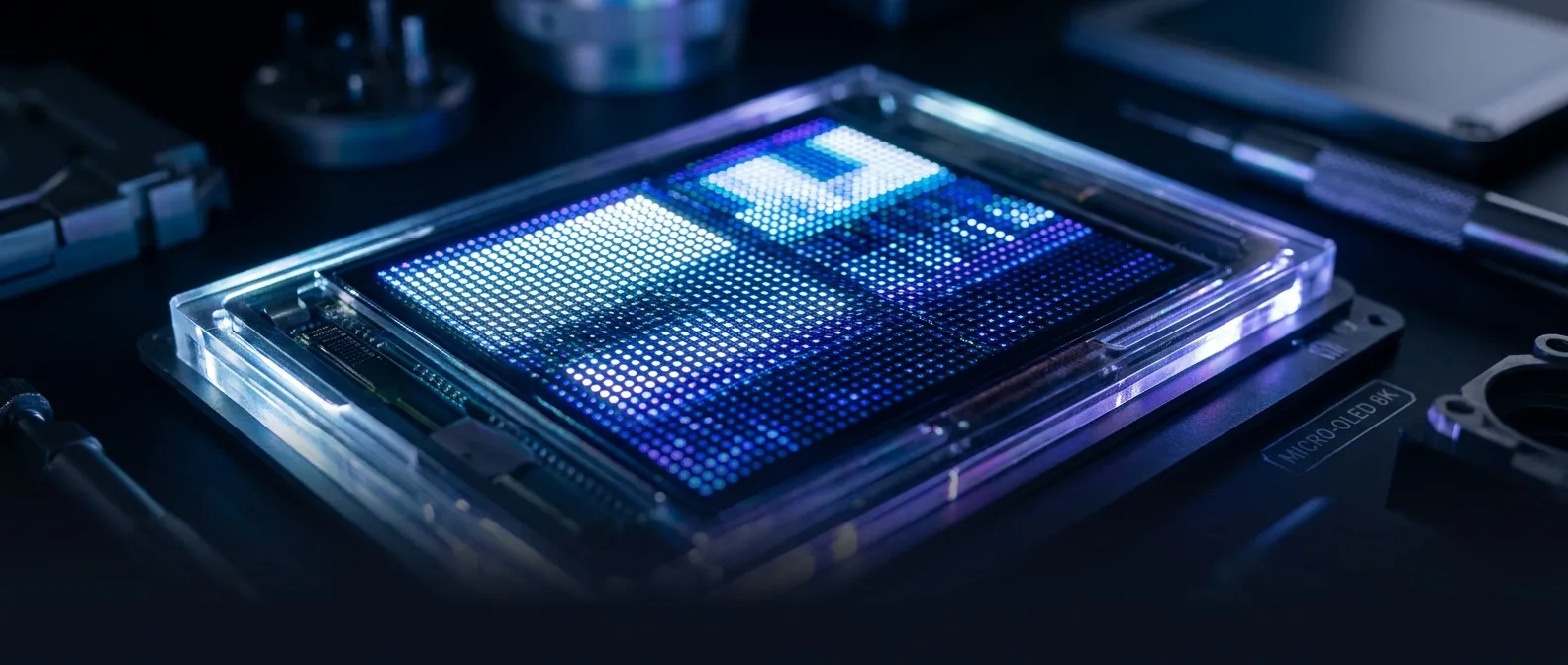
Four thousand pixels per inch on micro-OLED displays. That's ByteDance's bet for 2026. The company behind TikTok just dropped the official specs for Project Swan, their high-end VR headset gunning for Meta and Apple's crown. With dual-chip architecture and a new OS promising spatial multitasking, Pico wants to transform VR from gaming gadget into productivity powerhouse.
🔬 Displays That Rewrite the Rules
Try reading text on a VR headset. Any VR headset. If you've touched a Quest 3 or any budget device, you know the drill — blurry letters that strain your eyes after minutes.
Project Swan promises to obliterate this problem. The 4000 PPI micro-OLED displays deliver 40 pixels per degree (PPD) average and peak at 45 PPD in the center of your field of view. For context, Apple's Vision Pro — the current gold standard — hits roughly 34 PPD at center.
This resolution makes comfortable text reading on virtual monitors possible — sounds mundane, but it's essential if you want VR to actually replace your laptop.
What This Means for Users
Picture working on three virtual monitors simultaneously, without the cost and desk space of three physical displays. Or watching Netflix while keeping emails and documents open. The 4000 PPI density makes this feasible without headaches.
⚡ Dual-Chip Architecture: Power Meets Specialization
Pico didn't just slap better screens on existing hardware and call it done. Project Swan's architecture runs on dual-chip design reminiscent of Apple's approach with the R1 chip in Vision Pro.
The primary chip delivers double the CPU and GPU performance of the Snapdragon XR2 Gen 2 currently powering Pico 4 Ultra and Quest 3. But the real story lies in the second chip — a custom coprocessor handling computer vision and image processing exclusively.
Why a Second Chip?
VR tracking demands constant data processing from cameras, gyroscopes, and accelerometers. When these tasks run on the main processor, they steal resources from graphics and applications. A dedicated computer vision chip means more stable tracking and better overall performance.
The impressive detail is latency. Pico claims their custom chip delivers roughly 12 milliseconds latency — exactly what Apple reports for the R1 chip. This matters because latency determines how "natural" VR feels.
Who's Making the Main Chip?
Here's where things get interesting. Pico hasn't revealed which supplier will manufacture the primary processor. Speculation points to Qualcomm's Snapdragon XR2 Gen 3, but there's no confirmation.
If it's Gen 3, Project Swan would be among the first headsets to use it. If not, ByteDance might have struck deals elsewhere — MediaTek, Samsung, or even custom silicon.
🎮 Pico OS 6: When VR Meets Desktop Computing
Hardware is only half of Project Swan's story. The other half is Pico OS 6 — a completely redesigned operating system bringing true multitasking to VR.
Think about how you work on your computer today. Browser open, Word document running, Slack notifications, maybe Spotify in the background. Everything runs simultaneously and you switch between them with Alt+Tab.
Spatial Multitasking
Multiple 2D and 3D applications running simultaneously in shared environment
Unified Rendering
OS-level compositor handling physics, occlusion, and spatial audio
Cross-Platform Support
OpenXR, Unity, Unreal, and new WebSpatial framework
That's exactly what Pico OS 6 brings to VR. They call it the "Pico Spatial Engine" and according to the company, it took two years of development to build.
How It Differs from Meta and Google
Here's a crucial distinction. Meta Horizon OS and Google's Android XR allow only one 3D app at a time. Playing Beat Saber? You can't simultaneously have YouTube or another spatial application open.
Pico OS 6 aims to break this limitation. You could run a productivity app (virtual desktop) while a fitness app handles stretching breaks. Or watch tutorial videos while working in 3D modeling software.
📊 WebSpatial: The Future of Web in VR
One of the most intriguing announcements is WebSpatial — an open-source WebXR framework making spatial app development accessible to web developers.
The concept is simple: instead of learning Unity or Unreal for VR content, you use HTML, CSS, and JavaScript with minimal extensions. This could open doors to thousands of web developers who currently ignore VR.
WebSpatial is an "open, minimal extension to HTML, CSS and JS" that lets web developers build spatial experiences easily.
Pico Interactive
If this catches on, we might see VR versions of favorite websites. Netflix in spatial cinema mode. Wikipedia with 3D navigation. Even e-commerce sites where you "walk" through products.
Backward Compatibility and OpenXR
Despite radical changes, Pico promises full backwards compatibility. All applications running on today's Pico 4 Ultra will work on Project Swan without modifications.
The OS continues supporting OpenXR standard fully, meaning developers can use the same tools and frameworks they already know.
🎯 Price, Release Date, and Question Marks
Project Swan launches sometime in 2026, but Pico hasn't given specific dates or pricing. What we know is the company opened an early access program for developers and XR experts.
The pricing silence isn't accidental. Apple Vision Pro set the bar at $3,499 for premium VR headsets. Pico will likely target lower pricing for differentiation, but with these specs, don't expect budget prices.
Likely Pricing Scenarios:
- $2,000-2,500: Competitive with Vision Pro but more accessible
- $1,500-2,000: Aggressive pricing for market penetration
- $2,500+: Premium positioning, enterprise market focus
The Form Factor Mystery
There's an interesting question mark around the headset's physical design. Last year, The Information reported Pico was working on an ultralight headset achieving low weight through a tethered compute puck — an external box containing heavy chips while the mask stayed light.
But today's Pico graphics show both chips positioned side-by-side, not separated into a puck. This means either the report covered a different headset, or the company changed plans during development.
Weight will be crucial. Vision Pro's 650g is too heavy for extended use. If Pico keeps Project Swan under 400-450g without sacrificing specs, they'll have a serious advantage.
🚀 The Battle for Spatial Computing's Future
2026 shapes up as a pivotal year for VR. Apple set the standard with Vision Pro, Meta prepares Quest 4, and now ByteDance enters aggressively with Project Swan.
Project Swan's difference isn't just specs — it's vision. Instead of targeting gaming exclusively like Meta, or premium lifestyle like Apple, Pico seems focused on conquering the productivity market.
If successful, they could create an entirely new user category: workers who see VR as an alternative to traditional desktop setups. This market is massive and virtually untapped.
What to Watch
The coming months will be decisive. GDC 2026 on March 12 will reveal more developer details, while the early access program will show how the hardware actually performs in users' hands.
Critical questions remain: Will Pico keep weight low? Will pricing be competitive? Most importantly — will the Spatial Engine work as promised, or become another "revolutionary" technology that doesn't deliver?
One confident prediction: 2026 will determine whether spatial computing remains a niche hobby or becomes a mainstream productivity tool. Project Swan might hold the keys to that answer.