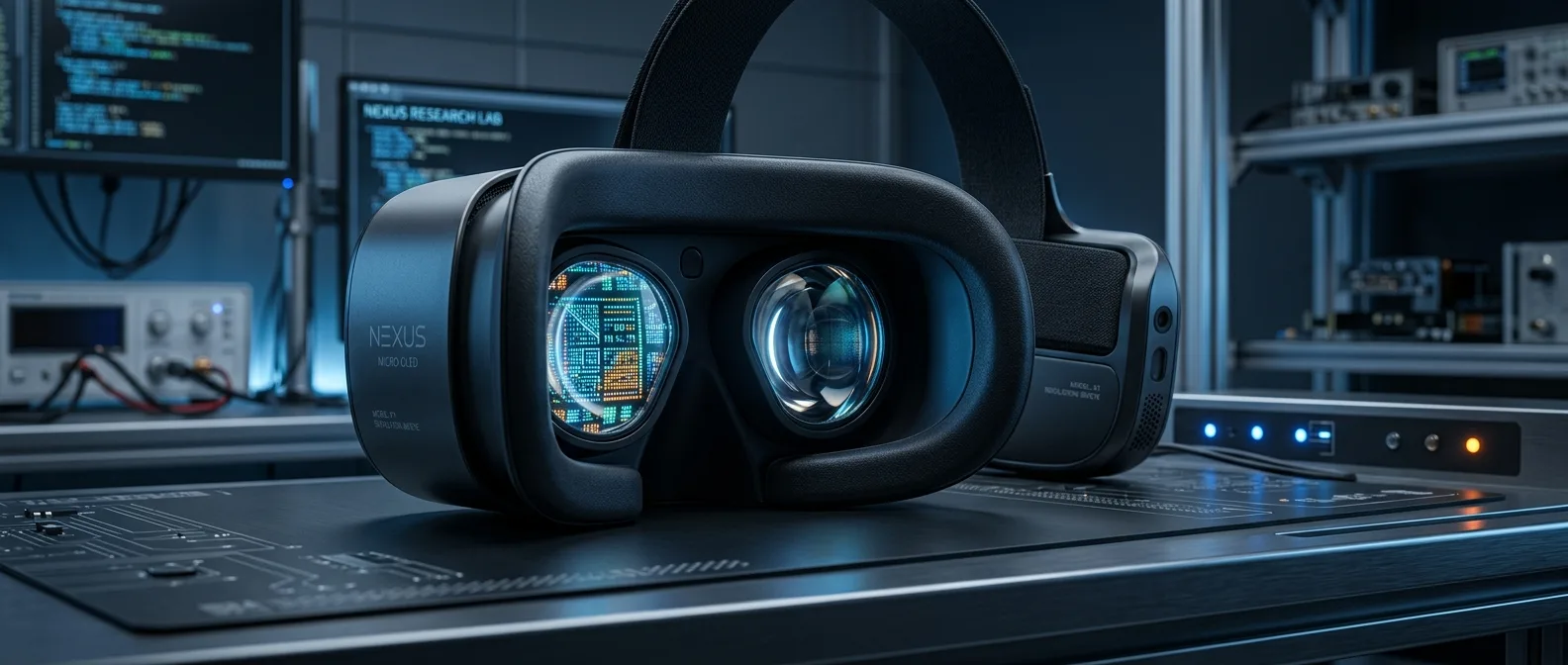
Two chips in one headset. That's ByteDance's Pico throwing down the gauntlet against Apple Vision Pro and Meta Quest. Project Swan launches Q2 2026 with 4000 PPI displays and a completely rebuilt operating system.
Project Swan isn't another incremental VR update. Pico is ditching compromises and targeting the tech that makes virtual monitors a real alternative to physical ones. With the new Pico OS 6, the company promises what Apple delivered with visionOS — but on a global scale.
🔬 4000 PPI Micro-OLED: Screen-Door Effect Finally Dies
Pico claims Project Swan micro-OLED panels hit 4000 pixels per inch. For perspective: Meta Quest 3 runs around 1200 PPI, Apple Vision Pro hits 3400 PPI. The numbers translate to 40-45 pixels per degree (PPD) on average — sharper clarity than Vision Pro.
What does this actually mean? You can finally read text on virtual screens without your eyes burning. The pixel density supports productivity tasks — something that's been a problem even on top-tier headsets until now.
Pico hasn't revealed which company manufactures the displays. Sony, which makes Vision Pro panels, seems like a strong candidate.
⚡ Dual-Chip Architecture: When One Processor Isn't Enough
Here's where things get interesting. Project Swan doesn't rely on one processor — it uses two. The first is the main SoC with double the CPU/GPU performance of the Snapdragon XR2 Gen 2 currently powering Quest 3 and Pico 4 Ultra.
The second is custom silicon for computer vision and image processing. Pico claims 12 milliseconds latency — identical to Apple Vision Pro's R1 chip. Coincidence? Probably not.
The idea is simple: one processor handles heavy gaming and rendering tasks, while the other manages real-time hand tracking, eye tracking, and passthrough.
Project Swan architecture analysis
The dual-chip setup solves a specific bottleneck. It lets the system run both 2D and 3D applications simultaneously over the physical environment. In practice: you see your room, have a virtual browser floating, and a 3D game running alongside.
Unknown Elements and Question Marks
Pico hasn't mentioned who manufactures the main processor. Qualcomm Snapdragon XR2 Gen 3 is a possibility, but there's no confirmation. Neither about whether the headset will be standalone or require a tethered compute puck as 2025 rumors suggested.
🧠 Pico OS 6: The Operating System That Changes the Rules
Hardware is half the story. The other half is Pico OS 6 and the new Pico Spatial Engine. Pico takes a different approach than Meta or Google: unified rendering architecture at the operating system level.
What does OS-level rendering mean? Instead of each app handling its own graphics, the operating system manages all rendering. Result: multiple apps run simultaneously in the same space, with consistent lighting, physics, and spatial audio.
Compare this to Meta Quest or new Android XR headsets that can only run one 3D application at a time. Apple's visionOS has similar logic, but Pico OS 6 will be available globally — not just in the US.
Cloud Crystal Design Language
The interface design they call "Cloud Crystal" appears inspired by visionOS. Adaptive lighting, environmental reflections, spatial UI elements that respond to the physical environment. Developers can use the Pico Spatial UI system for consistent experiences.
📊 Developer Ecosystem: Open Standards and Familiar Tools
Pico learned from other platform holders' mistakes. Pico OS 6 supports OpenXR, WebXR, Android apps, web apps, and PC VR streaming. Plus native integration with Unity and Unreal Engine through Pico Spatial Support.
The new WebSpatial framework is intriguing — an open-source extension for HTML, CSS, and JavaScript that lets web developers create spatial experiences. Essentially, spatial computing in the browser.
Developer Support
Android Studio, Kotlin, Unity, Unreal Engine with native spatial features
Web Standards
WebXR, WebSpatial framework for browser-based spatial apps
Backward Compatibility
All Pico 4 Ultra apps will run on Project Swan
🌍 Global Early Access and Launch Plans
Project Swan launches Q2 2026 — and for the first time, Pico comes to US consumers. Until now, it only had enterprise presence there.
The Global Early Access Program is currently running for developers and XR experts. The company wants "rigorous feedback" before official launch. For those interested, applications go through a ByteDance form.
What exactly is Pico looking for? "Select few with deep expertise across XR platforms." They probably don't want casual users in beta — they want people who know what they're doing and can provide constructive criticism.
Competition with Apple and Meta
The timing isn't random. 2026 expects a new Vision Pro, possibly the iPhone SE of mixed reality. Meta will likely have Quest 4. Pico comes to play in the same league with specifications that look competitive — at least on paper.
The question is whether they can do it at a price that won't kill the consumer market. Vision Pro at $3500 is still niche. If Project Swan comes around $1500-2000, things get interesting.
Because ultimately, 2026 won't just be the year we see better VR headsets. It'll be the year that determines which platform dominates spatial computing — and Pico seems determined not to let Meta and Apple play alone.