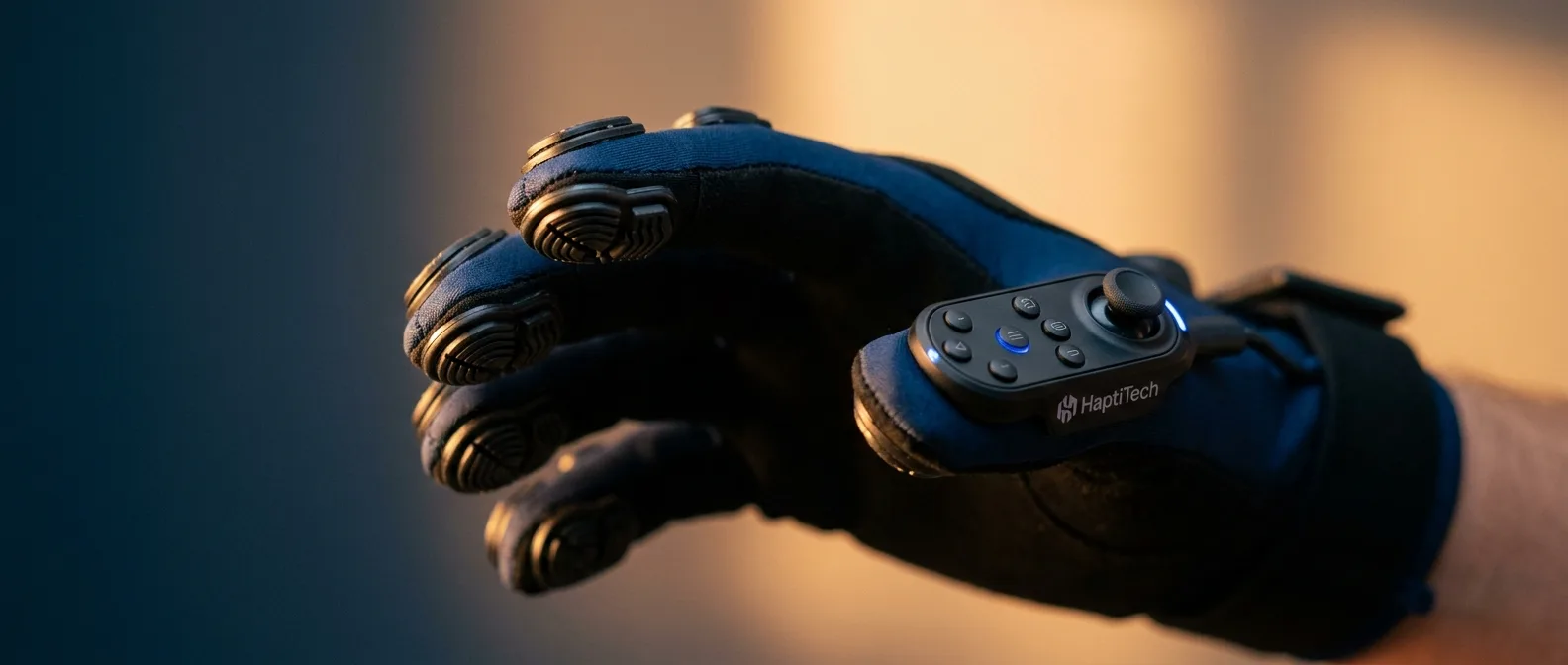
While thousands of conventional haptic gloves struggle to prove their worth, Sharp just announced a prototype that could rewrite the rules. This isn't just another VR glove — it's a hybrid controller with traditional controller buttons built into the glove plus multi-segmented tactile elements on each fingertip. The Japanese company slapped a provisional 100,000 yen price tag (roughly $650) on early access for anyone willing to test the tech in its infancy.
🎮 Glove Meets Controller: Why Didn't Anyone Think of This Before?
Sharp's big bet isn't just texture simulation — companies like bHaptics already do that with their $230 gloves. The difference is the hybrid design.
Slip on the glove and you'll find a controller-like surface mounted on the index finger side. Buttons, thumbstick, everything you need for navigation in VR apps. You get haptic feedback on your fingertips while staying compatible with every VR game that requires traditional controls.
Most VR accessories force you to choose: immersive haptics or practical input. Sharp's prototype says why not both?
Sharp states: "While haptics don't fully replicate reality, by adjusting parameters we've achieved a variety of tactile experiences."
Multi-Segment Tactile Elements: The Tech Behind the Touch
The "multi-segmented tactile elements" sit at each fingertip, including the thumb. Each element splits into electrodes that generate different vibration patterns.
Different patterns for different textures: smooth, rough, metallic. No force feedback — your fingers move freely — but the resolution is clearly higher than what's available today.
💰 Price and Availability: Everything's Provisional
Here's where things get interesting — and slightly complicated. Sharp closed pre-orders through its Japanese website but warns that "development or release may be canceled."
This stance reflects a realistic approach: the company wants feedback from early adopters before investing in mass production. Smart — especially in a space where many VR accessories end up in drawers.
Sharp's VR Track Record
If you're wondering why Sharp is dabbling in VR, it's not random. The company ranks among the top VR display OEM suppliers — Meta Quest 2 screens came from Sharp. Late 2024, they partnered with Japanese telecom NTT Docomo on the MiRZA AR glasses.
With this background, the move toward haptic controllers feels like logical evolution rather than sudden pivot.
⚡ Problems That Need Solving
Every innovative hardware has challenges. These are fairly obvious.
Tracking: The Big Question Mark
The glove lacks built-in positional or finger tracking. Sharp hints at exploring "attachment methods to controllers with high market share," possibly Quest or PSVR2 trackers.
For now it relies on computer vision hand tracking — meaning your headset's camera must "see" the glove as a hand. Works, but not always flawlessly.
Finger Tracking: No Delicate Detection
The company admits the device "doesn't allow delicate finger tracking like glove-type devices." We're talking basic motion detection, not the sub-millimeter precision you see in professional motion capture.
What's There
Multi-segment haptics, buttons, thumbstick
What's Missing
Force feedback, temperature sensing, precise finger tracking
🔬 What This Means for VR Markets
If Sharp's project reaches commercial release, it'll face specific competition.
bHaptics already sells haptic gloves for roughly half the price. SenseGlove focuses on force feedback for enterprise applications. Ultraleap offers hand tracking without wearables.
But none offer Sharp's hybrid approach. Controller buttons plus haptic feedback in one device. For casual gaming, this could be a significant advantage.
VRChat and Social VR: The Real Market?
The biggest opportunity isn't AAA games but social VR environments. VRChat users spend hundreds of dollars on custom avatars — the ability to "feel" virtual objects could justify the $650 price tag.
Developers will need to support the device, though. If Sharp can't convince studios to integrate, it'll remain a niche product for enthusiasts.
"Rather than keeping it in-house until developers are satisfied, we plan to collaborate with users to improve content quality."
— Sharp Corporation
🎯 Frequently Asked Questions
When will Sharp VR gloves launch commercially?
The company hasn't confirmed commercial release. Pre-orders in Japan closed, but Sharp warns the project may be canceled depending on feedback.
Will it work with Quest 3 or other VR headsets?
Currently lacks built-in tracking. Sharp is exploring compatibility with "high market share controllers," possibly Quest or PSVR2 trackers, but no official specifications exist.
How does it differ from other haptic VR gloves?
The main selling point is hybrid design — haptic feedback on fingertips plus traditional controller buttons and thumbstick in one device. Most VR gloves are either haptic-only or controller-only.
🚀 The Future of Haptic Gaming
Sharp's project represents more than just another VR accessory. It's proof that companies are starting to think beyond traditional input methods.
Instead of choosing between immersive haptics or practical controls, why not both? If Sharp can solve the tracking issues and convince developers to add support, this could become the template for next-generation VR input devices.
Of course, with a $650 price tag for a prototype without a confirmed release date, the question remains how many will want to invest in such experimental technology. The VR hardware cemetery is littered with promising projects that never found their market. Sharp, at least, seems to understand this — hence the careful approach with early access instead of a grand launch.
Sources: