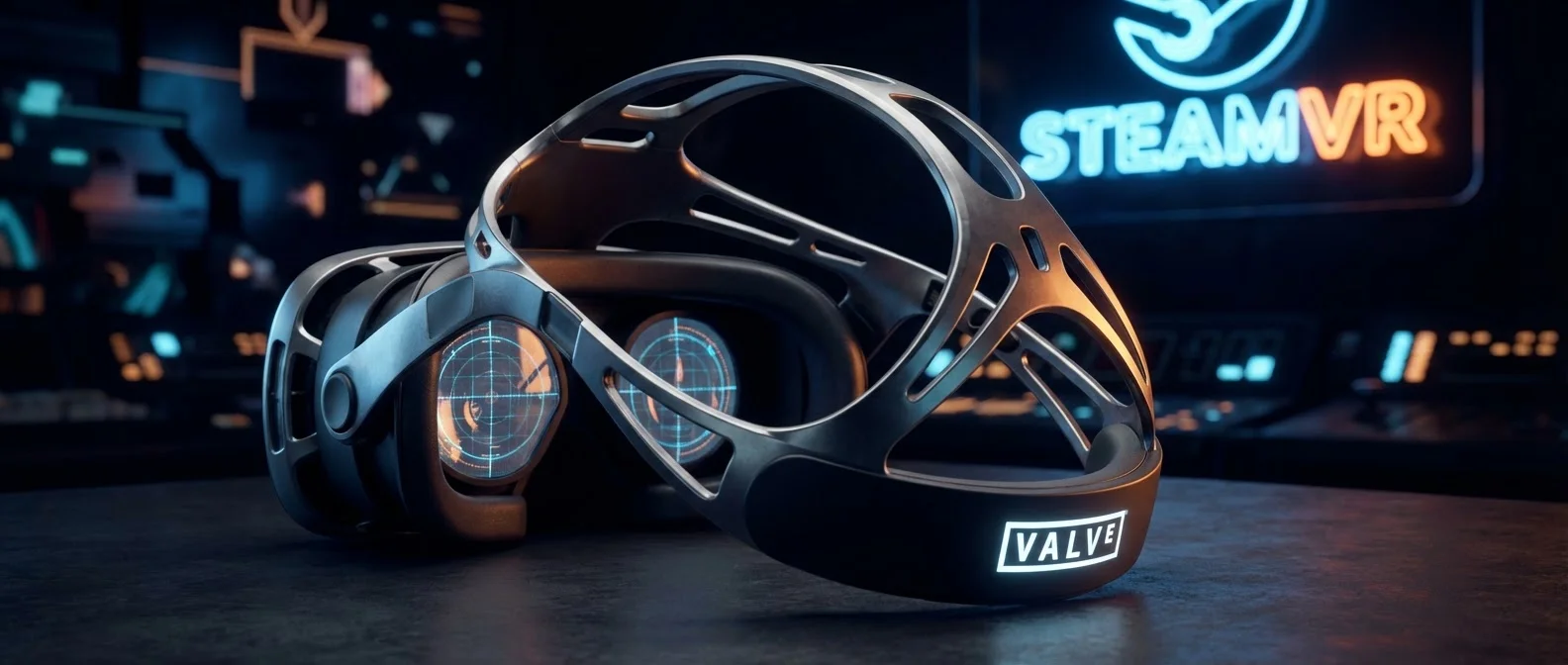
The Story Behind Steam Frame
Valve is no stranger to VR. Since the Valve Index launched in 2019, the company had set a high bar for VR experience quality — but that headset required a tethered PC connection, base stations, and a hefty $1,000 price tag.
In recent years, the VR market has been dominated by Meta's standalone headsets. Rather than rushing to compete, Valve was quietly working on a project codenamed "Deckard." On November 12, 2025, the company officially announced Steam Frame, simultaneously discontinuing the Valve Index. The release is expected in early 2026, although a slight delay was announced in February due to a global memory supply shortage.
What makes Steam Frame unique isn't just the specs — it's the philosophy. Valve describes it as a "streaming-first" headset: designed primarily for wireless PC streaming, but capable of running games standalone thanks to its powerful Snapdragon 8 Gen 3 processor.
Hardware and Design
The Lightest Visor in Its Class
Valve made deliberate design choices to keep weight low. The main visor — the front module containing the displays and optics — weighs just 185 grams. With the head strap and battery (mounted at the rear for better balance), total weight comes to 440 grams — significantly lighter than the Quest 3's 515g.
The strap is made from soft fabric with foam padding at the back, and it can fold completely flat — ideal for portability. The modular design means Valve will release CAD files, allowing third-party manufacturers to create alternative straps and accessories.
Displays and Optics
Steam Frame features dual LCD panels at 2160×2160 pixels per eye with pancake lenses — a significant upgrade from the Fresnel lenses of the original Index. The refresh rate ranges from 72 to 120Hz, with experimental support for 144Hz.
The field of view (FOV) stands “conservatively” at 110° horizontal × 110° vertical, meaning it may be slightly wider in practice — though it remains a bit narrower than the original Index's 130°. Valve explains that the choice of pancake lenses delivered a dramatic weight reduction, but with some trade-off in FOV.
Eye Tracking & Foveated Streaming
Steam Frame integrates eye tracking that isn't just used for foveated rendering (reducing GPU load in areas the user isn't looking at), but also for foveated streaming. During wireless PC streaming, the area where the user is looking is encoded at a higher bitrate, while the periphery uses a lower one — dramatically increasing image quality without increasing bandwidth requirements.
Processor and Performance
At the heart of Steam Frame sits the Qualcomm Snapdragon 8 Gen 3 with an Adreno 750 GPU. According to UploadVR's analysis, this processor is 25-30% more powerful than the Quest 3's Snapdragon XR2 Gen 2 in graphics, and roughly 50% better in single-threaded CPU performance. Importantly, Valve doesn't underclock the chip, unlike Meta does with the Quest 3.
RAM stands at 16GB LPDDR5X, while storage comes in 256GB and 1TB UFS options, with expansion via a microSD slot — a rarity in VR headsets. The microSD cards can even share data with the Steam Deck.
Connectivity: The Streaming-First Philosophy
One of Steam Frame's most innovative features is its approach to connectivity. Instead of relying solely on your router's Wi-Fi, Valve includes a dedicated Wi-Fi 6E USB adapter in the box. This adapter plugs into your PC and creates an exclusive 6GHz channel between the computer and headset.
Internally, the headset features two separate Wi-Fi 7 radios: one uses the 5GHz band for internet connectivity, while the second is dedicated to the 6GHz band for VR streaming. This separation eliminates interference and ensures consistently low latency — critical for VR gaming without motion sickness.
Dual Wi-Fi 7 Radios
Separate radios for internet (5GHz) and VR streaming (6GHz). Zero interference, low latency.
Wi-Fi 6E USB Adapter
Included in the box. Creates a dedicated 6GHz link with your PC for optimal streaming.
Expansion Port
Front-mounted PCIe Gen 4 + MIPI camera interface for future add-ons (color passthrough, depth sensor).
Software: SteamOS and Three Compatibility Layers
Steam Frame runs SteamOS, the Arch Linux-based operating system already familiar from the Steam Deck. This means full access to the Steam library — but how do Windows games run on an ARM Linux chip?
Valve has developed three distinct compatibility layers:
Proton — The well-known Windows-to-Linux API translation layer, extensively tested on the Steam Deck.
FEX-Emu — An x86-to-ARM translator that allows games designed for x86 processors to run on the ARM Snapdragon. According to Valve, the overhead is “shockingly small.”
Lepton — A compatibility layer that enables the installation and execution of Android APKs. This means you can theoretically run games and apps from the Meta Quest store by sideloading the APK files.
Additionally, Valve is introducing the Steam Frame Verified program — similar to Steam Deck Verified — which certifies which games can run standalone on the headset via Proton + FEX.
Controllers: A New Philosophy
The new Steam Frame Controllers represent a radical departure from the Index Controllers. Instead of the ergonomic “knuckles” design, Valve chose a layout resembling a gamepad: D-pad on the left, ABXY buttons on the right, triggers, bumpers, and two analog sticks.
The thumbsticks use TMR (Tunneling Magnetoresistance) technology — the same tech Valve uses in the Steam Deck — which eliminates the stick drift problem that plagues many VR users. Each controller features 18 IR LEDs for inside-out tracking, capacitive sensors on all buttons for finger detection, and runs on a single AA battery with approximately 40 hours of life.
Steam Frame vs Quest 3 vs Galaxy XR
What's Missing?
Despite its many strengths, Steam Frame has some notable gaps. The most significant is the lack of hand tracking. In an era where Quest 3 and Galaxy XR offer full hand tracking, Valve chose not to support it — at least for now.
Additionally, passthrough is monochrome only. The four grayscale cameras enable basic passthrough and room-scale tracking, but they fall short of delivering a proper mixed reality experience. Valve addresses this as an evolving feature: the front expansion port (PCIe Gen 4 + MIPI camera interface) was specifically designed for future modules like a color passthrough camera, depth sensor, or face tracking accessory.
Finally, pricing remains unclear as of February 2026. Valve has stated it aims for a price below the Index's $1,000, but hasn't given a specific number.
Steam Machine: The Companion PC
Alongside Steam Frame, Valve also announced the Steam Machine — a compact gaming PC designed specifically for VR streaming. It features semi-custom AMD hardware: a Zen 4 6-core / 12-thread CPU paired with an RDNA 3 GPU with 28 Compute Units, 16GB DDR5 RAM, and 512GB or 2TB SSD storage.
The concept is straightforward: anyone who wants the best VR streaming experience but doesn't already own a gaming PC can purchase the Steam Machine as a companion device. The Wi-Fi 6E USB adapter ensures a dedicated channel between PC and headset.
"We designed Steam Frame to work great standalone, but the best VR experience remains one powered by a PC — and we wanted to make that connection as reliable as possible."
— Valve, Official Announcement 2025Why Steam Frame Matters
The significance of Steam Frame goes beyond specifications. For the first time, a standalone headset offers access to the entire Steam library — thousands of VR titles that previously required a tethered PC connection. At the same time, the open philosophy (open specs, CAD files, expansion port) signals that Valve wants to build an ecosystem, not just a device.
The ability to run Android APKs via Lepton means users won't be locked into a single store. And the streaming-first approach with a dedicated wireless adapter addresses perhaps the biggest pain point of wireless PC VR: connection instability over shared home Wi-Fi networks.
Of course, the absence of hand tracking and color passthrough means Steam Frame isn't targeting the mixed reality market — at least not yet. Valve appears to be focusing on what it does best: gaming, with the ability to expand capabilities through modules down the road.
Who Is It For?
Steam Frame is aimed primarily at gamers who want access to the Steam VR library without cables. If you already have a gaming PC and want wireless PCVR, this could be the best solution on the market. If you're looking for standalone VR gaming, the Snapdragon 8 Gen 3 and three compatibility layers ensure a massive game catalog.
However, if you're more interested in mixed reality, hand tracking, or productivity — then the Quest 3 or Galaxy XR remain more complete solutions in those areas.
Pros
Ultra-lightweight (440g), eye tracking, full Steam library, dedicated wireless adapter, expansion port, TMR sticks, Android APK support, microSD slot
Cons
No hand tracking, monochrome passthrough, price unconfirmed, slightly narrower FOV than Index, no color MR