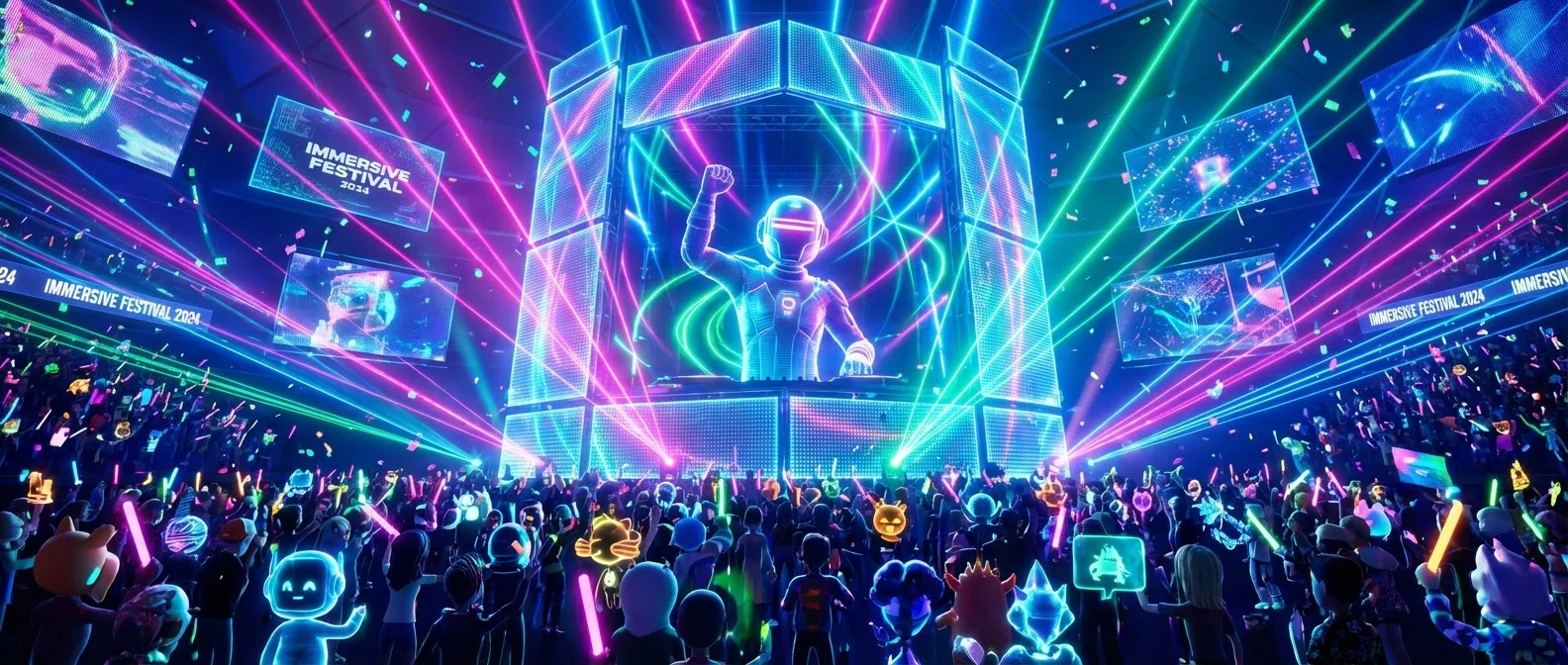
Imagine attending a concert with millions of viewers, standing front row next to your favorite artist, all without leaving your home. VR concerts and live events are fundamentally transforming how we experience live entertainment. From pioneering performances inside gaming platforms to dedicated VR concert venues, virtual reality is opening an entirely new chapter in the music industry and beyond.
📖 Read more: VR Phobia Therapy: How Does It Work?
The Rise of Virtual Concerts
The story of VR concerts essentially began inside gaming platforms. In April 2020, Travis Scott performed his now-legendary “Astronomical” concert inside Fortnite, attracting 12.3 million concurrent viewers. It was an event that forever changed our perception of live music — viewers flew through galaxies, plunged into the ocean, and experienced an audiovisual spectacle impossible in any physical venue.
Months later, Ariana Grande followed with her own Fortnite appearance “Rift Tour,” while Lil Nas X shattered every record on Roblox with 78 million total viewers across four shows. These events proved that virtual concerts weren't just a gimmick — they were an entirely new entertainment medium with a massive audience.
Why Gaming Platforms Became the Launchpad
Fortnite and Roblox already had hundreds of millions of active users, built-in social interaction tools, and graphics engines capable of supporting massive events. The transition from gaming to entertainment was a natural evolution. These platforms gave artists creative tools that transcended every physical limitation — a stage could change shape, gravity could disappear, and the audience could become part of the show itself.
Dedicated VR Concert Platforms
Beyond gaming environments, specialized platforms have emerged that focus exclusively on VR concerts:
Wave
The pioneering VR concert platform that has hosted artists like John Legend, The Weeknd, and Justin Bieber. It uses real-time motion capture to translate the artist's movements into stunning digital avatars. Viewers can interact through emotes, lighting effects, and even influence the show's visuals in real time.
AmazeVR
Specializes in cinematic VR concerts using volumetric capture technology. Instead of avatars, it records real artists in 3D, creating a hyper-realistic experience. AmazeVR partners with cinema chains to offer VR concerts in physical venues equipped with headsets.
Meta Horizon Worlds
Meta's platform regularly hosts music events and DJ sets inside custom-built virtual venues. With integrated spatial audio, every seat in the virtual audience delivers a different sonic experience — just like at a real concert.
VRChat Events
The VRChat community has built an entire ecosystem of independent music events, from underground DJ sets to anime music festivals. The creative freedom makes every event unique and community-driven.
📖 Read more: VR Racing: Best Racing Games in Virtual Reality
Music Festivals Go VR
It's not just individual concerts — entire music festivals are making the leap into the virtual world. Burning Man created the “BRCvr” experience in VR, allowing thousands of people to experience the magic of the playa without traveling to Nevada. Tomorrowland launched its “Around the World” digital festival, combining physical and digital presence with breathtaking virtual stages.
VR festivals offer something no physical festival can: the ability to “teleport” instantly from one stage to another, switch acoustic environments in seconds, and watch multiple performances without missing a single set.
How VR Concerts Work
Behind every impressive VR concert lies a complex technological system:
Real-Time Motion Capture
The artist wears a motion capture suit fitted with dozens of sensors. Every movement — from hand gestures to facial expressions — is transmitted in real time to their digital avatar. Newer systems use AI to add micro-details like hair movement and clothing physics.
Virtual Stage Design
Virtual stages are designed by teams of 3D artists and technical directors. Without physical constraints, a stage can be an entire planet, the ocean floor, or the interior of a living organism. Visual effects react dynamically to the music in real time, creating a synesthetic experience.
Audience Interaction
Viewers aren't passive — they can send emotes, trigger visual effects, “throw” digital objects onto the stage, and clap through hand motion tracking. On some platforms, audience reactions influence the visuals in real time, making every show unique.
📖 Read more: VR Real Estate: How Agents Will Show Homes in the Future
Technical Requirements
To attend a VR concert, requirements vary by platform. Events on Fortnite or Roblox run even on smartphones. For a full VR experience on platforms like Wave or AmazeVR, you'll need a VR headset (Meta Quest 3, PlayStation VR2, or a PC VR headset) and a stable internet connection of at least 25 Mbps. High-end events require a PC with an RTX 3070 or better GPU for full resolution rendering.
VR Concert vs Real Concert
✅ VR Advantages
- Front row for everyone — every viewer gets the best view
- Universal access — watch from anywhere in the world
- No crowds — comfort without queues and packed venues
- Impossible visuals — effects that transcend physical reality
- Affordable — tickets from €5 to €30
- Accessibility — ideal for people with mobility challenges
⚠️ VR Limitations
- Social atmosphere — missing the energy of a live crowd
- Physical sensations — you can't feel the bass in your chest
- Headset comfort — fatigue after 1-2 hours of use
- Technical issues — lag or disconnects during peak times
- Digital divide — requires significant hardware investment
The Business Model
VR concerts are creating entirely new revenue streams for artists:
Virtual Tickets
Tiered pricing: free basic access, premium “backstage” seats with exclusive content, and VIP meet & greet packages with the artist's avatar. VIP packages can run up to €100 or more.
Digital Merch
Limited edition skins, avatar accessories, virtual t-shirts, and collectible items. Travis Scott earned over $20 million from in-game items alone during his Fortnite concert.
Exclusive Avatars
Limited edition avatars inspired by the artist. NFT-based collectibles that appreciate in value after the event. Exclusive wearables that prove “you were there.”
Sponsorships
Brands sponsor virtual stages, create branded experiences within the event, and place interactive ads that viewers can explore voluntarily.
📖 Read more: Working in VR: The Future of Virtual Offices
Beyond Music: Sports & Comedy
VR live experiences extend far beyond music. The NBA League Pass VR offers viewers the ability to watch basketball games from courtside seats with free camera angle selection. Major boxing events are broadcast in VR with 360° cameras at ringside, delivering an experience like standing right next to the boxer's corner.
In the comedy world, comedians like Kevin Hart have experimented with VR stand-up shows, while platforms like VRChat host weekly open mic nights featuring comics from all around the world.
"A VR concert doesn't replace the live performance — it's an entirely new medium of expression. I can create experiences impossible in the physical world."
— Jean-Michel Jarre, pioneering VR performerThe Future of VR Events
The next generation of VR concerts will be even more immersive:
Haptic Feedback
Haptic vests and gloves will let you feel the bass vibrating through your body and the pulse of the music. Companies like bHaptics are already developing full-body haptic suits designed specifically for music experiences.
Spatial Audio
Sound technology that changes based on your position in the virtual space. Move closer to the stage and the sound intensifies; turn your head and the audio direction shifts — exactly like real life.
AI-Powered Performances
AI will create unique experiences for each viewer, adapting the visuals, setlist, and even stage effects based on your preferences. Every concert will be one of a kind.
Mixed Reality Integration
A blend of physical and digital worlds: attend a real concert through AR glasses while digital effects “fly” around you. The convergence of XR technologies will create experiences without precedent.
VR concerts didn't come to replace live performances — they came to complement them and push the boundaries of what's possible. With every technological advancement, the line between physical and virtual concerts grows thinner. The future of live entertainment is already here — and it's virtual.