📖 Read more: VR Meditation: Virtual Nature Relaxation
What Are Phobias — and Why Are They So Hard to Overcome
A phobia is an intense, persistent, and disproportionate fear response toward an object or situation. According to the DSM-5, phobias are classified into three main categories: specific phobias (animals, heights, blood, enclosed spaces), social phobia (fear of judgment by others), and agoraphobia (fear of being unable to escape from places or situations).
The problem isn’t just the fear itself — it’s the avoidance. Phobic patients radically alter their lives to avoid confronting the stimulus: they avoid flights, elevators, social gatherings, even work. The brain’s amygdala, the fear processing center, creates conditioned responses that are reinforced with each avoidance.
Phobia Statistics
Approximately 8.7%-18.1% of Americans experience some form of phobia, making it the most common mental disorder among women of all ages. Women are affected nearly twice as often as men: 21.2% of women vs 10.9% of men for specific phobias. The typical age of onset is 10-17 years.
How VRET Works — Step by Step
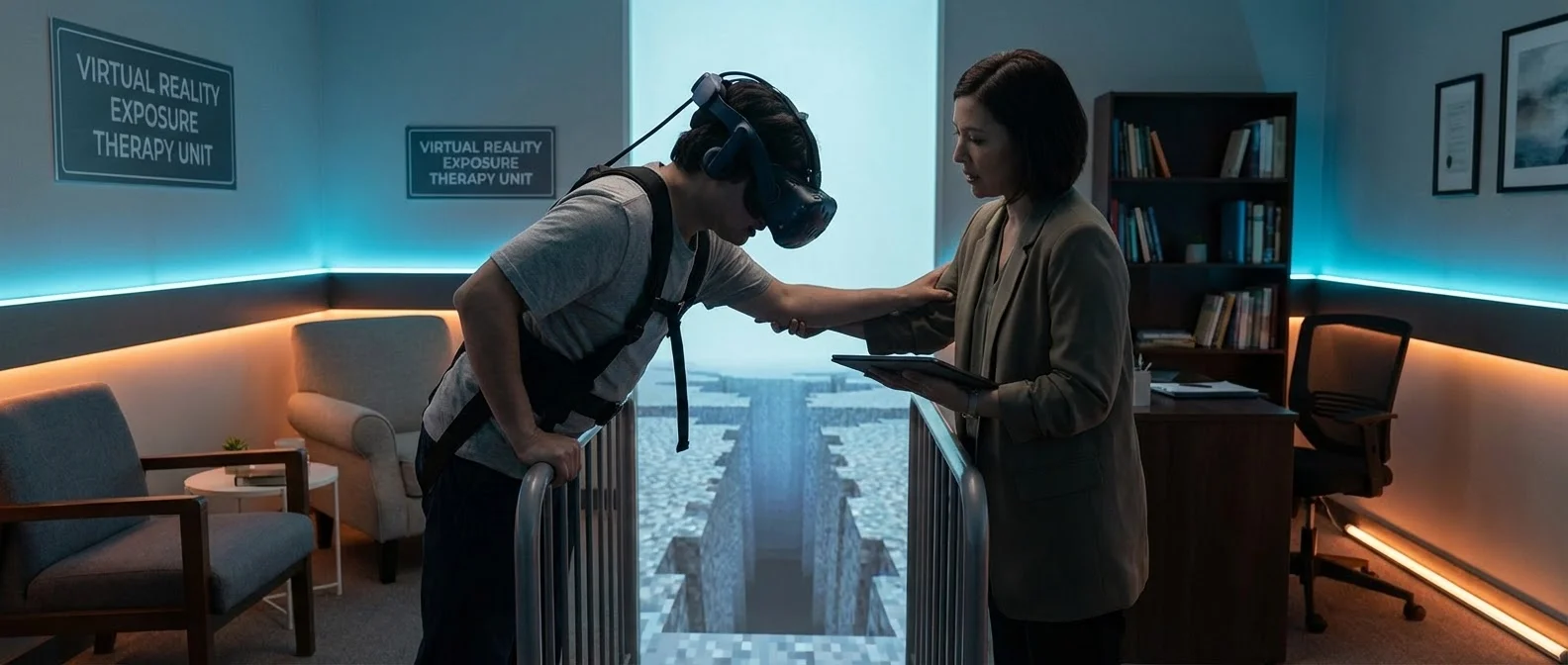
Virtual Reality Exposure Therapy (VRET) is based on the same principle as traditional exposure therapy: gradual, controlled contact with the phobic stimulus. The difference? The stimulus is created digitally in a safe virtual environment.
Graded Exposure
Starts with mild stimuli (e.g., a low balcony) and gradually escalates (e.g., top of a skyscraper). Each step is controlled by the therapist in real time.
Therapeutic Supervision
The psychologist monitors the patient’s reactions, adjusts intensity, and adds or removes stimuli (sounds, vibrations, visual elements) based on progress.
Scene Repetition
Unlike in-vivo exposure, virtual scenes can be repeated indefinitely — with or without modifications — until the patient becomes fully accustomed.
Safe Environment
The patient knows they’re in a virtual world. This lowers barriers to therapy acceptance and allows confrontation of scenes that would be impossible or dangerous in reality.
There are two main approaches: flooding, where the patient is immediately exposed to the most intense stimulus, and graded exposure, where stimuli escalate gradually. The latter is considered gentler and is more widely used in VRET.
Which Phobias Does VRET Treat
Acrophobia (Fear of Heights)
The most studied VRET application. A study in The Lancet Psychiatry showed significant fear reduction through VR compared to standard care. The majority of participants reported no longer fearing heights. Kaiser Permanente trials achieved >90% effectiveness across 40 patients.
Arachnophobia & Zoophobia
Virtual spiders and other animals are easily created in VR, eliminating the difficulty of finding real stimuli. Patients gradually interact with virtual animals until habituation.
Social Phobia
VRET simulates social situations — interviews, public speeches, everyday interactions. A randomized trial (2013) showed results comparable to in-vivo therapy.
Glossophobia (Fear of Public Speaking)
Dr. Chris Macdonald (Cambridge) developed an open-access VR platform. A single 30-minute session with 29 adolescents significantly reduced public speaking anxiety (Frontiers, 2024).
“Virtual reality simulation technology lends itself to mastery-oriented treatment. Rather than coping with threats, phobic patients manage progressively more threatening situations in a controlled environment… empowering people.”
VRET vs Traditional Exposure Therapy
Method Comparison
Meta-analyses of randomized clinical trials (Frontiers in Psychology, 2019) show that VRET is at least as effective as in-vivo exposure for acrophobia, specific phobias, and social phobia — with additional safety and cost advantages.
Leading VRET Systems & Platforms
A number of academic and commercial organizations have developed specialized VR therapy systems:
- BRAVEMIND (USC / US Army): Originally designed for veteran PTSD, it uses 14 virtual environments (Iraqi markets, desert roads, military camps). A 20-patient study reduced PTSD scores by 35% on average.
- Oxford VR / BehaVR: Automated, coach-guided VR cognitive therapy. The Lancet Psychiatry trial for acrophobia showed significant fear reduction. The gameChange study (psychosis) reduced agoraphobic avoidance.
- PsyTechVR: Platform with a library of ready-made environments for specific phobias, plus a generative AI tool for creating custom therapy scenarios.
- Virtually Better: Founded in 1996, a pioneer in VRET for aerophobia and acrophobia. Controlled trials showed results equivalent to in-vivo exposure.
- AppliedVR (EaseVRx): FDA Class II approved (2021) for chronic lower back pain. CMS created HCPCS code E1905 in 2023, recognizing it as durable medical equipment.
Limitations & Challenges
Despite impressive results, VRET faces certain challenges:
Key Limitations
- VR sickness: Prolonged use can cause dizziness, nausea, dry eyes — symptoms similar to motion sickness.
- Transfer to the real world: Success in VR doesn’t always guarantee real-life results, though the data is encouraging.
- Personalization: Projecting anxiety into a virtual environment is subjective — not everyone reacts the same way to the same digital stimuli.
- Development cost: Although cheaper in use, creating specialized VR environments requires significant initial investment.
- Ethical & legal issues: VR therapy doesn’t yet have a complete regulatory framework in many countries.
The Future of VR Phobia Therapy
Technology is evolving rapidly. Modern VR headsets (Meta Quest 3, Apple Vision Pro) offer realism that was unthinkable just a few years ago. Meanwhile, the integration of artificial intelligence (AI) into VRET promises automated therapy adaptation in real time — analyzing biometric data (heart rate, perspiration, eye movement) to optimize each session.
Researchers at York University proposed as early as 2011 an affordable VRET system that could be set up at home — eliminating the stigma of clinical therapy. With decreasing headset prices and FDA approvals (such as EaseVRx), at-home VRET is becoming a reality.
Avatar Therapy represents another groundbreaking development: patients with schizophrenia interact with digital avatars that represent the voices they hear, gradually learning to reduce the power of auditory hallucinations. Clinical trials show improvements in reducing the impact of hallucinations compared to conventional therapy.
“Virtual reality doesn’t replace the therapist — but it gives them a tool that no book, no photograph, and no video can replace: the sense of presence inside a phobic world, with absolutely zero real risk.”
VR phobia therapy is now a recognized clinical practice by the Anxiety and Depression Association of America. With over 30 years of research (since Max North’s first trials in 1992), more studies, better hardware, and AI-driven personalization, VRET is on track to become the dominant method of treating phobias worldwide.