📖 Read more: Pimax Crystal Super: 140° Field of View VR
The Brain's Spatial Map
In 1971, John O'Keefe and Jonathan Dostrovsky discovered something remarkable in the hippocampus of rats: neurons that “fired” only when the animal occupied a specific location in space. They called them place cells. Each such neuron activates within a defined “place field,” constructing an internal cognitive map of the environment.
The discovery was awarded the 2014 Nobel Prize in Physiology or Medicine, alongside the grid cells identified by Edvard and May-Britt Moser in the entorhinal cortex. Grid cells produce hexagonal firing patterns that function as the brain's built-in GPS, providing a coordinate system for spatial navigation.
What makes these findings critical for VR is that place cells also respond to virtual environments. Studies show that in VR corridors, place cells exhibit particularly high directionality — firing differently depending on the user's direction of movement (Dombeck et al., 2010). The brain, in effect, treats virtual space as real and begins mapping it accordingly.
In humans, place cells were first identified in 2003 in epilepsy patients navigating a virtual environment (Ekstrom et al., Nature). These cells were located in the hippocampus and activated at specific virtual locations — compelling evidence that the human brain constructs spatial maps even within digital worlds.
The Sense of Presence: When the Brain “Believes”
In VR terminology, the sense of presence is defined as the subjective sensation of “being there” — within a scene generated by a medium. It is not simply a matter of graphical fidelity or resolution. According to research at the Stanford Virtual Human Interaction Lab and Valve's VR team, presence requires specific technical prerequisites: a field of view of at least 80°, resolution of 1080p or greater, a refresh rate above 60 Hz (ideally 95 Hz), latency under 20 ms, millimetre-accurate tracking, and pixel persistence below 3 ms.
However, presence is not solely a technological phenomenon — it is deeply neurological. When the brain “believes” it is inside a virtual space, multiple regions activate simultaneously: the prefrontal cortex (action decision-making), the parietal cortex (spatial perception), the hippocampus (spatial memory), and the amygdala (emotional responses). This coordination explains why you can experience genuine fear standing at the edge of a virtual cliff, even though you logically know you are safely in your living room.
Researchers Ernest Adams and Staffan Björk distinguish three types of immersion: tactical (the “zone” feeling during skilled interaction), strategic (the mental challenge of complex problems), and narrative (emotional investment in a story). In VR, a fourth dimension — spatial immersion — is added, referring to the deep sense that the virtual space is real and convincing.
VR Sickness: The Neurological Conflict
If the sense of presence represents the positive side of brain-VR interaction, VR sickness (or cybersickness) is its darker counterpart. It is a sensory conflict: the eyes perceive motion within the virtual world, but the vestibular system in the inner ear “knows” the body remains stationary.
According to the sensory conflict theory, the brain detects this disagreement between the visual and vestibular systems and responds with nausea, disorientation, eye strain, headache, and sweating. The Neural Mismatch theory argues that the conflict occurs not only between senses but also between sensory inputs and stored expectations based on past experience.
Technical factors that exacerbate the phenomenon include low refresh rate, high input lag, the vergence-accommodation conflict (the eyes focus at a fixed distance on the display while the virtual world shows objects at varying depths), and extremely large or small fields of view. Interestingly, the relationship between field of view and nausea follows a curvilinear pattern, with symptoms plateauing above 140°.
"The sense of presence in VR is not an illusion — it is the brain doing what it does best: constructing reality from available sensory data."
A noteworthy finding concerns susceptibility differences to VR sickness. Women appear more susceptible, possibly due to hormonal factors or differences in interpupillary distance (IPD). Individuals over 50 show greater sensitivity, while VR experience significantly reduces symptoms — many users develop so-called “VR legs” as early as their second session. Mental rotation ability correlates negatively with VR sickness, suggesting spatial aptitude serves a protective function.
Neuroplasticity: How VR Reshapes the Brain
Neuroplasticity — the brain's capacity to reorganise its neural networks in response to experience — is perhaps the most significant link between VR and neuroscience. For decades, scientists believed plasticity manifested only during childhood. Today we know the adult brain remains plastic throughout life.
The most iconic evidence comes from Eleanor Maguire's study of London taxi drivers (2000): those who had learned the city's complex layout showed greater grey matter in the hippocampus. The same principle applies to VR — repeated navigation through virtual environments can strengthen neural circuits associated with spatial memory.
Functional neuroplasticity manifests through four mechanisms: homologous area adaptation (a brain region assumes functions of a damaged counterpart), map expansion (cortical territories linked to a specific skill enlarge), cross-modal reassignment (new sensory signals are routed to regions that have lost their original inputs), and compensatory masquerade (alternative neural pathways are employed to achieve the same goal). VR, as a rich and controllable sensory environment, can trigger each of these mechanisms.
In clinical settings, virtual reality is already used as a neuroplasticity tool. VR-based stroke rehabilitation leverages “neural reorganisation” — the ability of healthy brain regions to take over functions of damaged ones. Similarly, in amputee patients, VR is used to reduce phantom limb pain through visual feedback that “tricks” the brain regarding the presence of the missing limb.
📖 Read more: Volumetric Video: 3D Video in the VR Era
The Vestibular System and Spatial Perception in VR
The role of the vestibular system in the VR experience cannot be overstated. Place cells do not rely exclusively on visual information — they receive inputs from multiple senses, including the vestibular system, proprioception, and even olfactory information. Experiments on rats with bilateral vestibular lesions revealed that place cells exhibited abnormal firing patterns, underscoring the importance of vestibular input.
This explains why room-scale VR — where the user physically moves through space — produces less VR sickness and more accurate spatial perception compared to seated VR. Physical movement ensures vestibular signals match visual ones, minimising the conflict. Likewise, locomotion techniques such as teleportation in VR games minimise symptoms by eliminating the duration of the conflict — the user is instantly transported rather than experiencing continuous virtual movement.
One innovative approach involves a virtual nose (Nasum Virtualis) — a fixed visual reference point at the bottom of the display. Studies show this simple element significantly reduces nausea, acting precisely like the stable horizon line in the physical world. On the more technological end, galvanic vestibular stimulation — small electrical currents applied to the inner-ear labyrinth — is being tested as a means to “fool” the vestibular system so its signals align with virtual motion.
Neuroscience & VR: Key Takeaways
Place cells activate in virtual spaces just as they do in real ones — the brain constructs spatial maps regardless of whether the world is physical or digital. The conflict between visual and vestibular systems causes VR sickness, but modern techniques (room-scale tracking, foveated rendering, reduced FOV, galvanic vestibular stimulation) drastically reduce symptoms. The adult brain's neuroplasticity makes VR a powerful tool for therapeutic rehabilitation.
Memory, Learning, and VR
The link between place cells and episodic memory reveals why VR can be such an effective educational medium. Place cells do not merely encode locations — they provide a spatial context for forming memories. Through two mechanisms — pattern completion (recalling an entire memory from partial cues) and pattern separation (differentiating similar memories) — the hippocampus creates, stores, and retrieves experiences.
During sleep, place cells “replay” the day's firing sequences, strengthening synaptic plasticity and consolidating memories. This means an immersive VR experience can be encoded in memory in a manner similar to a real lived experience — explaining why VR training (medical, military, industrial) yields results comparable to hands-on practice.
However, ageing affects these mechanisms. In aged animals, the plasticity of place fields in the hippocampal CA1 region declines, resulting in instability of spatial representation. Similarly, in diseases like Alzheimer's, place cells degenerate and the brain fails to learn new environments — a finding that has led research teams to use VR as an early diagnostic tool for spatial disorientation.
Tackling VR Sickness: Science-Backed Solutions
The scientific community has not remained passive in the face of VR sickness. Beyond technical improvements (higher refresh rates, lower latency), a range of neuroscience-based solutions have been developed:
Dynamic field-of-view reduction automatically applies a “tunnel” to the peripheral field during movement, eliminating peripheral visual stimuli that trigger conflict. The zero-gravity movement technique avoids static acceleration, while the virtual nose (Nasum Virtualis) provides a stable reference point. Even ginger has been shown effective in some studies as a natural anti-nausea aid during VR use.
Unlike earlier headsets that caused “moderate to severe” symptoms, modern VR headsets (Meta Quest 3, PS VR2) have reduced VR sickness to “minimal to none” levels, thanks to the combination of high refresh rates (120 Hz), low latency (<20 ms), precise inside-out tracking, and optimised lenses. VR sickness is standardly measured using the Simulator Sickness Questionnaire (SSQ), a tool that assesses three symptom categories: nausea, oculomotor disturbances, and disorientation.
Future Directions
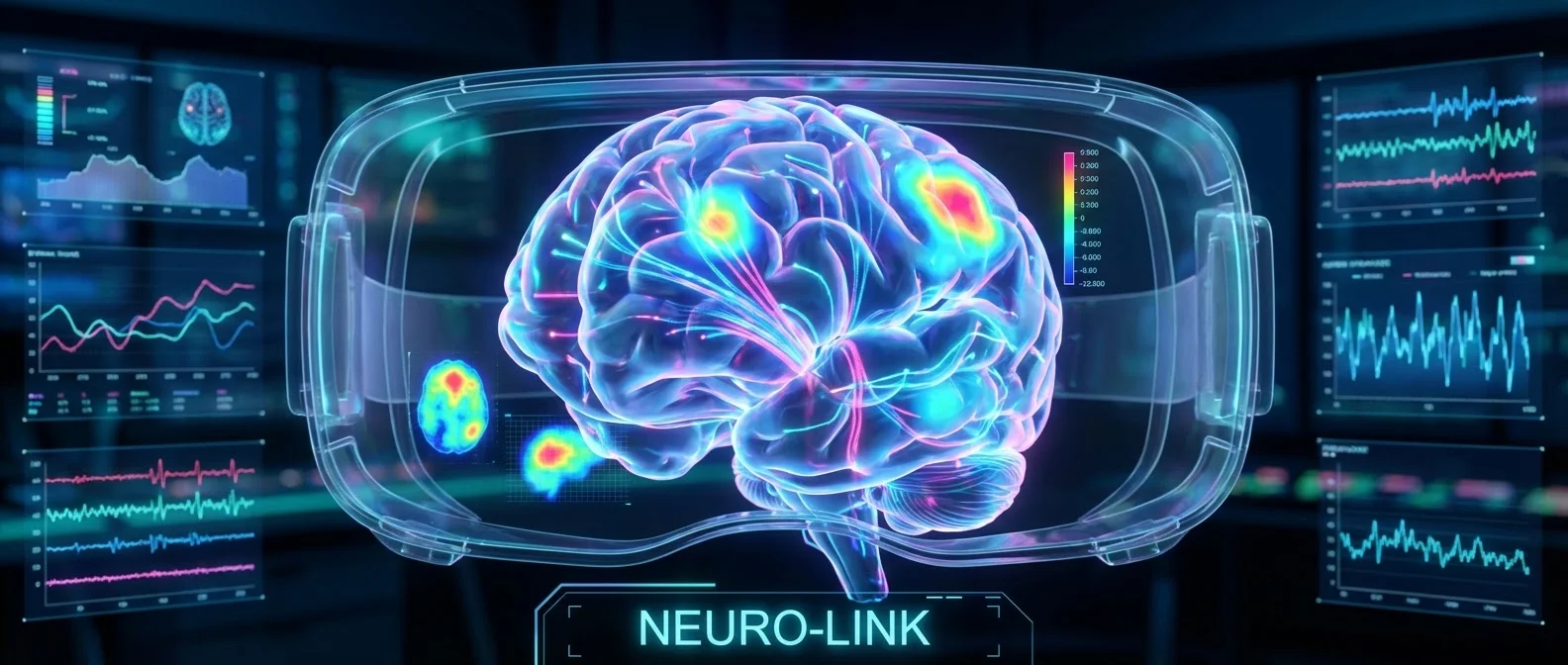
The convergence of neuroscience and VR is still in its early stages, but the trajectories are remarkable. The use of VR combined with fMRI and EEG allows researchers to observe the brain “in action” within virtual environments, rather than relying on the static stimuli (images, sounds) that dominated classical neuroscience.
Brain-computer interfaces (BCIs) promise the ability to control virtual worlds directly through brain activity, while galvanic vestibular stimulation could eventually “bridge” the gap between virtual motion and the vestibular system entirely. Simultaneously, the growing understanding of neuroplasticity is paving the way for VR-based physical rehabilitation, pain management, PTSD treatment, and even depression therapy.
The brain, ultimately, does not easily distinguish the real world from the virtual one. And this is not a weakness — it is the very ability that makes it such a remarkable machine, capable of learning, adapting, and redefining the boundaries of experience.