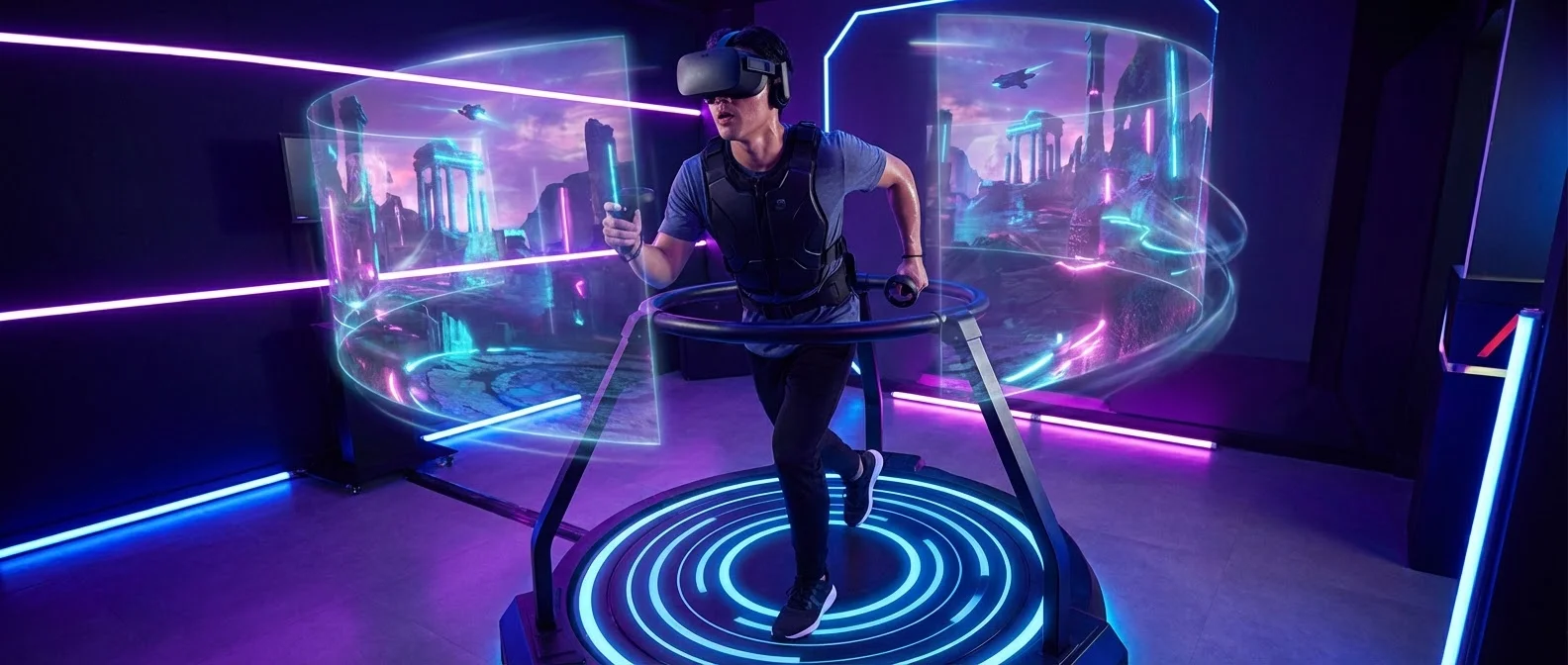
In VR games, movement typically happens via joystick or teleportation — both break immersion and can cause motion sickness. The solution has existed for over a decade: omnidirectional treadmills, platforms that let you walk, run, crouch, and jump inside the virtual world while staying in one spot in your room. In 2026, the technology has matured considerably — but price and space remain barriers. Let's look at what's available, how it works, and whether it's worth the investment.
📖 Read more: VR FPS: The 10 Best Shooting Games
⚙️ How a VR Treadmill Works
The term omnidirectional treadmill (ODT) describes a platform that allows movement in any direction — a full 360 degrees. Unlike a standard gym treadmill that only moves forward and back, an ODT enables movement in every direction. There are two fundamental approaches:
Passive Platform
Concave low-friction surface. You wear special shoes and slide — the platform itself doesn't move. Cheaper and more compact, but the sensation is less natural.
Active Surface
Motorized surface that actively moves you back to center. More natural gait, but enormous in size and extremely expensive — primarily for military and research use.
Harness vs Vest
Older ODTs use a waist ring (harness ring). Newer designs use a vest for greater arm freedom and a more natural range of motion.
In all cases, sensors (inertial or optical) on the shoes or feet track position, stride length, and movement speed. The data is translated into in-game locomotion in real time. The goal: turn physical walking into digital movement, without motion sickness.
🏆 Virtuix Omni: The Pioneer
The story of consumer VR treadmills essentially begins with Virtuix and founder Jan Goetgeluk. The original prototype debuted at E3 2013 alongside the Oculus Rift, immediately capturing community excitement. Palmer Luckey (Oculus founder) publicly endorsed the Kickstarter campaign, which raised $1.1 million (goal: $150,000) in just 3.5 hours.
📖 Read more: VR Physiotherapy: The Future of Rehabilitation
Goetgeluk also appeared on Shark Tank, asking $2M for 10% — the Sharks passed, but Mark Cuban invested after the episode aired. In total, Virtuix raised over $35 million from private and institutional investors.
The first Omni Pro (commercial version) began shipping in January 2016. It used a concave low-friction platform, a waist ring, and special shoes. Virtuix sold over 3,500 units to 500+ commercial locations worldwide. A treadmill based on the Omni's design even appeared in Steven Spielberg's Ready Player One (2018) — Virtuix provided a unit to the studio during production.
🎮 Omni Arena: Esports on a Treadmill
Omni Arena (2019) uses 4 Omni 2.0 platforms for multiplayer VR esports at entertainment venues. It features weekly and monthly competitions with an annual prize pool exceeding $100,000. The setup includes an automated staging area, social sharing stations, and a queuing app. The Omniverse management platform includes 24+ VR games optimized for arcade use.
🏠 Omni One: The Home Treadmill
In October 2020, Virtuix revealed the Omni One — its next generation, designed for home use. The key changes from the Pro:
- Vest instead of ring: the waist ring was removed in favor of a vest, providing much greater arm freedom
- New movements: supports crouching, kneeling, and jumping
- Standalone option: available as a bundle with a standalone VR headset — no PC required
- Smaller footprint: designed to fit in a normal room
Originally planned for 2021, the Omni One was significantly delayed — the first units shipped to investors in March 2023. Virtuix raised $11 million through SeedInvest in March 2021 to fund production.
📖 Read more: VR Sickness: Why You Get Dizzy and How to Avoid It
🆚 VR Treadmill Market: Who Sells What
Virtuix Omni One
- Type: Passive (concave platform)
- Support: Vest
- Movements: Walk, run, crouch, kneel, jump
- Headset: Standalone bundle
- Price: ~$2,595
- Market: USA
KAT Walk C2+
- Type: Passive (concave platform)
- Support: Harness ring
- Movements: Walk, run, strafe
- Headset: Compatible (SteamVR/Quest)
- Price: ~$1,299
- Market: USA, Europe, Asia
Cyberith Virtualizer Elite 2
- Type: Passive + haptic
- Support: Ring + harness
- Movements: Walk, run, crouch, jump
- Headset: SteamVR
- Price: ~$2,000+ (B2B)
- Market: Enterprise/Arcade
🔬 Military & Research Applications
Omnidirectional treadmills aren't just for gaming. The U.S. Army Research Laboratory uses active ODTs paired with CAVE (Cave Automatic Virtual Environment) graphics for military training — building-clearing exercises, navigation, and decision-making in virtual environments.
Virtuix itself lists military training as a core use case. The premise is that physical movement reinforces muscle memory and decision-making under pressure — something a controller or mouse can't replicate.
In medicine, ODTs are being researched for gait rehabilitation in patients with Parkinson's disease, stroke, and spinal cord injuries. A 2022 study used VR treadmill technology to detect early signs of Parkinson's through gait analysis.
⚠️ The Downsides: Why Not Everyone Has One
Price
From $1,300 to $2,600+ — more than an entire VR setup. Very few gamers can justify this investment.
Space
Even “compact” models need 1-2m² of permanent floor space. They don't fold away easily.
📖 Read more: 360° Photography: Complete VR Camera Guide 2026
Compatibility
They don't work out-of-the-box with every VR game. Many require custom mapping or modding.
Natural Feel
The sensation isn't exactly like real walking — you're sliding on a concave surface. It takes time to get used to.
🔮 The Future: Will They Go Mainstream?
The honest answer: unlikely, in their current form. VR treadmills remain niche hardware — excellent for arcades, military training, and hardcore VR enthusiasts, but far from mass adoption.
What could change the equation is a significant price drop (below $500 would be a game-changer), better compatibility (a universal SDK instead of per-game custom mapping), and more compact designs that can be stored in a closet.
Alternatively, redirected walking technology (tricking your brain into thinking you're walking straight while you're actually turning in a small space) and physical haptic suits may prove to be more practical long-term solutions. But for those who want the physical sensation of walking in VR right now — a treadmill remains the most convincing option.
“An omnidirectional treadmill based on the Omni's design played a prominent part in Steven Spielberg's movie adaptation of Ready Player One”
— Wikipedia, Virtuix Omni