Immersion: The Biggest Difference
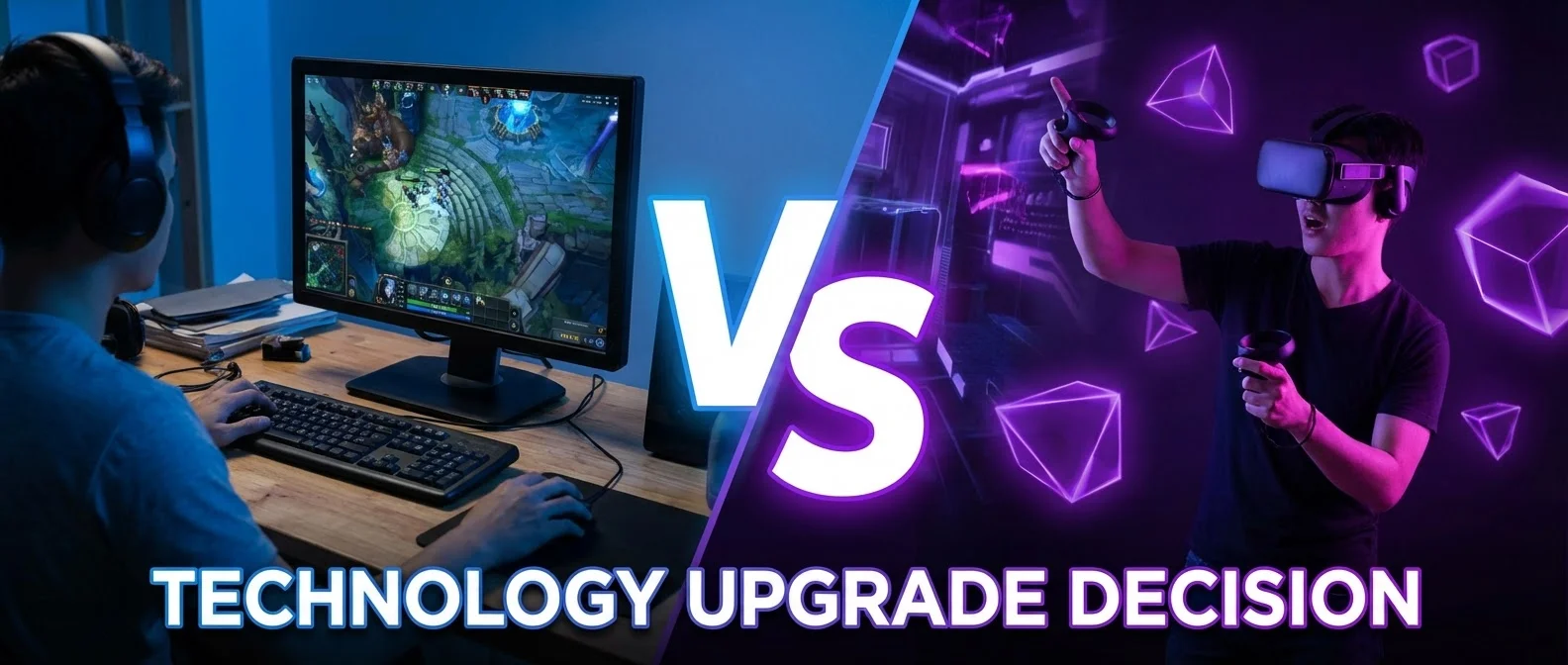
The core promise of VR gaming is immersion — and here it wins decisively. In flat gaming, you watch action on a screen. In VR, you're inside the action. You turn your head and see the world around you in 360°. You duck behind cover. You peer over a cliff edge and feel real vertigo.
That sense of presence — the illusion that you're actually there — is something no flat screen can reproduce, regardless of resolution or size. Horror games like Resident Evil 4 VR become genuinely terrifying, while racing sims with a wheel + VR headset deliver an experience that rivals actual track days.
On the flip side, flat gaming offers a more “relaxed” experience. You can sit on your couch, play for hours without fatigue, and enjoy equally captivating stories in titles like Baldur's Gate 3, The Witcher 3, or Elden Ring — just without the physical presence that VR provides.
Controls: Motion vs Gamepad
VR motion controls bring an entirely new level of interaction. Instead of pressing a button to aim, you physically raise your hand and point. Instead of hitting “reload,” you perform the real-world magazine swap. In Beat Saber, you slash cubes with your sabers. In Pavlov VR, you realistically handle weapons.
However, the precision and speed of a mouse + keyboard setup remain unmatched in competitive games. A pro FPS player is far faster with mouse flicks than with motion controller aiming. Traditional controls also excel in strategy games, city builders, and anything requiring many hotkeys.
VR Controls vs Flat Controls
Game Library: Quantity vs Quality
Here flat gaming wins hands-down on sheer numbers. Steam has over 50,000 titles, PlayStation and Xbox have decades-deep libraries, while the VR scene counts a few thousand titles — many of which are indie experiments or tech demos.
That said, VR game quality has improved dramatically. Titles like Half-Life: Alyx, Asgard's Wrath 2, Resident Evil 4 VR, and Batman: Arkham Shadow prove that AAA-quality VR gaming is now a reality. The Quest Store library grows steadily, with new titles every week.
Genres That Shine in VR
Horror
First-person VR horror is an experience beyond comparison. RE4 VR, Phasmophobia VR, Lies Beneath — you feel genuinely vulnerable inside the headset.
Rhythm
Beat Saber remains the king of VR gaming with countless custom songs. Synth Riders and Pistol Whip offer equally addictive alternatives.
Simulation
Microsoft Flight Simulator in VR puts you inside a real cockpit. Racing sims with VR + a wheel = the ultimate driving experience.
Tactical Shooters
Pavlov VR and Contractors deliver realistic combat. Physical magazine reloads, leaning behind cover, hand-to-hand combat.
Genres That Are Still Better Flat
Not every genre thrives in VR. Strategy games (Civilization, Total War) need overview cameras and complex menus that don't translate well to VR. MMORPGs like WoW or Final Fantasy XIV require long sessions that aren't practical with a headset. Story-driven RPGs spanning dozens of hours (Baldur's Gate 3, Persona) are more comfortable on a screen.
Graphics: 4K Flat vs VR Resolution
In graphics, flat gaming has a clear advantage. A modern GPU can run games at 4K resolution at 120–144fps with ray tracing on a massive OLED monitor. The image is crystal-clear, colors are stunning.
In VR, resolution is improving but still lags behind. The Quest 3 offers 2064×2208 pixels per eye — impressive, but due to lens proximity, you can still spot pixels in some scenes. PCVR on headsets like the Valve Index or Bigscreen Beyond upgrades visuals, but demands a powerful PC (RTX 4070 minimum for a good experience).
Bridging the Graphics Gap
Technologies like foveated rendering (high-quality rendering only where you're looking), DLSS/FSR upscaling for VR, and new pancake lenses are significantly narrowing the gap. Headsets in 2026–2027 are expected to reach retinal resolution (~60 PPD), eliminating the screen door effect.
Comfort & Motion Sickness
An often-underestimated factor is physical comfort. In flat gaming, you can play 6+ hours without an issue. In VR, things change:
Motion sickness affects a significant percentage of players, especially in games with smooth locomotion. Teleport movement options help but reduce immersion. Headset weight (Quest 3: ~515g) fatigues your neck after 1–2 hours. Sweating during intense games is a real problem — you need silicone face covers and good ventilation.
That said, many gamers report that tolerance improves with time. After 2–3 weeks of regular use, motion sickness decreases dramatically. Comfort accessories (head straps, counterweights, face gaskets) significantly improve the experience.
Cost Comparison
How Much Does Each Experience Cost?
It's worth noting that the Meta Quest 3 at ~$500 is the most affordable entry into VR gaming, requiring no external computer. If you already have a gaming PC, you can connect it via Air Link or a Link cable for a premium PCVR experience.
Social Gaming & Esports
On the social front, flat gaming has decades of tradition. Esports — League of Legends, Counter-Strike, Valorant — is an established billion-dollar industry. Discord, voice chat, and Twitch streaming all run on flat gaming infrastructure.
However, VR offers something unique: social presence. In platforms like VRChat, Rec Room, or Horizon Worlds, you feel like you're genuinely next to someone. Body tracking, gestures, and spatial audio create a sense of connection that no voice chat can match.
VR as Exercise
A unique VR advantage: you exercise while you play. One hour of Beat Saber on Expert+ burns 400–600 calories — roughly equal to a fairly intense run. Apps like FitXR and Les Mills Bodycombat VR offer structured fitness programs inside VR. Even casual games keep you on your feet.
This is something flat gaming simply cannot offer. Even if you use Ring Fit Adventure on Switch, the experience doesn't come close to VR's fitness gamification.
"VR doesn't replace traditional games — it complements them. Some days I want to relax with an RPG on my monitor; other days I want to feel like a pilot in DCS World in VR."
The Hybrid Approach: Best of Both Worlds
The most realistic way to enjoy gaming today is the hybrid approach. You don't need to choose exclusively VR or flat — you can have both:
Flat gaming for: lengthy RPG sessions, strategy games, competitive esports, couch casual gaming, multiplayer with friends in established titles.
VR gaming for: horror experiences, rhythm games & fitness, racing/flight sims, social VR platforms, short intense sessions.
Many games now support both modes. No Man's Sky, Elite Dangerous, Phasmophobia, Microsoft Flight Simulator, Project Cars, and Subnautica can all be played flat or in VR — depending on your mood.
Who Should Upgrade?
Definitely Yes
Simulation fans (flight, racing), rhythm game lovers, VR fitness enthusiasts, social gamers who crave presence, and horror gaming fans.
Maybe
Casual gamers looking for something new, FPS players curious about VR shooters, tech enthusiasts who want cutting-edge experiences.
Probably Not (Yet)
Competitive esports players (VR esports aren't mainstream yet), MMO addicts, strategy game fans, and those prone to motion sickness.
Top Tip
Try VR at a friend's place or a store before buying. The experience is very personal — some love it instantly, others need time to adjust.
Final Verdict
After years of evolution, VR gaming is no longer a gimmick — it's a genuinely unique gaming platform with experiences you can't find anywhere else. However, it does not replace flat gaming. The two work best together, each covering the other's weaknesses.
If you love horror, rhythm, simulation, or fitness games, a Quest 3 is worth the money. If you're looking for a full replacement for your gaming PC — not yet. The right answer isn't “VR or flat” — it's "VR and flat".
Looking Ahead
With headsets getting lighter, visuals improving rapidly (Apple Vision Pro, Quest 4 leaks), AAA VR exclusives multiplying, and technologies like eye tracking + foveated rendering maturing, 2026–2028 may be the era when VR gaming goes mainstream. Until then, enjoy the best of both worlds.