📖 Read more: VR Social: Social Life in Virtual Worlds
🌍 What Is VRChat
VRChat is an online virtual world platform created by Graham Gaylor and Jesse Joudrey, operated by VRChat Inc. It was initially released on January 16, 2014 as a Windows app for the Oculus Rift DK1, and entered Steam Early Access on February 1, 2017.
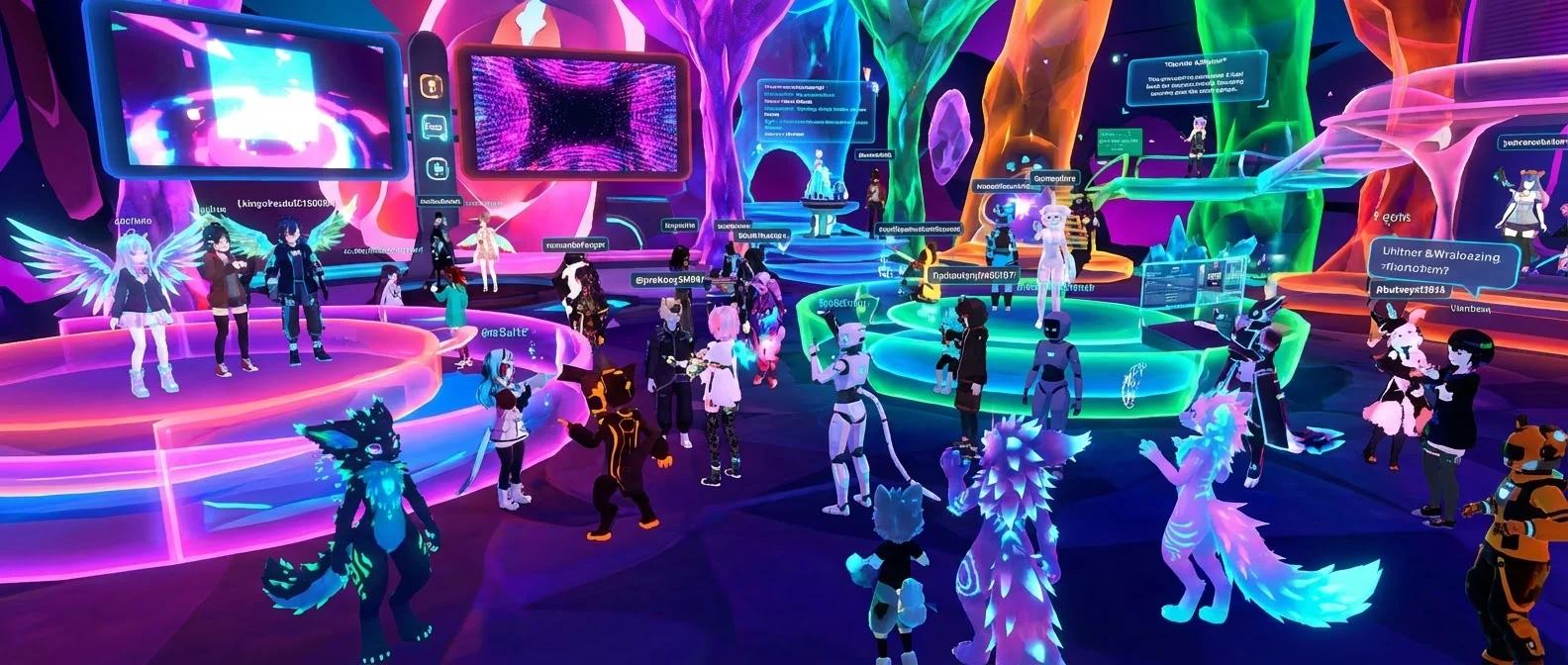
Its functionality resembles platforms like Second Life and Habbo Hotel: users enter virtual worlds created by other users, interact through 3D avatars, talk via voice chat, dance, attend events, or just hang out. It runs on the Unity engine and is completely free.
The platform saw tremendous growth during the COVID-19 pandemic. From 24,000 concurrent users on Halloween 2020 (boosted by the Quest 2 launch), it reached 40,000+ on New Year's Eve 2021 — so many that the security provider accidentally blocked the connection, mistaking it for a DDoS attack. By 2025, the platform consistently averaged ~120,000 users every weekend, and on New Year's Eve 2026 it broke every record with ~149,000 concurrent users.
Avatars
Create or download thousands of 3D avatars. From anime schoolgirls to robot warriors — your identity is your choice.
Worlds
Hundreds of thousands of user-generated worlds: nightclubs, art galleries, escape rooms, taverns, even entire MMO games.
Community
Live events, concerts, workshops, support groups. With 120K+ users every weekend, you always find company.
Creator Tools
Unity SDK, Udon visual programming, Creator Economy. Build, sell, and earn money from your creations.
🎭 Avatar System
Avatars in VRChat aren't just “icons” — they're full 3D models that mirror your movements in real time. They support lip syncing (mouth movement while talking), eye tracking, blinking, and with full-body tracking, your entire body movement is transferred to your avatar.
Avatar creation is quite a technical process — one uses external tools like Blender for 3D modeling and then uploads through VRChat's Unity SDK. However, only a small percentage of users create avatars — most are distributed for free or sold on marketplaces like Gumroad and Booth.
In May 2025, the Avatar Marketplace launched — an official in-platform store where you can purchase premium public avatars using VRChat Credits. At launch, it even included officially licensed avatars, such as Quill from the game Moss.
Avatars support finger tracking with controllers like the Valve Index Controllers (each finger independently) and Oculus Touch. For full-body tracking, options include Vive Trackers, SlimeVR (IMU-based), and even Kinect.
📖 Read more: Gorilla Tag: Why It's the Most Popular Free VR Game
🗺️ Worlds and Content Creation
Everything you see in VRChat was built almost exclusively by users. Worlds range from simple chat rooms to complex interactive games, virtual music nightclubs, art galleries, haunted houses, and much more.
In 2020, VRChat Inc. introduced Udon — a visual programming language based on a node graph system. It allows world creators to add interactivity, mini-games, portals, scoreboards, and more. For more advanced users, there's UdonSharp, a source-to-source compiler that allows writing code in C#.
Since 2022, there's the VRChat Creator Companion (VCC) — an application for managing Unity installations, projects, and packages. The old VRChat SDK2 was deprecated in February 2023, with SDK 3.x (Udon-based) becoming mandatory for all new content.
📊 VRChat vs Competition
🤝 Community and Events
VRChat's community is remarkably diverse. The platform hosts virtual nightclubs (Loner Online, inspired by Akihabara's Mogra nightclub, even recreates bathroom stalls), music festivals, dance performances, art exhibitions, and even film festivals.
In June 2020, French musician Jean-Michel Jarre presented “Alone Together” on VRChat. On December 31, 2020, he followed with "Welcome to the Other Side" — a virtual concert inside a virtual replica of Notre-Dame, broadcast on radio, television, and online platforms. British drum'n'bass producer Muzz performed a virtual tour on VRChat through the SlyFest festival in 2021.
Japanese company Hikky organizes Virtual Market (VKet) events — virtual conventions for selling digital assets, with sponsors like Bandai Namco, Disney, HP, and East Japan Railway. The furry convention Furality has been hosted on VRChat since 2020 — its 9th edition in 2025 (Furality Somna) set a record with 26,000+ registered participants and raised over $109,000 for charity.
Notable is the LGBTQ+ community, as avatars allow many to freely express their gender identity in a safe environment. Trans Academy — a support group for transgender users — had over 36,000 members as of December 2024.
💰 Creator Economy & Avatar Marketplace
In May 2023, VRChat launched the Creator Economy — a monetization system based on VRChat Credits (digital currency). Eligible groups can offer subscriptions to their supporters, granting access to VIP rooms, exclusive cosmetics, and in-game features. 50% of revenue goes to the creator.
Since May 2025, the Avatar Marketplace also operates — an in-platform store for premium avatars, including officially licensed characters. Creators, fashion designers, and artists can now sell their work directly to hundreds of thousands of users.
📖 Read more: Metaverse 2026: What Happened to the Big Promise
📱 Platforms and Access
VRChat is available across an impressive range of platforms:
- PC VR: SteamVR (HTC Vive, Valve Index, etc.), Meta Quest via Link/Virtual Desktop, Oculus Rift
- Standalone VR: Meta Quest 2 and newer, PICO 4 (since November 2023), HTC Vive XR Elite (since December 2023)
- Desktop Mode: Windows PC without a VR headset, using mouse/keyboard or gamepad
- Mobile: Android and iOS (full release October 24, 2025) — touchscreen controls, social features, push notifications from groups
Cross-platform play means users on VR, desktop, and mobile share the same worlds. However, due to hardware limitations, content for mobile platforms must be optimized within specific constraints.
The premium VRC+ (VRChat Plus) subscription offers extra slots for favorite avatars, profile photos, custom emojis/stickers, UI themes, and since March 2025: virtual camera dolly, flyable camera drone, and Selfie Expression — a feature that enables face tracking via webcam even without a VR headset.
🛡️ Trust System and Safety
VRChat uses a Trust Ranks system — users are automatically classified based on time spent on the platform, number of friends, and content uploaded. Higher ranks unlock more avatar features (animations, particle effects, etc.) that could be disruptive if used by new users.
Moderation is handled by users themselves through a votekick system — if someone is disruptive, anyone can initiate a vote to remove them. User-created groups can set rules and assign moderators.
In September 2023, a Content Gating system was added: avatars and worlds can be flagged for adult content, suggestive content, violence, or extreme horror. For users under 18, all flagged content is automatically blocked. Since January 2025, there's also opt-in age verification through third-party provider Persona, available to VRC+ subscribers.
"VRChat isn't just a game — it's a parallel world. Here, people create, connect, and express themselves freely. It's our closest definition of the metaverse."
🚀 How to Get Started
If you want to try VRChat today, follow these steps:
- Download for free: From Steam (Windows), Meta Quest Store, PICO Store, Google Play, or App Store
- Create an account: You can make a VRChat account or use Meta/Steam login
- Choose an avatar: Start with default avatars or visit avatar worlds for thousands of free options
- Explore: Go to the “Worlds” menu and search for popular worlds — the “Featured” and “Hot” tabs are an ideal starting point
- Make friends: Don't be afraid to talk! The community is generally friendly — and if you prefer not to speak, that's fine too. Many users ("mutes") communicate solely through gestures
- Safety: Adjust your Safety settings — you can block sounds, particle effects, and avatars based on Trust Rank
With a VR headset (Quest 3S from $299, or PC VR), the experience changes dramatically — your hands move, you can look around naturally, and social interactions gain a sense of presence unlike anything else on the internet. But even desktop or mobile mode is enough to discover why hundreds of thousands of users log in every day.