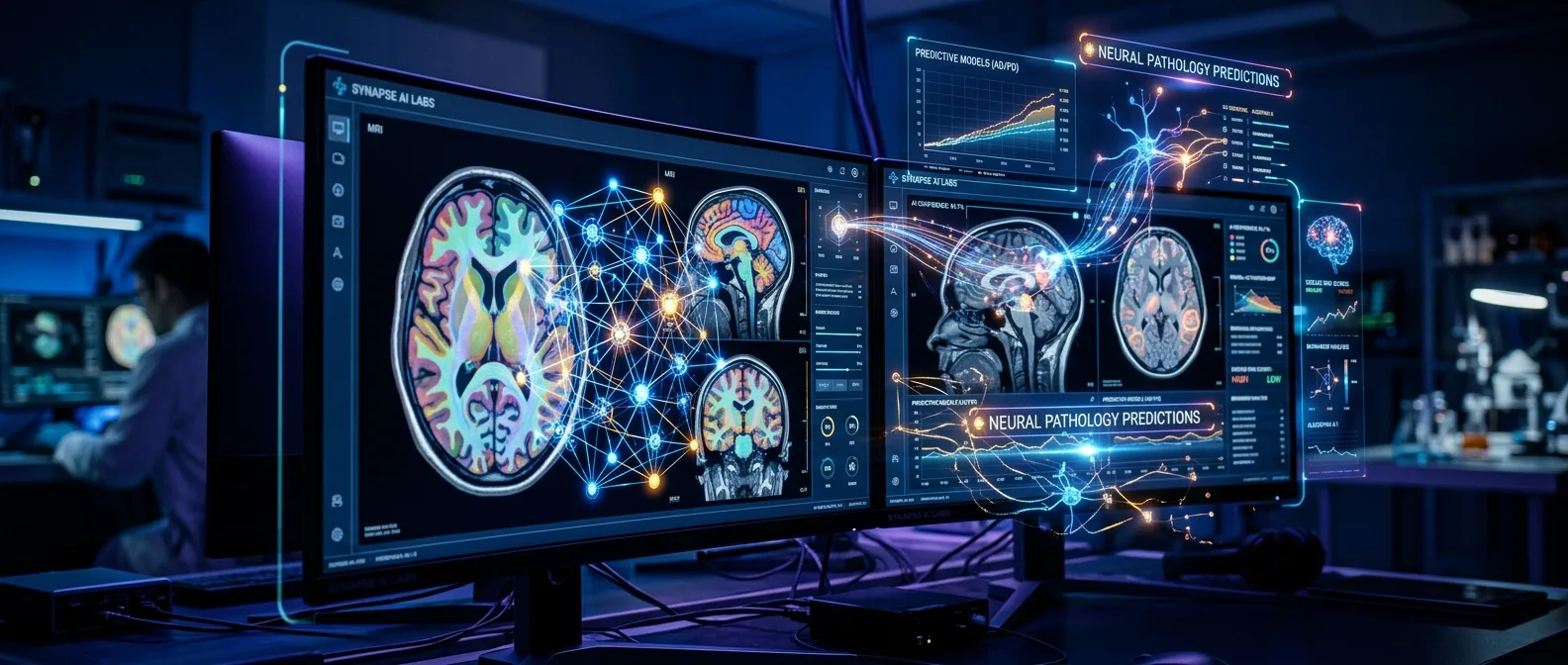
Three chips in a laptop equals superbrain? Try 48,900 brain MRI scans fed into one algorithm. Harvard Medical School and Mass General Brigham just dropped BrainIAC — a foundation model that diagnoses 10 neurological conditions from Alzheimer's to brain cancer using nothing but standard magnetic resonance imaging. One scan. Ten diseases. What does this mean for medical diagnosis in 2026?
🧠 BrainIAC Foundation Model: From Images to Predictions
BrainIAC (Brain Imaging Adaptive Core) isn't just another brain scan analysis tool. It's a foundation model — technology that resembles OpenAI's GPT more than the narrow-application AI systems we know from medicine. What makes it different?
Instead of training on pre-labeled data where some doctor has marked "tumor here," BrainIAC uses self-supervised learning. It trains itself on unlabeled data, recognizing patterns and connections in brain tissue that we might not have discovered yet.
The DNA of Foundation Models
Traditional AI models are like specialist doctors — they know a lot about one area. BrainIAC is like a pathologist with experience across everything. Thanks to its foundation model structure, it can adapt to new tasks with minimal additional training.
"We find that BrainIAC consistently outperforms traditional supervised models," reports Benjamin Kann, lead researcher at Dana-Farber Cancer Institute. And it does so with "minimal fine-tuning" — meaning it doesn't need months of additional programming for each new application.
📊 What Can BrainIAC Actually Predict?
BrainIAC scans for everything from brain tumors to stroke risk. The system analyzes:
- Brain age — Calculates how "aged" your brain is relative to chronological age
- Dementia and Alzheimer's — Detects early signs of neurodegenerative diseases
- Stroke risk — Predicts "time-to-stroke," essentially when it might happen
- Brain cancer — Identifies glioblastomas and other tumor types
- Genetic mutations — Detects IDH mutations that help categorize tumors
- Survival rates — Estimates life expectancy in brain cancer patients
Impressive detail: BrainIAC simultaneously analyzes T1-weighted, T2-weighted, FLAIR, and contrast-enhanced MRI sequences — all the basic "visual" angles neurologists use.
How Does "Self-Training" Work?
Imagine a child learning to recognize faces without anyone explaining what eyes and mouths are. They just see thousands of photos and figure out the patterns. That's how BrainIAC works — it takes random regions from MRI scans, compares them to each other, and gradually builds a "grammar" of brain tissue.
BrainIAC builds internal maps of brain tissue patterns without human guidance.
⚡ Comparison with Traditional Methods
When researchers tested BrainIAC against other AI models, the results were clear. Especially in few-shot learning scenarios — when the system has very few samples for training.
"BrainIAC achieves higher accuracy even when training data is limited"
— Benjamin Kann, Harvard Medical School
What does this mean practically? It can be developed for rare diseases or regions where thousands of labeled MRIs don't exist for training. BrainIAC learns fast and applies its knowledge to new situations.
The Robustness Test
A major problem with medical AI is that it "breaks" when data comes from different hospitals or MRI machines. Researchers tested BrainIAC with various image distortions — contrast changes, Gibbs ringing artifacts, bias field distortions.
BrainIAC remained "stable" while other models showed significant performance drops. This robustness is critical for real clinical applications where every hospital has different equipment.
🔬 Technical Details and Architecture
BrainIAC is built on Vision Transformer architecture — the same technology used by the most advanced computer vision systems. It uses SimCLR framework for contrastive learning, meaning it learns to distinguish different patterns in images.
Training Data
32,015 multiparametric brain MRI from 16 datasets covering 10 different neurological conditions
Architecture
Vision Transformer with SimCLR contrastive learning for 3D MRI volume analysis
Adaptation
End-to-end fine-tuning with minimal labeled data for new tasks
What Does It See in Images?
Through saliency visualization, researchers examined which brain regions BrainIAC "looks at" for each diagnosis. The results are anatomically logical:
- Cognitive disorders: Focuses on the hippocampus
- Brain age: Analyzes periventricular white matter
- Tumors: Concentrates on tumor regions
In other words, BrainIAC doesn't make "magical" predictions — it follows neuro-anatomically logical processes that an experienced radiologist would follow.
🏥 Clinical Applications and Future Capabilities
BrainIAC could function as a "triage tool" in community hospitals that don't have specialized neuro-radiologists. Every patient getting a brain MRI could automatically receive risk assessments for multiple conditions.
Picture this: You go in for a routine checkup, get an MRI, and simultaneously learn your brain age, Alzheimer's risk over the next 5 years, and whether there are early signs of vascular problems.
Democratizing diagnosis: BrainIAC's biggest advantage is that it doesn't need specialized datasets from every hospital. It can be "transferred" anywhere with minimal adaptation.
Limitations and Challenges
BrainIAC has its limits too. It only works with structural MRI sequences — it doesn't include diffusion imaging, functional MRI, or other advanced techniques. Also, it only analyzes skull-stripped images, so it needs preprocessing.
Researchers plan to integrate omics data and clinical information to create a multimodal system. But that means more complexity — and more opportunities for errors.
🎯 The Next Phase of Medical AI
2026 appears to be the year of "Generalist Biomedical AI" systems. BrainIAC is just the beginning — similar foundation models are expected for cardiology, oncology, and other specialties.
The philosophy is changing: From "one AI for each problem" to "one AI for all problems." This will lead to more efficient development, but also greater dependence on a few, very powerful systems.
BrainIAC can be integrated into imaging pipelines and multimodal frameworks and may lead to improved biomarker discovery
— Harvard Research Team
Regulatory Gap
The biggest obstacle isn't technological — it's regulatory. How do you approve an AI that makes 10 different diagnoses? Which authority has the knowledge to evaluate such a system?
Researchers mention they're preparing "prospective validation trials" — real-time tests with real patients. Only then will we know if the impressive numbers from papers translate to better diagnoses.
🧩 Bottom Line: AI That Thinks Like a Doctor
BrainIAC represents a shift from single-purpose medical AI to systems that examine multiple conditions simultaneously. Instead of focusing on one disease, it examines the entire brain "landscape" and identifies multiple problems simultaneously.
It's a step toward preventive medicine — where we'll learn about diseases years before they show symptoms. But it's also a step toward a world where diagnoses depend on a few, very powerful AI systems.
The question isn't whether such tools will be adopted — but how quickly doctors will embrace them, and what happens when these systems start seeing patterns we don't understand yet.