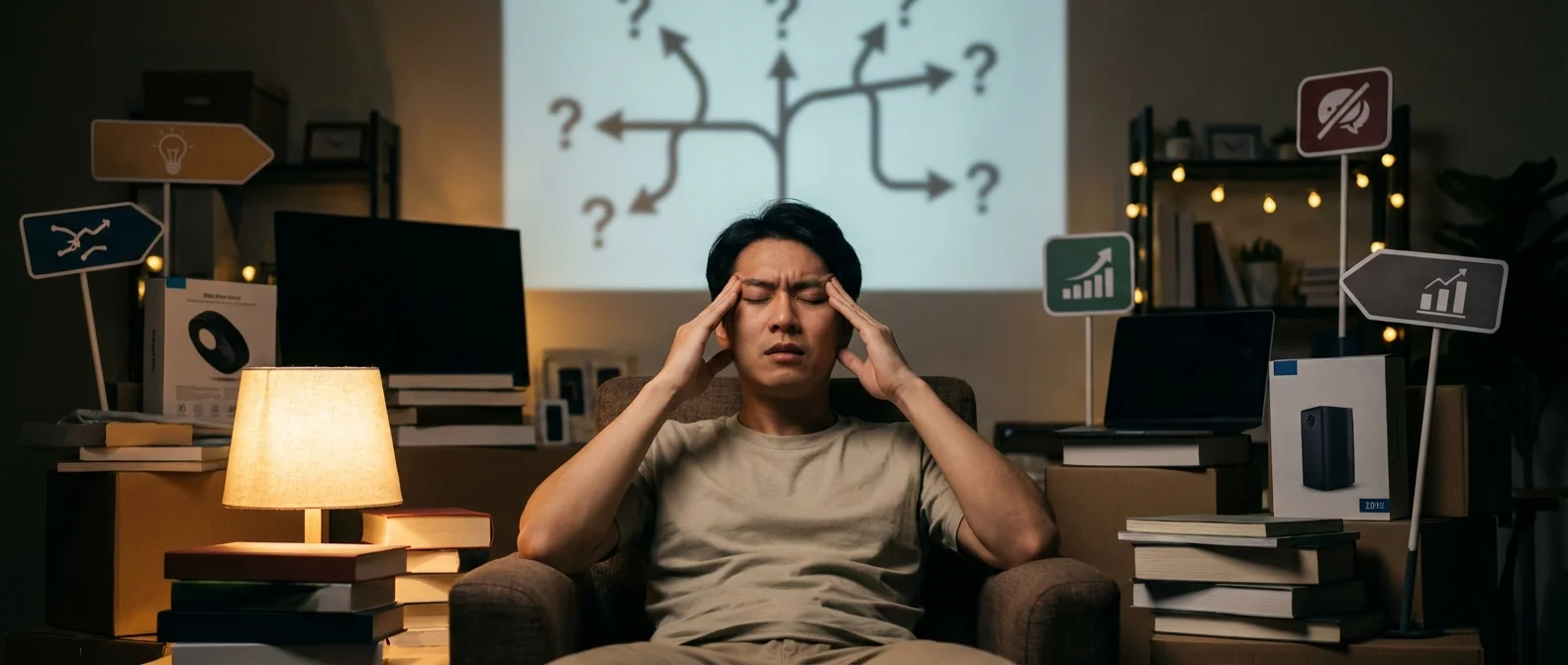
What should I wear? What should I eat? Should I reply now or later? Gym or couch? Every day you make thousands of decisions — and each one drains your brain a little more. This isn't just a feeling. It's biochemistry. And science now knows exactly what happens inside your head when the “battery runs out.”
📖 Read more: Dopamine Fast: The Brain Reset Technique
Your Brain Battery Is Draining
Think of your brain as a battery. In the morning, it's full. Every decision — even the most trivial — consumes energy. By evening, the battery is nearly empty. The result? You choose what's easy, what's familiar, or you simply avoid deciding at all.
Glutamate: The Toxic Substance of Fatigue
A study from the Paris Brain Institute (2022), published in Current Biology, revealed what exactly happens in the brain after hours of intense cognitive work. In 40 participants who performed demanding cognitive tasks for 6.5 hours, researchers found accumulation of glutamate — a neurotransmitter that becomes toxic in large quantities — in the lateral prefrontal cortex (LPFC), the region that controls decision-making.
The group that performed the difficult tasks preferred easy, short-term rewards at the end of the day — proving that mental fatigue literally changes the way you decide.
📖 Read more: Flow State: How to Enter the Zone of Peak Performance
Judges, Doctors, and Bad Decisions
Decision fatigue isn't just about what to eat for dinner. It affects lives.
Similar findings in clinics: doctors at the end of their shift prescribe more unnecessary antibiotics — because the safe choice (prescribe medication) requires no thought.
📖 Read more: Music & Psychology: How Sounds Change Your Mood
The Jam Experiment
In 2000, psychologists Sheena Iyengar and Mark Lepper ran an experiment at a supermarket. They set up a jam-tasting table — once with 6 flavors, once with 24.
This was named "The Paradox of Choice" by Barry Schwartz: the more options you have, the harder it is to decide, the less satisfied you feel, and the more often you regret.
Why Steve Jobs Always Wore the Same Clothes
Steve Jobs, Mark Zuckerberg, and Barack Obama almost always wore the same outfits. It wasn't laziness — it was strategy. By removing trivial decisions (what to wear, what to eat for breakfast), they were "saving" decision energy for serious matters. Psychologist Daniel Kahneman calls this strategy “offloading to System 1” — letting automatic habits handle the trivial stuff.
📖 Read more: Bipolar Disorder: What You Need to Know
6 Techniques Against Decision Fatigue
The brain is most rested early on. Don't waste energy on emails and trivia before the important stuff.
Create a weekly breakfast menu, a capsule wardrobe, automate recurring tasks. Every eliminated decision = energy gained.
Nobel laureate Herbert Simon suggested: instead of searching for perfection, choose what's “good enough.” Satisfaction increases dramatically.
The brain consumes glucose with every decision. A study showed judges who just ate were 65% more “generous” in their rulings.
Sleep clears glutamate from the brain. It literally “flushes out” the toxin that blocks your thinking.
Air traffic controllers only work 2 hours before taking a 30-minute break. Your brain needs the same.
Decision fatigue doesn't mean you're weak — it means you're human. Your brain wasn't designed for 35,000 decisions a day. By reducing trivial choices, you protect your energy for the ones that matter. And if you need to make an important decision at the end of a tiring day — sleep on it. Literally.
1. Wiehler A et al. (2022). A neuro-metabolic account of why daylong cognitive work alters the control of economic decisions, Current Biology, DOI: 10.1016/j.cub.2022.07.010
2. Danziger S, Levav J, Avnaim-Pesso L (2011). Extraneous factors in judicial decisions, PNAS, DOI: 10.1073/pnas.1018033108
3. Iyengar SS, Lepper MR (2000). When choice is demotivating, J. Personality and Social Psychology, DOI: 10.1037/0022-3514.79.6.995
4. Schwartz B (2004). The Paradox of Choice: Why More Is Less, HarperCollins.