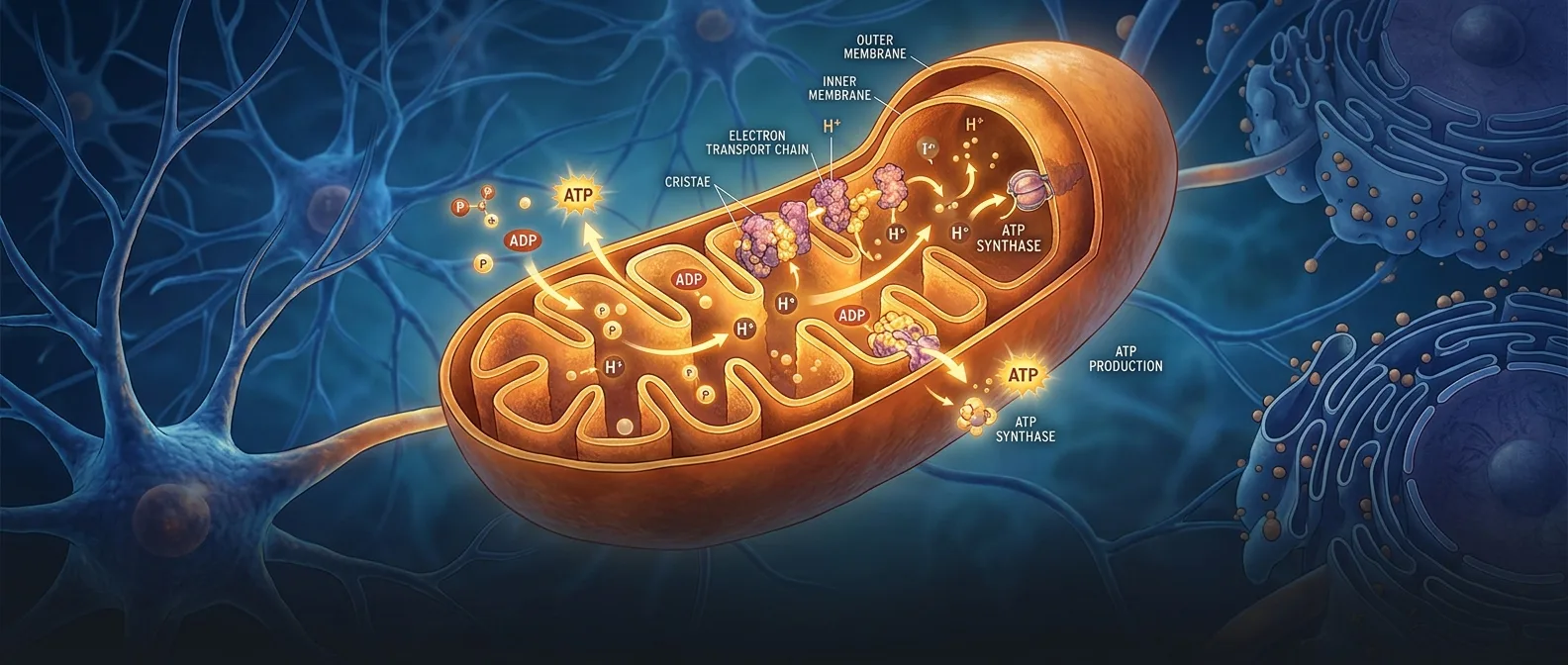
A massive spike in ATP production at the cellular level. No, that's not what you'd expect to find in the brain of someone with depression. Yet new 2026 research from the University of Queensland reveals that brain cells in young adults with major depressive disorder (MDD) pump out more energy molecules at rest — but crash when they actually need to perform.
Think of a car engine revving at redline while parked. Sounds powerful, but when you actually hit the gas, there's nowhere left to go. The research points to depression as a fundamental breakdown in how cells manage energy — not just the "chemical imbalance" we've long assumed.
🔬 ATP and the Brain's Energy Crisis
ATP (adenosine triphosphate) is the "energy currency" of every cell. In the new study, 18 participants aged 18-25 with diagnosed depression underwent brain scans and blood tests. The results were startling: their cells showed ATP overproduction at rest, but reduced ability to respond to stress.
⚡ The Cellular Stress Paradox
Dr. Roger Varela from the Queensland Brain Institute describes the phenomenon in terms that make the science accessible: "It's like the cells are working overtime early in the disease, which could lead to long-term problems."
The finding contradicts what we'd expect. We'd normally expect lower energy production in people with depression — after all, fatigue is one of the most common symptoms. Instead, the mitochondria appear locked in a state of constant alarm.
What This Means for Depression Diagnosis
The research, published in Translational Psychiatry, is the first to identify the same ATP patterns in both brain and blood. This opens the door to a potential biological diagnosis of depression through a simple blood test.
Imagine: instead of subjective questionnaires, a test that measures cellular energy. It would be game-changing for early diagnosis — especially in young adults where symptoms might be dismissed as a "phase."
🧬 Mitochondria: The Factories Running on Empty
Every cell hosts hundreds or thousands of mitochondria. These microscopic "batteries" handle ATP production — without them, we'd simply stop functioning.
The brain is particularly vulnerable to mitochondrial dysfunction. Despite making up just 2% of body weight, it consumes roughly 20% of total energy. A single neuron at rest burns through about 5 billion ATP molecules per second — an incredibly intensive process.
The "Mitochondrial Allostatic Load" Model
The new research strengthens a theory that's gained traction in recent years: "mitochondrial allostatic load." According to this model, chronic stress causes mitochondrial fragmentation, reactive oxygen species production, and damage to mitochondrial DNA.
It's a vicious cycle: mitochondria trying to meet increased demands eventually collapse, leaving the brain without the energy it needs for normal function.
📊 New Data, Old Problems
The innovation here isn't just in the findings, but in the methodology. Researchers used 31P magnetic resonance at 7 Tesla — an advanced technique that allows real-time observation of energy production.
The same energy disruptions in brain cells also appeared in blood cells. This suggests depression isn't just "in your head" — it's a systemic problem affecting the entire body.
"This shows that multiple changes are happening in the body, including the brain and blood, and that depression affects energy at the cellular level."
Dr. Roger Varela, Queensland Brain Institute
The Fatigue Connection
Fatigue in depression isn't simple tiredness or laziness — it's biological reality. Researchers found direct correlation between ATP levels and scores on the Fatigue Severity Scale.
The higher the mitochondrial "overdrive" at rest, the more intense the feeling of exhaustion. Makes sense: if your cells are burning energy constantly, where do they find more when you actually need it?
🔬 Toward New Treatment Approaches
If depression begins at the cellular level, then maybe treatments need to target there too. Associate Professor Susannah Tye expresses hope that this discovery will lead to "early intervention and more targeted therapies."
What could this mean practically?
Blood-Based Diagnosis
Simple test measuring cellular energy balance instead of subjective symptoms.
Mitochondrial Pharmacotherapy
Drugs targeting mitochondrial function improvement directly.
Personalized Medicine
Treatments adapted to each patient's specific energy profile.
How We See Depression Differently
The piece with perhaps the biggest social impact is changing how we perceive depression. When we can see biological changes at the cellular level, it becomes harder to dismiss depression as "character weakness."
"It proves that not all depressions are the same," Dr. Varela notes. "Each patient has different biology, and each patient is affected differently."
🎯 Questions That Remain
Despite the enthusiastic reception, the research raises as many questions as it answers. Why does this energy dysfunction occur? Is it cause or consequence of depression?
The researchers' hypothesis is that it's a compensatory mechanism appearing in early disease stages. Mitochondria try to cover increased energy demands created by stress or inflammation, but eventually burn out.
Study Limitations
Eighteen people — a relatively small number for such significant conclusions. And all young adults, so we don't know if the phenomenon applies to other age groups.
The research also examined only the visual cortex region of the brain. Areas directly related to mood — like the prefrontal cortex and hippocampus — might show different patterns.
🧪 The Future of Mental Health
If the theory holds up in larger studies, it will fundamentally change how we approach depression. Imagine a world where:
- Diagnosis happens with a 24-hour blood test
- Drugs target mitochondrial function directly
- Prevention begins before symptoms appear
- Treatment is personalized based on energy profiles
The research gives millions of people confirmation that what they feel is real, measurable, and treatable. Whether this energy theory will transform depression treatment remains to be tested in larger studies.