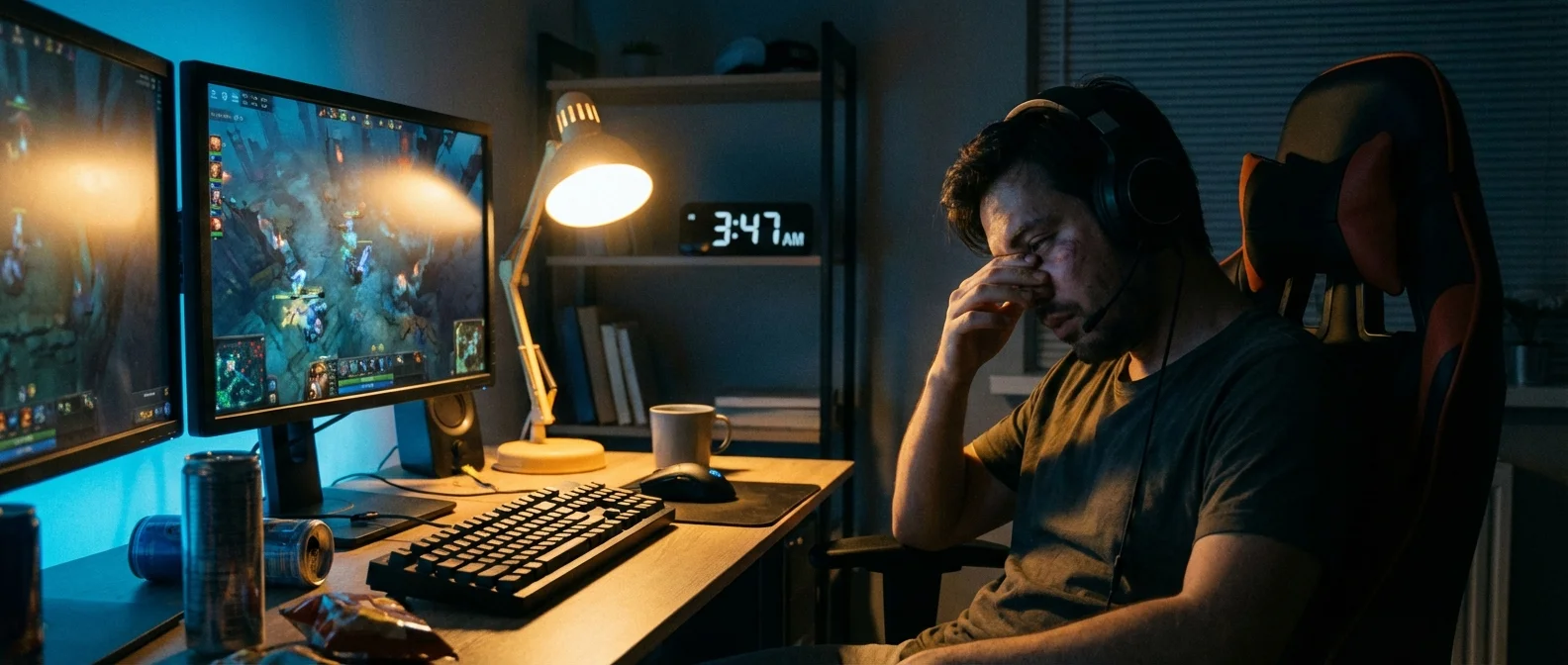
Video games are not the enemy. Millions of people play daily without any issues — they learn, socialize, relax. But for a small percentage, gaming becomes an obsession: hours are lost, relationships crumble, careers suffer. Where's the line between a hobby and an addiction?
📖 Read more: Dopamine & Your Phone: How Screens Make You Addicted
Gaming Disorder: The Official Recognition
In June 2018, the World Health Organization (WHO) added “Gaming Disorder” to the revised International Classification of Diseases (ICD-11), which came into effect in January 2022. This means gaming addiction is now recognized as an official mental health disorder.
The decision wasn't uncontested. The American Psychiatric Association (APA) hasn't yet included Internet Gaming Disorder as a full diagnosis in the DSM-5 — placing it in the “conditions for further study” category. However, clinical reality clearly shows that some people do lose control.
The 3 Diagnostic Criteria (ICD-11)
According to the WHO, Gaming Disorder requires all 3 criteria to be met for at least 12 months:
Loss of Control
Inability to control the frequency, intensity, duration, termination, and context of gaming. “I'll play for 30 minutes” becomes 5 hours — again and again.
Increasing Priority
Gaming takes precedence over other interests and daily activities. Food, sleep, work, relationships — everything comes second.
Continuation Despite Negative Consequences
You continue playing despite seeing the damage: lost job, destroyed relationships, physical problems. And you can't stop.
⚠️ Important Clarification
Playing many hours doesn't automatically mean addiction. A professional gamer or streamer may play 10+ hours/day without meeting the criteria. The key is loss of control and negative consequences in life.
Where Do You Stand? The Gaming Spectrum
Characteristics: You play for relaxation, socializing, or fun. You stop easily. Your life isn't affected. You have other interests. This is not a problem.
Characteristics: You play more than planned. You start ignoring obligations. You feel restless when you can't play. Sleep is affected. Time for self-awareness.
Characteristics: Significant decline at school/work. Relationship tensions. Physical problems (pain, insomnia). You try to cut back but fail. You may need help.
Characteristics: Complete loss of control. Inability to stop despite serious consequences. Isolation, depression, inability to function daily. Seek professional help.
The Psychology Behind Addiction: Why Do We Get “Hooked”?
Video games aren't addictive by chance. They're designed using psychological principles to maximize engagement. Researchers like Przybylski, Rigby & Ryan (Self-Determination Theory, 2006) explain that games satisfy 3 core psychological needs:
Sense of Competence
Level ups, achievements, leaderboards — the game gives clear feedback that you're improving. In real life, progress is vague.
Social Connection
Guilds, clans, co-op missions — especially in MMOs, you find community, you belong somewhere, someone needs you.
Sense of Autonomy
Open worlds, character customization, freedom of choice — in the game, you control your destiny. In life? Not always.
Variable Rewards
Loot boxes, random drops, gacha mechanics — the brain “fires” dopamine at unpredictable rewards, just like gambling.
FOMO & Daily Rewards
Daily log-in bonuses, limited-time events, battle passes — if you don't log in today, you miss out. The pressure is by design.
Sunk Cost Fallacy
"I've put in 2,000 hours, I can't stop now." The illusion that invested time/money justifies continuing.
📖 Read more: Love Bombing: The Dark Side of Excessive Love
The Role of Dopamine
A neuroscience study by Koepp et al. (1998, Nature) — one of the first to use PET scans during gaming — showed that video games increase dopamine levels in the striatum by approximately 100% — an increase comparable to that of psychostimulant substances.
However, the relationship isn't linear. More recent studies (Weinstein, 2017; Dong et al., 2020) show that in addicted gamers:
- Baseline dopamine is lower — they feel less pleasure in everyday life
- D2 receptors decrease — they need more gaming to “feel” something
- The prefrontal cortex underperforms — reduced impulse control ability
This pattern is nearly identical to what's observed in substance use disorder.
Which Games Are Most Addictive?
Not all games are equally addictive. According to research in Computers in Human Behavior (2021), the most “risky” genres are:
- MMORPGs (World of Warcraft, Final Fantasy XIV) — endless endgame, guild social pressure, sunk cost
- Battle Royale (Fortnite, PUBG, Apex) — short cycles, “just one more game”, dopamine of winning
- MOBAs (League of Legends, Dota 2) — ranked ladder, feeling of needing to “climb rank”
- Gacha/Mobile (Genshin Impact, Clash Royale) — loot boxes, microtransactions, FOMO events
- Sandbox/Survival (Minecraft, Rust) — “just a bit more”, endless building
Single-player/story-driven games (e.g., The Witcher, Red Dead Redemption 2) tend to be less addictive — they have an ending, no social pressure, and don't use FOMO mechanics.
Self-Assessment: 9 Key Questions
🎮 Do You Have Gaming Disorder?
Based on the Internet Gaming Disorder Test criteria (IGD-20, Pontes et al., 2014). Answer honestly:
5+ “Yes” = Strong indication of Gaming Disorder. Professional evaluation recommended.
3-4 “Yes” = Signs of risky use. Self-monitoring is worthwhile.
0-2 “Yes” = Likely healthy use.
Treatment & Recovery
If you want to set your own boundaries:
- Use timers: Set a timer before starting. When it goes off, you stop — no exceptions.
- Remove triggers: Uninstall the most addictive games. Keep story-driven/offline titles.
- Replace, don't remove: If gaming fulfills a social need, find an alternative — sports, board games, meetups.
- Relocate the device: Don't sleep in the same room as your PC/console. Easy access increases use.
- Track usage: Keep a gaming diary. Self-awareness is the first step to change.
Professional treatment:
According to a meta-analysis in Clinical Psychology Review (Stevens et al., 2021), the most effective approaches are:
- CBT (Cognitive Behavioral Therapy): Changes automatic thought patterns ("I need to play to relax")
- Motivational Interviewing: Helps the gamer find their own motivation for change
- Family therapy: Especially for teens — family dynamics play a role
- Mindfulness-based therapy: Training in noticing urges without acting on them
For Parents: Managing Your Child's Gaming
🚫 What NOT to do:
- Throw away/break the device — causes anger, not change
- Use games as punishment/reward — makes them more valuable
- Say “stop, they're not important” — you're dismissing something that IS important to them
- Ignore the signs because “they're just games”
✅ What you SHOULD do:
- Understand what they play: Sit with them, ask, show interest
- Set limits TOGETHER: Agree on rules together — ownership, not enforcement
- Suggest alternatives: Don't remove without offering something instead
- Be a role model: How much time do YOU spend on your phone?
- Seek help: If they won't listen, if they withdraw, if they become aggressive — speak to a professional
Conclusion
Video games are one of the most popular forms of entertainment in the world — and rightfully so. They offer experiences, community, and creativity. But like any pleasure, they can become a problem when control is lost.
If you recognize yourself in some of the signs above, don't be ashamed. You're not “weak” — your brain is simply responding to a system designed to keep you engaged. Self-awareness is the first step.
The question isn't “how much do you play” but “do you control the game, or does it control you?”
📚 Sources & References
- World Health Organization (2022). ICD-11: Gaming Disorder (6C51).
- Przybylski, A.K., Rigby, C.S., & Ryan, R.M. (2010). A Motivational Model of Video Game Engagement. Review of General Psychology, 14(2), 154-166.
- Koepp, M.J. et al. (1998). Evidence for striatal dopamine release during a video game. Nature, 393, 266-268.
- Stevens, M.W.R. et al. (2021). Global prevalence of gaming disorder: A systematic review. Clinical Psychology Review, 88.
- Pontes, H.M., Király, O., Demetrovics, Z., & Griffiths, M.D. (2014). The conceptualisation and measurement of DSM-5 Internet Gaming Disorder. PloS One, 9(10).
- Dong, G. & Potenza, M.N. (2014). A cognitive-behavioral model of Internet gaming disorder. Journal of Psychiatric Research, 58, 7-11.