Brain's Hidden Circuit: How Mistakes Unlock Learning
You shank a tennis serve. Fumble a piano melody. Trip on a sidewalk crack. In that split second of failure, something extraordinary happens inside your skull. Your brain doesn't just register disappointment — it activates a hidden neural circuit that literally unlocks your capacity to learn.
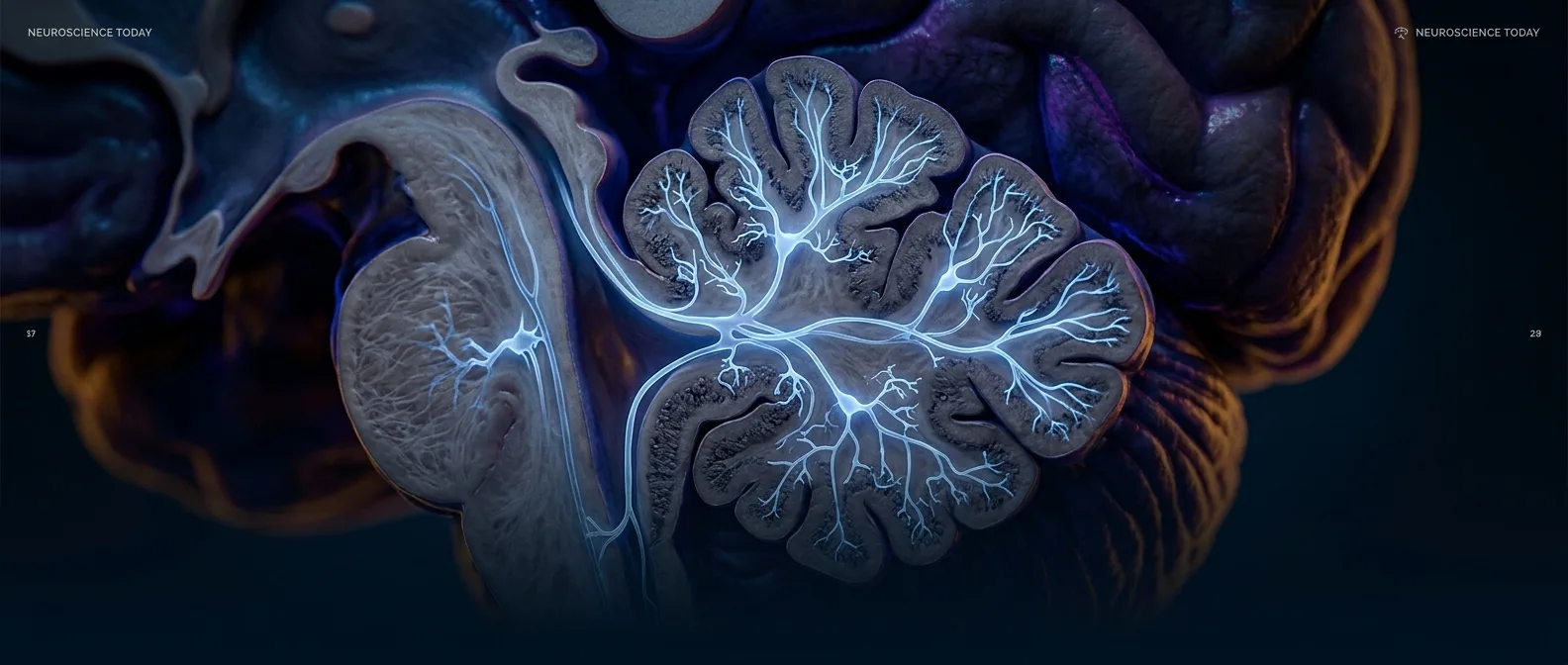
Groundbreaking research from Duke University and Harvard Medical School, published in Nature this March, has cracked open one of neuroscience's most persistent puzzles. The cerebellum — that wrinkled ball of tissue tucked behind your brain stem — harbors a sophisticated mechanism that transforms obvious mistakes into improved performance.
The key? A "hidden circuit" that works like learning brakes. When we make glaring errors, this circuit lifts the brakes and allows the brain to discover new ways of moving.
🧬 The Purkinje Cell Paradox
For decades, neuroscientists knew the cerebellum relies on powerful "error signals" to improve movement. These signals travel through specialized neural highways called climbing fibers. When you mistime a swing or miss a target, these fibers fire.
The signals activate Purkinje cells — the cerebellum's main output neurons — triggering calcium bursts that help rewire neural connections. This process, called neuroplasticity, forms the biological foundation of learning.
But there was a paradox. Climbing fibers also activate inhibitory cells that should prevent those calcium signals. How can the brain promote learning and suppress it simultaneously?
⚡ The "Hidden Circuit" Revealed
The answer came from Fernando Santos-Valencia's team at Duke. Using high-resolution electron microscopy in mice, researchers discovered that climbing fibers don't activate all inhibitory cells equally.
Instead, they preferentially target a specific group of neurons called MLI2 cells. MLI2 cells don't inhibit Purkinje cells directly. They shut down another group of inhibitory neurons — MLI1 cells — whose normal job is to suppress learning.
Put simply, one set of neurons shuts down another set that normally blocks learning. By inhibiting the inhibitors after an obvious mistake, the brain temporarily lifts its own brakes.
The Power of Synchronized Errors
This mechanism works best when multiple climbing fibers fire together. This "group effort" typically happens after unambiguous mistakes — not minor imperfections, but clear misses.
When strong error signals arrive together, MLI2 cells "open a window" for learning. They allow Purkinje cells to generate the robust calcium signals needed to drive long-term plastic changes.
🎾 From Lab Bench to Tennis Court
This finding changes how we think about motor skill learning. Take tennis — a favorite subject among researchers.
In the 1970s, coaches believed repeating perfect strokes was key. The new research suggests something different: robotic perfection isn't the best path to athletic improvement.
"To improve, you have to take risks and make big mistakes. If you're going to fail, fail spectacularly."
— Billie Jean King
It's the combination of practice and clear feedback from notable mistakes that pushes peak performance to the next level.
What This Means for Language Learning and Music
The findings apply beyond sports. Whether you're learning piano, a new language, or complex professional skills, the principle seems to be that the brain learns better when mistakes are clearly defined.
Small or inconsistent errors don't activate the MLI disinhibition circuit as effectively as obviously wrong ones. That's why immediate, high-quality feedback matters so much.
🔬 The Neurobiology of Self-Correction
The "hidden circuit" discovery explains why certain training methods work better. Programs that make mistakes "loud and clear" are likely more effective because they generate synchronized climbing fiber activity.
This tips the balance toward "lifting the brain's brakes." The best coaches often emphasize their athletes' mistakes — they're creating conditions that help the brain learn.
Neuroplasticity
The brain's ability to reorganize its connections based on experience.
Climbing Fibers
Neural pathways that carry error signals from the brainstem to the cerebellum.
Inhibition as Core Mechanism
"The key is having 'brakes' that can control neural plasticity," explains Santos-Valencia. Rather than constantly amplifying error messages to produce plasticity, a braking mechanism allows the brain to open learning windows when needed.
And close them when they're not.
📊 Implications for 2026 Neuroscience
While the study used mice, the cerebellum is highly "conserved" across species. Researchers believe similar mechanisms operate in humans.
Imbalanced excitation and inhibition in the cerebellum could lead to motor dysfunction or impaired motor learning. The hope is that understanding how the circuit works under normal conditions can help identify what goes wrong in conditions like ataxias.
Or even conditions like autism spectrum disorders, which some researchers link to cerebellar dysfunction.
The Future of Education
These findings may change how we design learning programs — from languages and music to surgical skills and driving. If "obvious mistakes" are key, we might need to reconsider the philosophy of gradual perfection.
That is, instead of trying to avoid mistakes, we might need to welcome them strategically.
🎯 Frequently Asked Questions
Why don't small mistakes help as much as big ones?
Small mistakes don't activate enough climbing fibers simultaneously to "lift the brakes" of the hidden circuit. It takes obvious, unambiguous errors to trigger the disinhibition mechanism.
How can I apply this knowledge to my own learning?
Instead of avoiding situations where you'll make mistakes, seek environments that offer immediate, clear feedback. Don't fear making "spectacular" mistakes — they're part of the learning process.
Does this mean perfect practice is useless?
Not exactly. Practice remains important, but it needs redesigning. The combination of practice with clear, immediate feedback on mistakes is what drives optimal learning.
The old saying "practice makes perfect" needs an update. Not just practice — practice with notable mistakes makes perfect. Next time you're struggling to master a new skill, drop the self-control and perfectionist oversight. "Spectacular" mistakes pave the road to mastery.