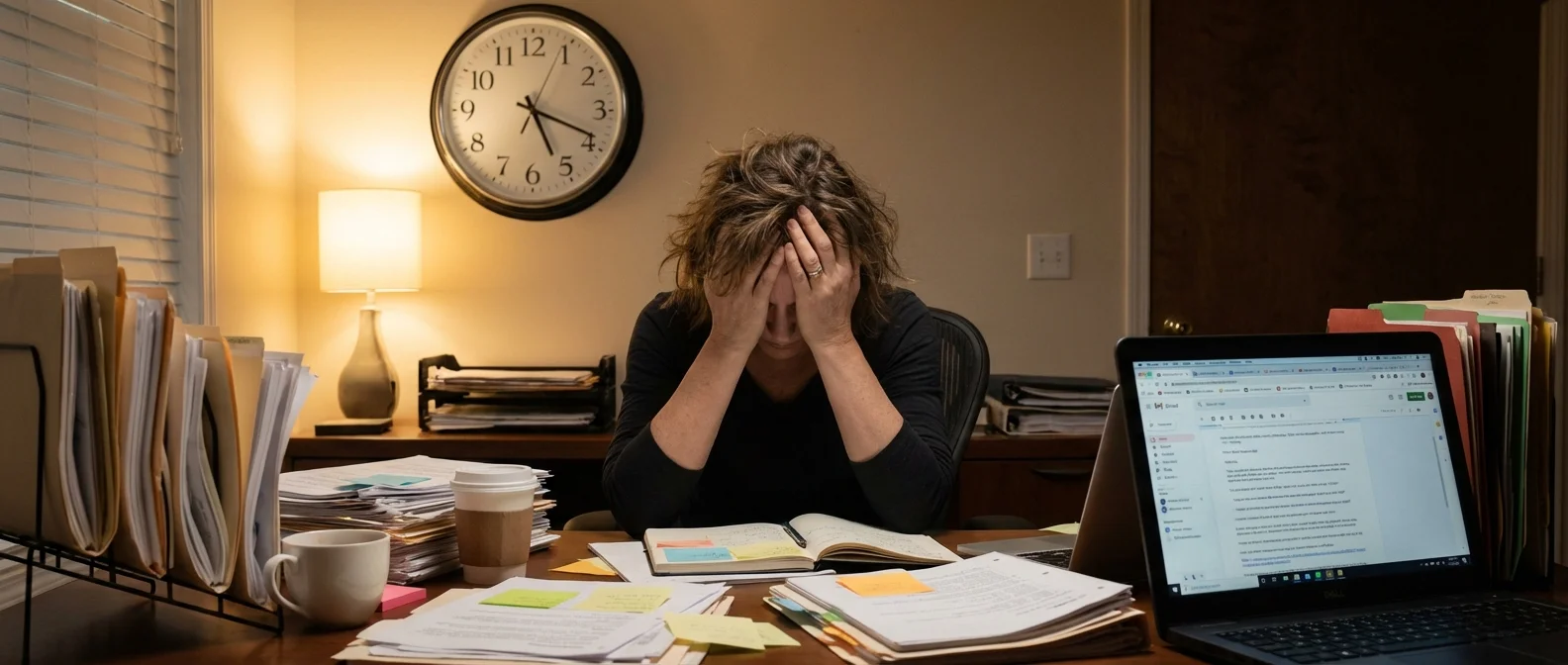
"I'll start tomorrow." The most popular sentence in the world — and the most misleading one. Because “tomorrow” never comes. It turns into the day after, then “Monday,” then “September.” And you remain trapped in a cycle of guilt, avoidance, and self-criticism. If you think procrastination is about laziness or discipline, science says something entirely different.
📖 Read more: Decision Fatigue: Why Decisions Exhaust You
You're Not Lazy — Your Brain Is “Protecting” You
Procrastination isn't a time management problem — it's an emotion regulation problem. When a task triggers discomfort (boredom, anxiety, fear of failure, ambiguity), the brain activates a defensive strategy: “Avoid it. Now.” Instead of tackling the difficult assignment, you open Instagram, clean the house, or do anything that doesn't need doing.
A groundbreaking 2018 MRI study at Ruhr-Universität Bochum scanned the brains of 264 people and found something striking: procrastinators have a larger amygdala — the brain's fear center — and a weaker connection between the amygdala and the dorsal anterior cingulate cortex (dorsal ACC), the region that selects which action to execute.
The Doer's Brain
Smaller amygdala, strong connection with dorsal ACC. Assesses negative consequences but doesn't let fear block action.
The Procrastinator's Brain
Larger amygdala, weak connection with dorsal ACC. Worry about negative consequences dominates — producing paralysis instead of action.
The Positive-Negative “Scale”
A 2024 study from Ohio State University introduced a new concept: the "valence weighting bias." When you face an unpleasant task, your mind simultaneously weighs two signals:
Across three studies (232, 147, and an additional experimental group), the researchers found that people who weigh negative signals more heavily procrastinate systematically — filing their tax returns late or starting assignments at the last minute. The striking finding? In the third study, researchers managed to shift this tendency in self-identified procrastinators — resulting in them completing their tasks faster.
📖 Read more: Comfort Zone: Why Your Safe Space Holds You Back
Optimism as an Antidote
In 2024, researchers at the University of Tokyo studied 296 young people and discovered something unexpectedly important: procrastination is closely linked to how we perceive the future. Specifically, people who believed that stress would decrease in the future compared to the present were less likely to be severe procrastinators.
Conversely, those who viewed the future pessimistically — “it'll get worse” — were more likely to fall into the severe procrastination group. Notably, this relationship wasn't found with general well-being or self-esteem — it was specifically the perception of future stress that made the difference.
The Anatomy of Delay
Procrastination follows a pattern we easily recognize — once it's pointed out. Here's how it unfolds almost every time:
📖 Read more: Growth Mindset: How to Change the Way You Think
6 Research-Based Strategies
The 2-Minute Rule
If something takes less than 2 minutes, do it now. Otherwise, commit to just 2 minutes of work — starting is the hardest part.
Recognize the Emotion
Instead of saying “I'm lazy,” ask: “What do I feel about this task?” Fear? Boredom? Overwhelm? Recognition reduces the emotion's power.
Break Big Into Small
"Write the thesis" triggers panic. “Write one paragraph” is doable. The amygdala reacts less to small tasks.
Shift the “Scale”
Per the Ohio State research, you can train yourself to weigh positive signals more: visualize how you'll feel after completing the task.
Cultivate Future Optimism
The Tokyo study shows: if you believe the future won't be more stressful, you procrastinate less. Focus on what's going well.
Self-Compassion Over Self-Criticism
Self-punishment amplifies discomfort — therefore amplifying procrastination. Self-compassion reduces the emotional charge, making it easier to begin.
Start Now — Even If You Don't “Feel Ready”
Perhaps the most important truth about procrastination is this: you don't need motivation to start — you need to start to find motivation. Motivation doesn't come before action — it comes after. Psychological research shows that once someone begins a task, even reluctantly, resistance drops dramatically within the first few minutes.
Procrastination isn't a character flaw. It's human. But it is changeable — not through pressure and guilt, but through understanding, small steps, and a kinder relationship with yourself.
1. Schlüter et al. (2018). The Structural and Functional Signature of Action Control, Psychological Science, DOI: 10.1177/0956797618779380
2. Granados Samayoa & Fazio (2024). Task delay as a function of valence weighting bias, Personality and Individual Differences, DOI: 10.1016/j.paid.2023.112504
3. Kashiwakura & Hiraki (2024). Future optimism group and procrastination, Scientific Reports, DOI: 10.1038/s41598-024-61277-y