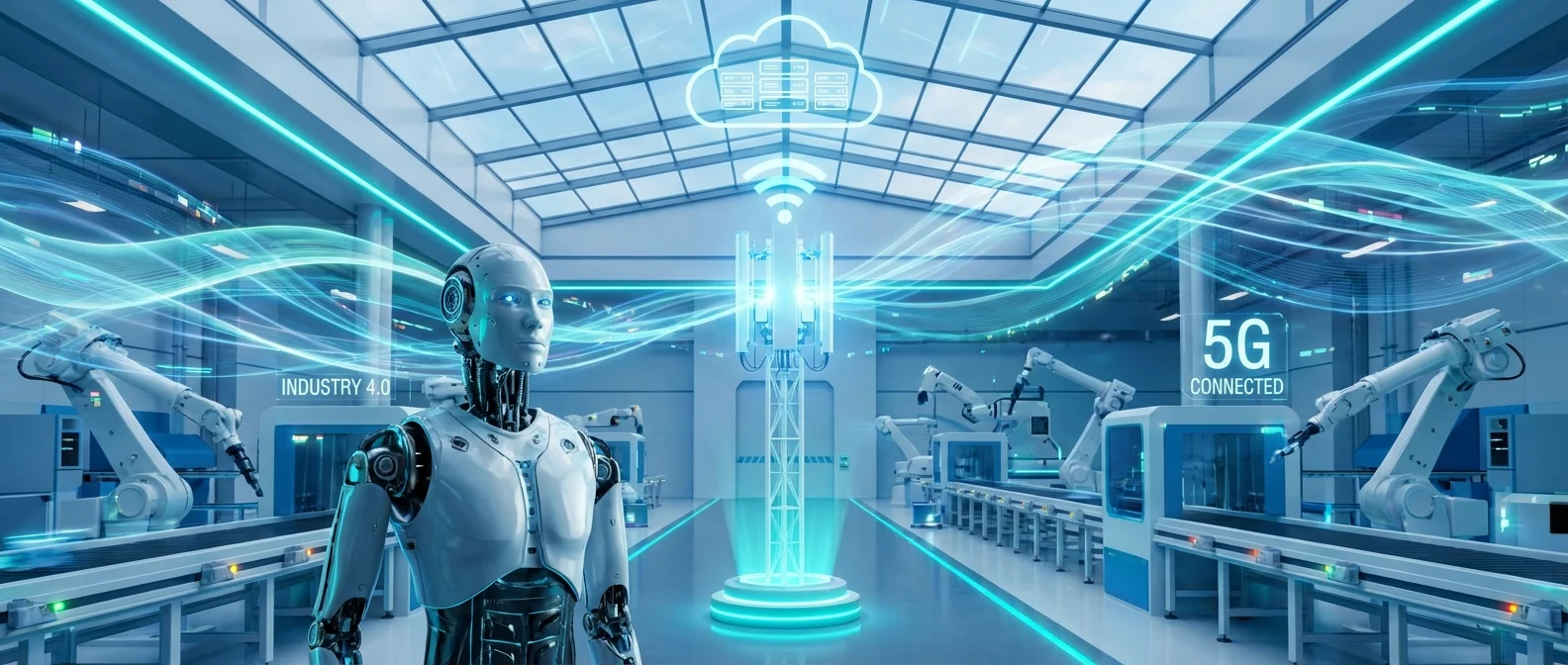
A warehouse robot receives motion commands in under 10 milliseconds. A surgeon in Paris operates on a patient in Delhi, 8,500 kilometers away. A self-driving truck on the highway reacts to an obstacle before the remote operator can even hit the brakes. The common denominator? 5G — the fifth generation of mobile networking that is rewriting the rules of robotics.
📖 Read more: Edge AI: Robots That Think Without the Cloud
📡 What Is 5G and Why Does It Matter for Robotics
5G (5th Generation) is the successor to 4G LTE. Its commercial rollout began on April 3, 2019 in South Korea (SK Telecom, KT, LG U+) — just hours before Verizon flipped the switch in the United States. Technical standards are defined by 3GPP in coordination with the ITU's IMT-2020 program.
Why does it matter for robots? Because three categories of 5G services solve three critical problems at once:
URLLC (Ultra-Reliable Low-Latency Communications): Targets sub-1ms radio-interface latency with 99.999% reliability. In practice, this means a robot can receive motion commands in near-real time.
eMBB (enhanced Mobile Broadband): Data rates up to 20 Gbps (theoretical) — the highest speed ever measured on a commercial network was 5.9 Gbps (2023). In the real world, South Korea leads with an average of ~430 Mbps (2022).
mMTC (massive Machine-Type Communications): Supports up to 1 million devices per square kilometer — essential for factories packed with thousands of sensors.
🤖 Robot Teleoperation
Teleoperation — controlling a machine or robot remotely — is arguably the most impressive 5G application in robotics. There are two main forms:
- Remote Driving: The operator directly controls steering, throttle and brakes (e.g., Waymo robotaxis, GM Cruise vehicles)
- Remote Assistance: The operator issues high-level commands ("go there", “avoid that”) while autonomous navigation handles execution
Companies like DriveU.auto, Roboauto, Pylot/Fernride, Ottopia, Designated Driver, Soliton Systems and Transitive Robotics provide 5G-based teleoperation platforms. The major autonomous vehicle players — Waymo, Cruise, Aptiv, Zoox, Denso — use 5G teleoperation as a safety net when autonomous navigation fails.
On the factory floor, industrial robots are remotely controlled via 5G URLLC: the same specialist can tune a robot in Germany in the morning and one in China in the afternoon, without ever leaving their desk.
🏥 Remote Surgery: A Robot Operates on Another Continent
Remote surgery is not a new idea. But 5G is what makes it genuinely practical.
It started with the Lindbergh Operation (2001) — Dr. Jacques Marescaux in New York performed a cholecystectomy on a patient in Strasbourg, France, across 6,230 km. A dedicated ATM fiber-optic line was used, with roughly 155ms latency.
Today, with 5G:
- 2024: Remote robotic lung tumor surgery over 5,000 km via a 5G network
- 2025: The longest-distance robotic surgery ever — a bariatric procedure from France to India, 8,500 km, lasting 48 minutes, using the SSI Mantra 3 robot, performed by Dr. Mohit Bhandari
The critical factor: network latency must stay below 200ms for safe telesurgery. 5G URLLC targets <1ms — providing an enormous margin. A da Vinci surgical robot costs roughly $1 million, but if one world-class surgeon can operate on patients in 10 hospitals simultaneously, the economics shift dramatically.
"Network latency in telesurgery isn't a technical issue — it's a matter of life and death. Every millisecond counts."
— Principles of Telesurgery🏭 Smart Factories: 5G on the Shop Floor
The fourth industrial revolution (Industry 4.0) — the convergence of digital and physical worlds in manufacturing — finds its ideal partner in 5G. The term "Industrie 4.0″ was coined in Germany (2011) by Siegfried Dais (Bosch) and Henning Kagermann (German Academy of Sciences).
What does a private 5G network bring to a factory?
5G Benefits in Manufacturing
- Wireless robot connectivity: No more cables — AGVs (Automated Guided Vehicles) roam freely
- Real-time response: URLLC guarantees sub-10ms response for robotic arms
- Digital Twins: Virtual replicas of machines reflect real-time performance data
- Massive sensor networks: mMTC connects thousands of temperature, pressure and vibration sensors
- Predictive Maintenance: Continuous monitoring predicts failures before they happen
- Security: A private network means full data control, no reliance on public infrastructure
Bosch pioneered industrial IoT, deploying autonomous failure prediction and self-organizing production coordination. In 2017, it founded the Chicago Connectory, an incubator for industrial IoT. Leading manufacturers — Mercedes-Benz (Factory 56 in Sindelfingen), BMW (Regensburg plant), Siemens (Amberg), Samsung — are deploying private 5G networks across their facilities.
3GPP Release 17 (2022) introduced 5G RedCap (Reduced Capability) — purpose-built for industrial IoT sensors, actuators and surveillance cameras, with 20 MHz bandwidth on FR1. Release 18 / 5G-Advanced (2024) added AI/ML in the RAN for beam optimization, network energy savings and improved positioning accuracy for industrial IoT.
📶 Network Slicing: One Network, Many Worlds
One of the most revolutionary ideas in 5G is Network Slicing — the ability to run multiple logical networks ("slices") on a single physical infrastructure. Each slice has guaranteed characteristics (latency, bandwidth, reliability) independent of the others.
The architecture (per 3GPP) has three layers:
- Service Instance Layer: The end-service level (e.g., “robotic control”)
- Network Slice Instance Layer: A chain of Network Functions delivering the required network characteristics
- Resource/Infrastructure Layer: Physical and virtual resources (SDN + NFV)
In practice: in a factory, one URLLC slice handles real-time robot control (guaranteed latency <1ms), an eMBB slice carries HD video streaming from surveillance cameras, and an mMTC slice connects thousands of IoT sensors. Each slice has guaranteed QoS — video traffic can never “steal” bandwidth from robotic control.
⚡ Edge Computing: The Brain Right Next to the Robot
Even with 5G, if a robot's data has to travel to a cloud server hundreds of kilometers away, latency increases. The solution: MEC (Multi-Access Edge Computing) — computing power placed at or near the base stations.
The idea: instead of sending sensor images to the cloud (in the US or Ireland), AI processing happens on an edge server just meters away. The result: round-trip latency drops from ~30ms (cloud) to ~14ms or less (edge), with jitter of just ~1.8ms.
Major MEC players: AWS Wavelength (the first major commercial MEC — embedding AWS compute/storage inside Verizon, Vodafone, SK Telecom and KDDI networks), Nokia, Samsung, Intel, Cisco, Huawei, Ericsson.
The combination of 5G + MEC makes “cloud robotics” a reality with virtually zero latency: robots with minimal on-board computing power harness powerful edge servers for AI object detection, path planning and autonomous navigation — all in real time.
☁️ Cloud Robotics: A Brain in the Cloud
The term “Cloud Robotics” was publicly introduced by James Kuffner (then at Google, now CEO of Toyota Research Institute) at the IEEE Humanoid Robotics Conference (2010). The concept: instead of every robot carrying a powerful (and expensive) on-board computer, they tap cloud servers via the network.
The six core components of a cloud brain (per IEEE):
- A central cloud brain in the data center
- A library of images, maps and object data
- Massively parallel computation on demand
- Shared results and trajectories across robots
- Open-source code, data and designs
- On-demand human guidance
Project RoboEarth (EU, Seventh Framework): created a Wikipedia for robots — a knowledge base with action “recipes” (e.g., “how to serve water”). FogROS2 (UC Berkeley, 2022): an open ROS 2 framework that offloads heavy tasks (SLAM, grasp planning) to the cloud. Before 5G, these ideas were theoretical — Wi-Fi/4G latency was simply too high. Now they are becoming reality.
📊 5G vs 4G vs Wi-Fi — Robotics Comparison
| Feature | 4G LTE | 5G NR | Wi-Fi 6/6E |
|---|---|---|---|
| Peak Download | 1 Gbps (theor.) | 20 Gbps | 9.6 Gbps (theor.) |
| Latency | 30-50ms | 8-12ms (URLLC: <1ms) | 10-30ms (local) |
| Reliability | 99.9% | 99.999% | Variable |
| Connection Density | ~100K/km² | 1M/km² | Limited |
| Mobility | Up to 350 km/h | Up to 500 km/h | Minimal |
| Spectrum | Licensed | Licensed + unlicensed (NR-U) | Unlicensed |
The key difference: Wi-Fi works great indoors (home, office) but doesn't support mobility — when an AGV switches access points, it drops connection for hundreds of milliseconds. 4G LTE offers no guaranteed latency — during peak hours, latency spikes. Only 5G URLLC guarantees sub-1ms with 99.999% reliability — essential for robot control loops that need sub-10ms response.
📈 The Market: Numbers That Speak
The global 5G infrastructure market will be worth $133.19 billion by 2033 (CAGR 13.1%), while the explosive 5G Industrial IoT market grew from $0.5B (2020) to $15.7B (2026) — a CAGR of 79.1%. Asia-Pacific holds 46.4% market share. Private 5G networks dominate the enterprise sector. Leading equipment vendors: Huawei, Samsung, Nokia, Ericsson, ZTE, CommScope, Cisco, NEC, HPE.
🔮 The Future: 5G-Advanced, 6G and Robots
The evolution doesn't stop at 5G. 3GPP Release 18 / 5G-Advanced (2024 — sometimes called “5.5G”) introduces AI/ML in network management, improved time-synchronization independent of GNSS, expanded support for non-terrestrial networks (satellites, aerial platforms), and eRedCap for even more efficient industrial devices.
On the horizon: 6G (expected ~2030). Theoretical targets: 1 Tbps speeds, sub-100µs latency, AI-native architecture. If achieved, this will mean: robots that react faster than human reflexes, fully autonomous telesurgery with zero perceptible lag, factories without a single cable.
Already today, the bridge of 5G + Edge Computing + AI gives robots something they never had before: a connection fast enough for their “brain” to live somewhere else. In a server room, in the cloud, on an edge node — anywhere except on board. This changes everything: cheaper robots, smarter robots, robots that learn together simultaneously. Speed matters — and 5G delivers it.