📖 Read more: Delivery Robots: Autonomous Food Delivery 2026
📦 From a $775 Million Bet to 1 Million Robots
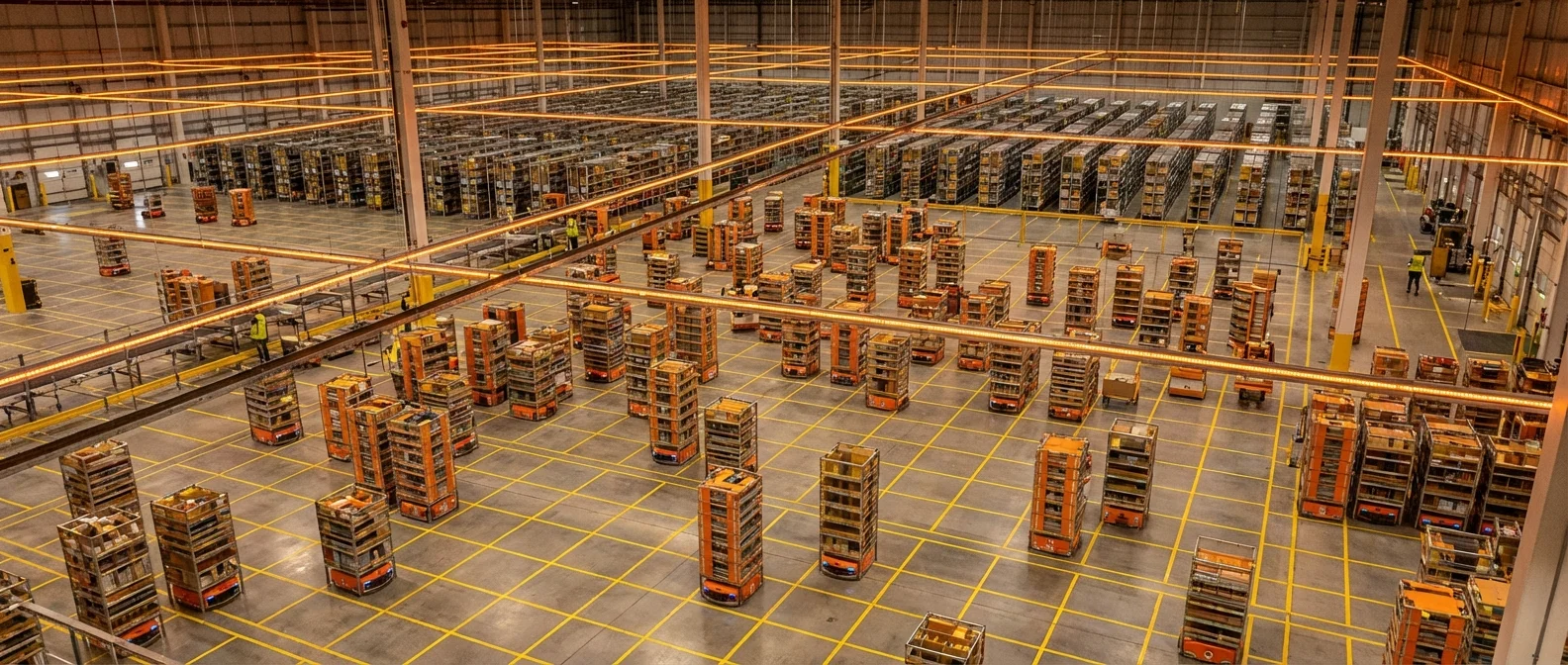
The story begins in 2003, when Mick Mountz — a former executive at Webvan, an e-commerce startup that spectacularly collapsed — founded Kiva Systems alongside Peter Wurman and Raffaello D'Andrea. The idea was simple but revolutionary: instead of workers walking to shelves, bring the shelves to the workers. Small orange robots (2×2.5 feet) lifted entire shelving units weighing up to 1,000 pounds and carried them to workstations, navigating via barcodes on the warehouse floor.
Clients included Gap, Walgreens, Staples, and Crate & Barrel. And, of course, Amazon — which in March 2012 acquired Kiva Systems outright for $775 million. It was the company's second-largest acquisition at the time. Immediately after, Amazon stopped selling Kiva robots to competitors — the technology would remain an in-house advantage. In August 2015, Kiva was rebranded as Amazon Robotics LLC.
The scale grew exponentially. By 2019: 200,000 robots. By June 2022: 520,000+. By October 2023: 750,000+. And in June 2025, Scott Dresser, VP of Amazon Robotics, announced they had crossed the 1,000,000 mark across 300+ facilities worldwide. Amazon now describes itself as “the world's largest manufacturer and operator of mobile robotics.”
🤖 The Army: Which Robots Do What
Amazon doesn't rely on a single robot type — it deploys dozens of different models, each engineered for a specific task. Some move, some grab, some scan. Together, they form end-to-end warehouse automation systems.
Hercules units are the workhorses — mobile drive units that lift shelving pods weighing up to 1,250 pounds, navigating via 3D cameras and floor markers. Titan units handle double that weight for bulkier, heavier items. Both operate in fenced-off areas — no human workers enter the robot floor.
Robotic arms are a separate category entirely. Robin sorted 1 billion packages in 2022 — roughly one in every eight packages Amazon shipped. Sparrow (November 2022) uses computer vision and AI to identify and grasp over 200 million different products. Cardinal lifts packages up to 50 pounds, reads labels, and places them onto carts — entirely without human intervention.
The most significant newcomer: Vulcan (May 2025), a robotic arm equipped with tactile sensing. Force sensors in its “hand” allow Vulcan to handle roughly 75% of all item types — fragile, irregularly shaped, soft. It was first deployed in Dortmund, Germany and Spokane, Washington.
Proteus: The First Fully Autonomous One
In July 2022, Amazon unveiled Proteus — its first robot designed to move freely alongside human workers, without fenced enclosures. Until then, every Amazon robot operated in restricted zones. Proteus uses advanced sensors for navigation and collision avoidance, moving GoCart trolleys from outbound stations to loading docks.
Sequoia: The System That Changed Everything
In October 2023, Amazon introduced Sequoia — not a single robot, but an integrated AI+robotics system. It combines mobile robots, gantry systems, robotic arms, and ergonomic workstations. The result: inventory identification and storage runs 75% faster than before, while order processing time dropped by 25%.
First deployment: Houston, Texas. In October 2024, a newer facility — 5 times larger — launched in Shreveport, Louisiana. Amazon's first “next-gen” warehouse, it holds 30+ million items and delivers 25% lower fulfillment costs during peak periods.
📖 Read more: Robots in Greece: Where They're Already at Work in 2026
👥 The Big Question: Have Workers Been Replaced?
Amazon's consistent answer: no. According to its own figures, since the Kiva acquisition in 2012, the company has added “over 1 million jobs globally.” Robots, Amazon says, handle the dull, repetitive tasks — while humans transition into maintenance, technology, and engineering roles. According to the company, 700+ new job categories were created because of robotics. Over 700,000 employees have upskilled — and robotics technicians (mechatronics apprentices) earn hourly wages 40% higher than entry-level positions ($20.50+/hour).
Next-generation fulfillment centers (like Shreveport) require 30% more employees in reliability, maintenance, and engineering roles compared to older facilities — a sign that robots aren't eliminating jobs so much as transforming them.
That's Amazon's version. The view from outside is more complicated.
⚠️ The Shadow: Safety and Criticism
Amazon claims that warehouses with robotics have 15% fewer recordable incidents compared to its non-robotic facilities, and 18% fewer lost-time injuries (2022 data). The company says safety has improved by over 30% in recent years.
But external analyses tell a different story. The Washington Post (June 2021), analyzing OSHA data, found that Amazon warehouses may actually be more dangerous than comparable facilities. The National Employment Law Project (2021) found that Amazon warehouses in Minnesota had more than double the injury rate of non-Amazon warehouses (2018-2020 data).
The fines speak for themselves. March 2022: Washington state labor authority issued a $60,000 fine for “willful violation” of safety laws — forcing workers into repetitive motions at high speed. December 2022: OSHA fined Amazon $29,008 for injury recordkeeping failures. January 2023: OSHA levied $60,269 for unsafe conditions across 3 warehouses — falling boxes, non-ergonomic lifting. And in June 2024, California imposed a $5.9 million fine for 59,017 violations of the Warehouse Quotas Act.
Two Sides of the Coin
Amazon compares its robotic warehouses against its own non-robotic ones — and the numbers show improvement. External analyses (OSHA, Washington Post, National Employment Law Project) compare Amazon warehouses against the industry as a whole — and the picture reverses. Senator Bernie Sanders launched a formal Senate investigation in June 2023 into what he called “dangerous and illegal” working conditions.
🦿 Digit: The Humanoid in the Warehouse
In October 2023, Amazon began testing Digit — a bipedal humanoid robot built by Agility Robotics. Its initial role: “tote recycling” — moving empty bins after orders are fulfilled. Amazon chose it because, in the company's own words, “its size and dimensions are suited to buildings designed for people.”
📖 Read more: 5G & Robotics: The Speed That Changes Everything
Agility Robotics is one of the companies Amazon backed through its Amazon Industrial Innovation Fund — a $1 billion venture fund launched in 2022 to invest in warehouse robotics, computer vision, and wearable safety technology. Other investments include Vimaan (computer vision) and Modjoul (safety wearables).
Reaction to Digit was mixed. The Verge noted that Amazon's ambition to “scale” Digit was “concerning for its 1 million human warehouse workers.”
🧠 Blue Jay, DeepFleet, and What Comes Next
In October 2025, Amazon unveiled Blue Jay — a ceiling-mounted multi-arm robotic system designed for Same-Day delivery facilities. It's currently being tested in South Carolina.
Meanwhile, in June 2025, Amazon announced DeepFleet — a generative AI model that optimizes routing for entire robot fleets, delivering 10% gains in fleet travel efficiency. Rather than optimizing each robot individually, DeepFleet looks at the whole picture — thousands of robots simultaneously — and finds more efficient paths for everyone.
The trajectory is clear: Amazon isn't just adding robots — it's building integrated systems that combine hardware (arms, drive units, humanoids) with AI (computer vision, fleet optimization, generative models). Every new warehouse is more automated than the last. The question isn't whether jobs will change — it's how fast.
"The speculation was endless that Amazon was replacing people. A decade later, the facts tell a different story."
— Amazon, 10 Years of Amazon Robotics, June 2022🔮 The Verdict
Is Amazon replacing workers with robots? The honest answer: yes and no. Yes, because tasks that once required human hands — sorting, shelf transport, picking — are now handled by machines. No, because Amazon hasn't reduced its headcount — it's grown it, albeit into fundamentally different roles.
What's changing isn't the number of jobs — it's their nature. The 2012 warehouse worker walked 10-12 miles a day collecting packages. The 2026 warehouse worker monitors robots, troubleshoots systems, or trains in mechatronics. The pay may be 40% higher — but the transition isn't smooth, and those 59,017 violations in California are a stark reminder that the pace of automation must not outstrip human endurance.
Cathie Wood (ARK Invest) predicted that by 2030, Amazon will have more robots than humans in its warehouses — adding roughly 1,000 robots per day. In some of its newest facilities, that's already the case.