📖 Read more: Boston Dynamics Atlas Robot Enters Factory Production 2026
🏭 From Gym Tricks to Factory Floor
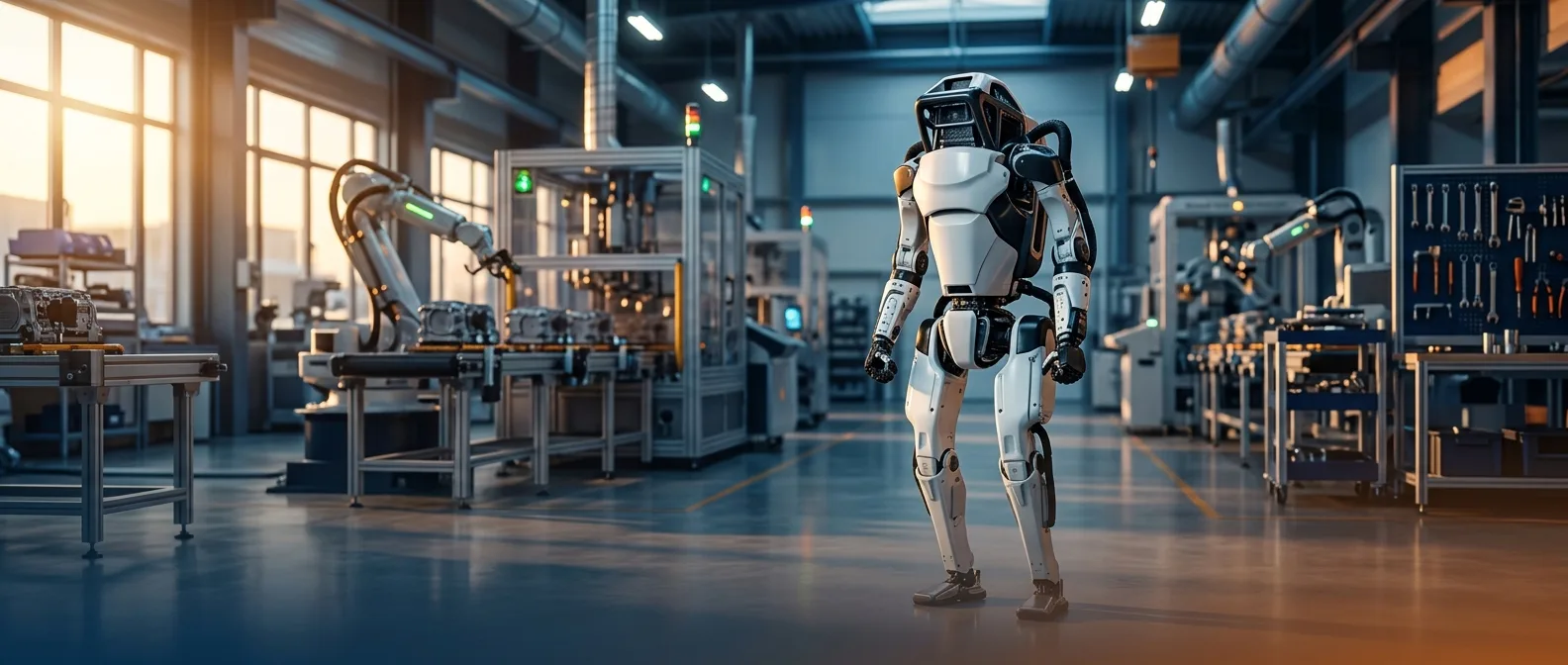
Boston Dynamics announced in early January 2026 that production of the electric Atlas humanoid robot has begun — and this time they mean business. No more parkour videos or backflips. Atlas is now an industrial product targeting factory automation, warehouse operations, and tasks that until now required exclusively human workers. What makes this different isn't just the technical specs. Boston Dynamics has already sold out their entire 2026 production run — every unit rolling off the line has a destination. Hyundai will deploy Atlas robots at their Robotics Metaplant Application Center (RMAC), while Google DeepMind will use them for AI training experiments and model development.⚡ Electric Atlas: Built for Real Work
The new Atlas runs entirely on electric power — a shift that signals the evolution from the hydraulic prototype we've seen in demos. This change isn't cosmetic. Hydraulic systems require complex maintenance, can leak, and aren't suitable for working alongside humans in industrial environments.Built to Survive Anything
One of Atlas's most impressive features is its resilience to extreme conditions. It operates in temperatures from -4°F to 104°F, with water resistance built in. This means it can work in freezer warehouses, outdoor environments, and industrial settings with high humidity. When the battery dies, Atlas doesn't wait for a technician. It autonomously navigates to the charging station, swaps its own battery in under three minutes, and gets back to work. It's like having a built-in survival instinct that enables 24/7 operation.🤖 Three Ways to Control Atlas
Atlas operates in three distinct modes depending on task requirements. In autonomous mode, it makes decisions using AI and sensor data. In teleoperated mode, a human controls it remotely. There's also a hybrid tablet mode where operators give high-level commands and Atlas executes them independently.Integration with industrial systems happens through Boston Dynamics' Orbit software, which connects with Manufacturing Execution Systems (MES) and Warehouse Management Systems (WMS). This means Atlas isn't just a smart robot — it's part of the broader factory ecosystem."This is the best robot we've ever built. Atlas will transform how industry operates."
— Robert Playter, CEO Boston Dynamics
Shared Learning Across the Fleet
One of Atlas's most intriguing capabilities is knowledge sharing. When one robot learns a new task, that experience transfers immediately to the entire fleet. It's like having a workforce that constantly shares expertise — without the egos and miscommunications.📖 Read more: Boston Dynamics Atlas: Robot Does Parkour Better Than Humans
🔗 Strategic Partnerships That Matter
Boston Dynamics isn't going it alone. The company announced a strategic partnership with Google DeepMind to develop advanced AI models that will be integrated into Atlas. This collaboration aims to give the robot better cognitive abilities — not just executing tasks, but understanding its environment and adapting accordingly. Meanwhile, Hyundai Mobis will supply the actuators for Atlas. This isn't coincidental — Hyundai Motor Group owns a stake in Boston Dynamics and has announced a $26 billion investment in its US operations, including a new robotics factory that will produce 30,000 robots annually.Google DeepMind
Advanced AI models for better environmental understanding
Hyundai Mobis
Actuator supply and manufacturing chain integration
NVIDIA Partnership
AI infrastructure for faster physical robotics training
🏁 The Humanoid Robot Race Heats Up
Atlas isn't the only humanoid robot entering production. Chinese companies like UBtech are already deploying their Walker S2 robots in automotive, logistics, and data centers. Tesla continues developing Optimus, while companies like Figure AI and 1X work on their own models. What sets Atlas apart is its industrial focus. While other companies talk about humanoids in homes and daily life, Boston Dynamics concentrates on tasks with immediate economic value: material handling, order fulfillment, machine tending.The Price of Tomorrow
Boston Dynamics hasn't announced Atlas pricing — unsurprising since the first units already have homes. The company's Spot robot costs around $75,000, so Atlas will likely run $150,000-200,000 or more. Expensive for an employee, but not for an employee that works 24 hours a day for years.🎯 Frequently Asked Questions
When will we see Atlas robots in factories globally?
Boston Dynamics will add new customers starting in 2027. Companies interested in Atlas will need to wait at least until then, unless they have partnerships with Hyundai or other existing customers.
Can Atlas completely replace human workers?
Not yet. Atlas is designed for specific tasks like material handling and machine tending. It requires supervision and can't handle unpredictable situations the way humans can.
What about safety when working alongside humans?
Atlas features human detection sensors and fenceless guarding systems. It can detect people in the surrounding area and adjust its movement or stop completely if necessary.
Atlas isn't just the next step in robotics evolution — it's a statement of intent. Boston Dynamics is showing that the era of humanoid demos is over, and the era of humanoid coworkers has begun. The question isn't whether robots will work alongside us, but how quickly we'll get used to it.