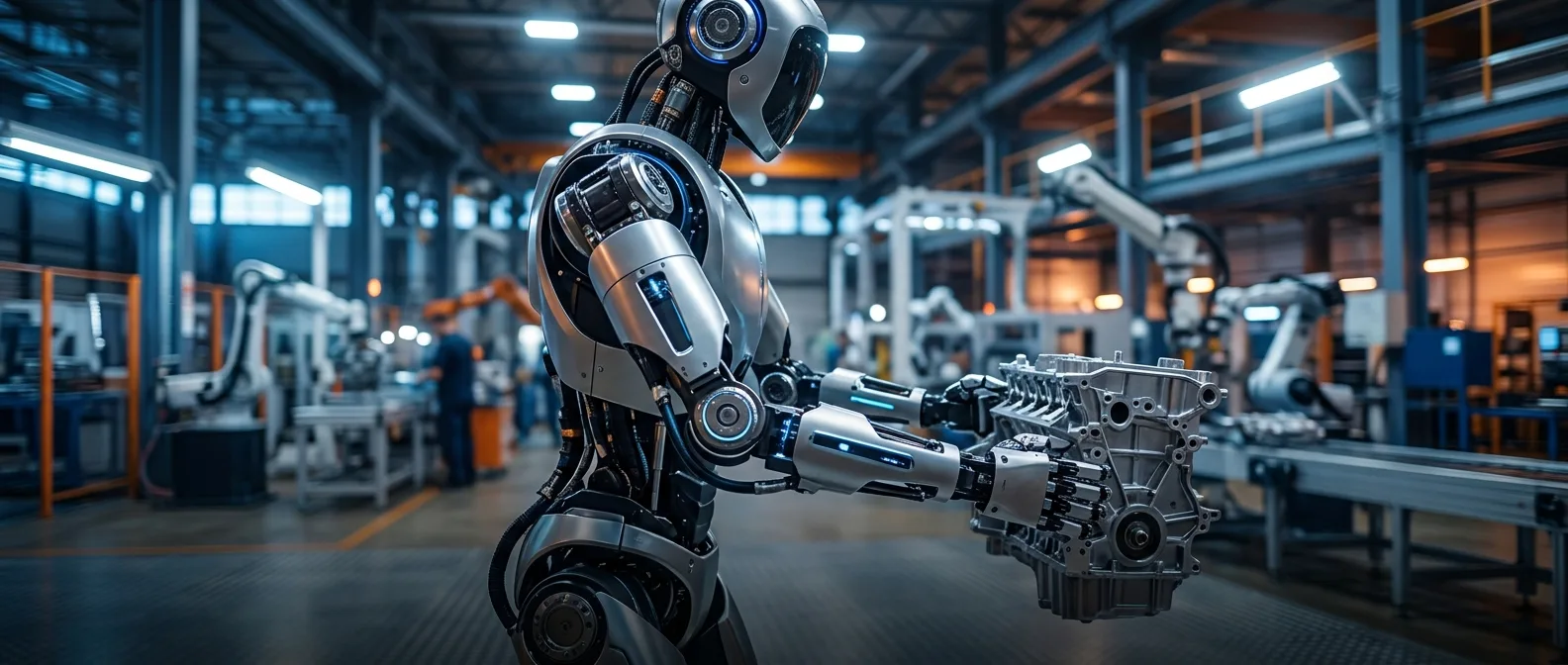
Thirty years of backflips and viral videos just paid off. Boston Dynamics dropped the mic at CES 2026 with news that the Atlas robot is shipping to customers today — not as a research curiosity, but as a production-ready humanoid that Hyundai will deploy in its Georgia factory. Google DeepMind gets the first batch too, and every 2026 unit is already spoken for.
This isn't the hydraulic beast that leaked oil and sounded like a construction site. The commercial Atlas runs purely on electric actuators, carries 50 kilograms without breaking a sweat, and stretches to 2.3 meters when it needs to reach high shelves. But here's the kicker: when its battery runs low, it walks itself to a charging station, swaps out the power pack, and gets back to work. No human required.
CEO Robert Playter wasn't mincing words at the Vegas reveal. "This is the best robot we've ever built." After watching Atlas stumble through its first steps in 2011, then master parkour by 2021, that statement carries weight. The 2026 model represents fifteen years of falling down and getting back up — literally.
🔧 From Lab Experiment to Factory Floor
The Atlas robot started as a DARPA research project when smartphones were still novel. Now it's walking out of Boston Dynamics' labs to punch a time clock. The transformation took three complete redesigns, countless software iterations, and one crucial decision: ditch the hydraulics that made earlier versions sound like angry dinosaurs.
Those 56 degrees of freedom matter more than the spec sheet suggests. Traditional industrial robots move like mechanical arms because that's exactly what they are. Atlas moves like a person because it was designed to work in spaces built for people. No factory redesign required.
The robot operates in three modes: fully autonomous, remote control, or tablet interface. Its 360-degree sensors detect approaching humans and integrate with existing MES and WMS systems through Boston Dynamics' Orbit software. This isn't a standalone machine — it's designed to slot into existing workflows.
⚡ Google DeepMind: Teaching Atlas to Think
Raw physical capability only gets you so far. The real breakthrough comes from Atlas's partnership with Google DeepMind, which is integrating Gemini Robotics foundation models into the platform. Instead of pre-programmed tasks, Atlas will understand the physical world and learn from experience.
We believe robots should understand the physical world like we do. They need to learn from their experiences rather than just execute pre-loaded routines.
Carolina Parada, Google DeepMind
Here's where it gets wild: when one Atlas robot masters a new task, that knowledge propagates to the entire fleet. Imagine thousands of robots learning simultaneously from each other's successes and failures. That's not science fiction — it's shipping this year.
Gemini Robotics: The Brain Behind the Brawn
Gemini Robotics models aren't chatbots for robots. They're multimodal AI systems that let machines perceive, reason, use tools, and interact with humans. What traditional industrial robots lack — adaptability — becomes Atlas's core strength.
🏭 Hyundai's $26 Billion Bet on Humanoid Workers
Hyundai isn't testing the waters. The automaker is diving headfirst with Atlas robots arriving at its Georgia facility this year for real-world trials. By 2028, they'll handle parts sequencing — the precise choreography of component placement on assembly lines.
Hyundai's Robot Strategy
The Robotics Metaplant Application Center (RMAC) opened this year to train robots on lifting and rotating motions. Data from RMAC combines with real factory operations in Georgia to create a comprehensive training dataset.
By 2030, Hyundai expects Atlas robots to tackle component assembly. Repetitive motions, heavy lifting, complex procedures — everything that makes factory work exhausting for humans becomes routine for machines that never get tired.
Hyundai Motor Group announced a $26 billion investment in US operations, including plans for a new robotics facility producing 30,000 robots annually. That's not a pilot program — that's an industrial transformation.
🤖 Technical Specs: What Makes Atlas Different
Fifty-six degrees of freedom versus ten for a typical industrial arm. That's the difference between human-like movement and robotic rigidity. Atlas doesn't just perform tasks — it adapts to unexpected situations with fluid, natural motion.
Autonomous Energy Management
The most impressive feature isn't strength or speed. It's self-sufficiency. When Atlas's battery hits low levels, it navigates to a charging station, swaps power packs, and returns to work. Zero downtime, zero human intervention.
360° Vision
Cameras detect humans and obstacles from every angle
Tactile Sensors
Hands that feel texture and pressure like human touch
Safety Systems
Human detection and fenceless guarding for collaborative work
Atlas also handles extreme conditions, operating from -20°C to 40°C and resisting water damage. These aren't lab specifications — they're real-world requirements for industrial environments.
💰 The Economics of Humanoid Labor
Boston Dynamics won't discuss pricing, but here's what we know: every 2026 production slot is sold out. New customers join the waitlist for 2027 delivery. That suggests pricing that makes economic sense for early adopters.
Consider the math: Atlas works 24/7 without breaks, sick days, or vacation time. If acquisition costs equal 2-3 years of human wages, the ROI becomes compelling. Especially for dangerous, repetitive, or precision tasks where human error carries real costs.
The first buyers aren't purchasing Atlas for publicity stunts. They're betting it will pay for itself — and generate profit beyond that initial investment.
🌐 Reshaping the Future of Work
Commercial humanoid robots represent more than technological progress. They're a social transition. For the first time, robots will work alongside humans in shared spaces, using identical tools and processes.
Stop redesigning your workspace for robots. Start enabling flexible, predictable, and intelligent material handling with Atlas.
Boston Dynamics
This philosophical shift opens automation possibilities for thousands of facilities that couldn't justify traditional robotic retrofits. Instead of adapting factories to robots, robots adapt to existing factories.
The Next Generation of Jobs
What happens to human workers when robots handle repetitive tasks? The Atlas project itself provides clues. Someone needs to program these machines, maintain them, and supervise human-robot collaboration. The jobs change, but they don't disappear.
🎯 What Comes Next
Atlas represents the beginning, not the endpoint. Boston Dynamics plans to expand capabilities into machine tending, order building, and additional applications. Each new skill learned by one robot instantly becomes available to the entire fleet.
Roadmap 2026-2030
- 2026: First commercial deployments (Hyundai, Google DeepMind)
- 2027: Market opens to new customers
- 2028: Parts sequencing on production lines
- 2030: Component assembly and complex procedures
The Google DeepMind partnership promises to make Atlas not just stronger, but more intuitive in its responses. Imagine robots that don't just execute commands, but understand context and adapt behavior accordingly.
Thirty years after its founding, Boston Dynamics achieved something that seemed impossible: making robots a natural part of the workplace. Atlas isn't just a product — it's proof that the future of work doesn't belong to humans or robots. It belongs to both, working together.