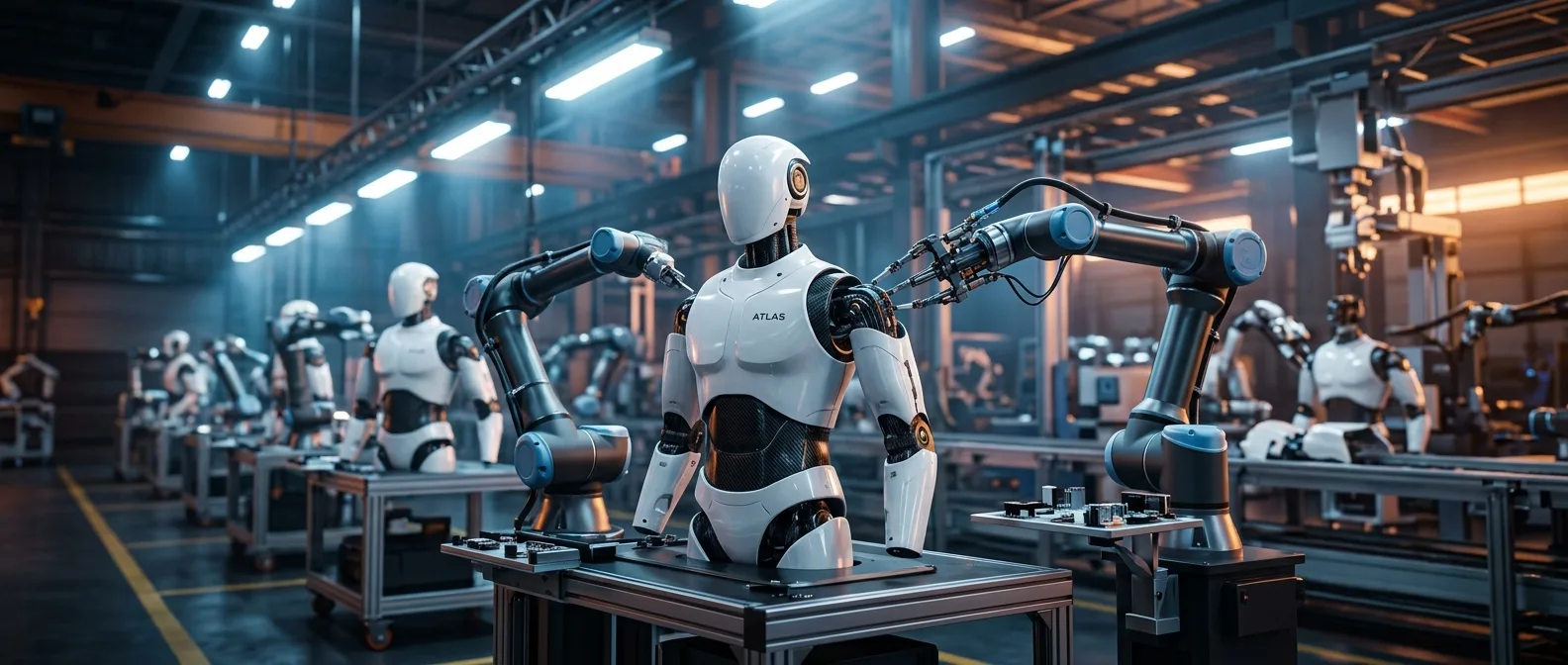
January 5, 2026, CES Las Vegas. Boston Dynamics just broke the robotics industry with an announcement that changes everything. Atlas production is happening — 30,000 humanoid robots rolling off assembly lines annually. The backflipping, dancing robot that captivated YouTube isn't a lab curiosity anymore. It's going commercial, and Hyundai is building the factory to make it happen.
🏭 From YouTube Star to Factory Floor
For three years, Atlas dominated social media. Parkour routines. Dance choreography. Viral videos that looked more like CGI than reality. The commercial Atlas marks a complete departure from entertainment to industry.
Robert Playter, Boston Dynamics CEO, put it bluntly: "This is the best robot we've ever built. Atlas will revolutionize how industry operates." No more demos for entertainment. This is a tool for business.
The production Atlas stands 6.2 feet tall and operates in temperatures from -4°F to 104°F. It lifts 110 pounds repeatedly, peaks at 145 pounds occasionally. Battery life hits four hours of continuous work, and when power runs low, the robot swaps its own battery pack in under three minutes.
Three Control Modes
Atlas operates fully autonomous, via human teleoperation, or through tablet interface. This flexibility makes it suitable for different work environments and skill levels.
🤝 The Hyundai Alliance and Google DeepMind Integration
The biggest surprise isn't just Atlas production — it's the corporate partnerships. Hyundai, Boston Dynamics' parent company, will build a factory capable of 30,000 robots annually. Meanwhile, Google DeepMind brings its AI into the mix.
Atlas becomes more than mechanics — it gains intelligence that learns, adapts, and shares knowledge across entire fleets. When one Atlas masters a new task, every robot in the network can execute it immediately.
The new Atlas generation significantly reduces unique component count, and every element is designed for automotive industry compatibility.
Zack Jackowski, GM Atlas, Boston Dynamics
🎯 Where Atlas Robots Will Work First
Forget household helpers — at least for now. Atlas targets specific industrial applications: material handling, order fulfillment, equipment maintenance. It works 24/7 without fatigue in environments that would exhaust humans.
First deliveries go to Google DeepMind and Hyundai's Robotics Metaplant Application Center (RMAC). Additional customers join from early 2027.
Competition from China
Boston Dynamics isn't alone in this race. Last month, Chinese company UBtech released footage of Walker S2 humanoids deployed in automotive plants, logistics centers, and data facilities. The battle for factory-floor humanoids is heating up globally.
Industrial System Integration
Atlas connects seamlessly with MES (Manufacturing Execution Systems), WMS (Warehouse Management Systems), and other industrial platforms through Boston Dynamics' Orbit™ software. It includes barcode scanners, RFID, and human detection systems for safety.
⚡ The Technology Behind Mass Production
The secret to successful lab-to-production transition lies in automotive partnerships. Hyundai Mobis supplies the actuators — the robot's "muscles." This means Atlas leverages existing supply chains and manufacturing expertise.
Every component is designed for automotive industry compatibility — a strategy targeting reliability and economies of scale. Boston Dynamics essentially took mass car production philosophy and applied it to humanoid robots.
Autonomous Charging
The robot navigates to charging stations and swaps batteries without human intervention
Extreme Durability
Operates from -4°F to 104°F and features exceptional water resistance
Fleet Learning
When one Atlas learns a new task, the entire fleet can execute it immediately
🔮 What This Means for the Future of Work
Boston Dynamics' announcement comes as everyone debates AI's impact on employment. Atlas isn't designed to replace workers — at least not immediately. It targets dangerous, repetitive, or harsh-environment tasks.
But 30,000 units annually? If Atlas robots prove effective, that number will scale rapidly. It's not hard to imagine factories where humanoid robots work alongside humans — or in some cases, instead of them.
The Cost Factor
Boston Dynamics hasn't announced pricing, but estimates suggest hundreds of thousands of dollars per unit. For large enterprises, Atlas could pay for itself within 2-3 years, considering it works 24/7 without vacation, insurance, or salary.
🎯 Frequently Asked Questions
When will we see Atlas robots in businesses globally?
First deliveries begin in 2026 for companies like Hyundai and Google DeepMind. Global businesses will likely have access from 2027-2028, depending on demand and partnerships Boston Dynamics develops worldwide.
How safe are Atlas robots in workplace environments?
Atlas features built-in human detection systems and fenceless guarding, meaning it can work alongside employees without safety barriers. Boston Dynamics has invested years developing algorithms that make the robot react predictably to unexpected situations.
Will we see Atlas robots in homes?
Not in the foreseeable future. Atlas is an industrial tool with corresponding cost and complexity. Boston Dynamics has stated long-term vision for domestic robots, but that remains in research phases.
Thirty years after Boston Dynamics' founding, Atlas isn't an engineering dream anymore. It's business reality that will reshape how we think about automation. The question isn't whether it will work — but how quickly businesses will adopt it to stay competitive in a world where robots no longer just dance for cameras.