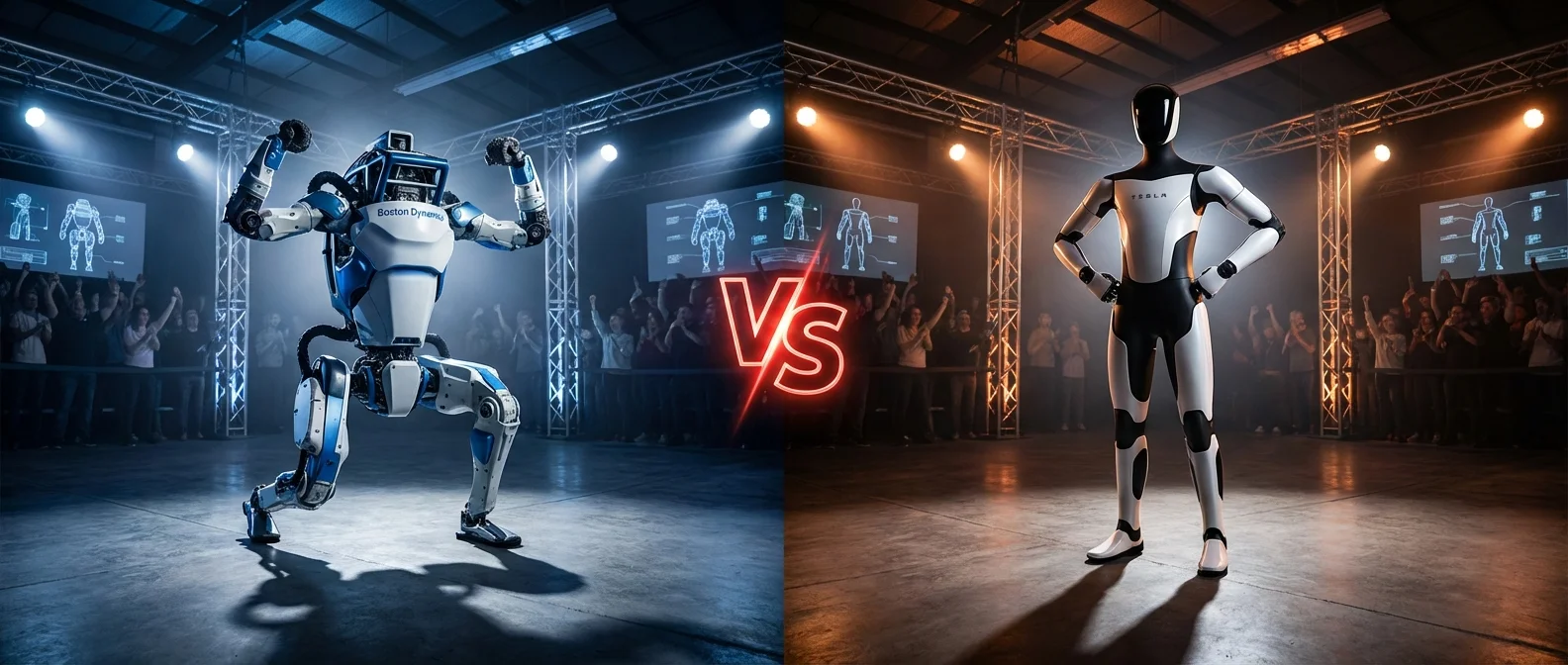
📊 The Core Specs at a Glance
Full Spec Comparison
| Feature | Atlas (Electric, 2024) | Optimus (Gen 3, 2024) |
|---|---|---|
| Height | 6.2 ft (1.90 m) | 5'8" (1.73 m) |
| Weight | 198 lbs (90 kg) | 125 lbs (57 kg) |
| Degrees of Freedom | 56 | 28+ (22 in hands alone) |
| Payload (instant) | 110 lbs (50 kg) | 45 lbs (20 kg) |
| Payload (sustained) | 66 lbs (30 kg) | Undisclosed |
| Battery | 4 hours + self-swap | ~2 hours (est.) |
| Reach | 7.5 ft (2.3 m) | Undisclosed |
| IP Rating | IP67 | Unannounced |
| Operating Temp | -4°F to 104°F | Unannounced |
| Sensors | Tactile + 360° camera | Camera (Autopilot-based) |
| Price (est.) | Unannounced (B2B) | ~$30,000 (Musk, Oct 2024) |
| Deployment | Hyundai HMGMA, 2028 | Tesla factories (limited, 2025) |
🏭 Boston Dynamics Atlas: The Veteran
Atlas isn't new — it's the product of 13 years of continuous development. The original hydraulic version debuted in July 2013 as a joint project with DARPA, the Pentagon's advanced research arm. It was built for search-and-rescue missions: opening doors, shutting off valves, driving vehicles through disaster zones.
From there, Boston Dynamics took an unexpected path: parkour, backflips, synchronized dance routines. Video after video on YouTube, tens of millions of views, and a reputation no other robot could touch. In August 2021, two Atlas robots ran a full parkour course — standing 5 feet tall, weighing 190 lbs, powered by hydraulics with 20 degrees of freedom.
In April 2024, Boston Dynamics retired hydraulic Atlas and unveiled a completely new electric version. The new Atlas stands 6.2 ft (1.9 m), weighs 198 lbs (90 kg), and features 56 degrees of freedom with joints that rotate beyond human limits. It can lift 110 lbs instantly (66 lbs sustained), has a 7.5 ft reach, IP67 protection, and a 4-hour battery — with autonomous self-swapping: the robot replaces its own battery without human intervention.
"We designed the electric version of Atlas to be stronger, more dexterous, and more agile. We are equipping the robot to move in the most efficient way possible, rather than being constrained by a human range of motion."
— Boston Dynamics, April 2024CES 2026: The Big Reveal
In January 2026, Atlas made its debut at CES in a live demonstration — remotely operated, but designed for full autonomy. It demonstrated car part sequencing and factory component handling, winning CNET's “Best Robot” award at CES 2026. The production version is now being manufactured for deployment at Hyundai's HMGMA (Hyundai Motor Group Metaplant America) facility in 2028.
Crucially, Google Gemini is expected to be integrated into Atlas. Outgoing CEO Robert Playter (stepping down after 6 years, February 2026) stated the goal is for Atlas robots to be "contextually aware of their environment and able to use their hands to manipulate any object."
🤖 Tesla Optimus: The Newcomer
Optimus (a.k.a. Tesla Bot) was announced at AI Day on August 19, 2021 — accompanied by a person in a robot costume. The press was skeptical. The Verge called it “bizarre tomfoolery.” AI researcher Gary Marcus said: “I bet that no robot will be able to do all human tasks by the end of 2023.”
By September 2022, Tesla revealed semi-functional prototypes — one could walk, another could wave its arms. Deutsche Welle cited experts who called the project a “complete and utter scam.”
Generation 2 (December 2023)
A year later, Tesla released a video of Optimus Gen 2: dancing, handling an egg without breaking it, a slimmer frame, and improved hands with 11 degrees of freedom. In May 2024, videos on X (formerly Twitter) showed Optimus performing tasks at a Tesla factory. But critics pointed out many tasks clearly required teleoperation — remote human control.
Generation 3 and the Controversial “We, Robot”
In October 2024, at the "We, Robot" event, multiple Optimus units mingled with attendees. The response was mixed: Tesla was criticized for not being transparent about teleoperation. Competitors (Figure, Astribot) published their own videos, emphasizing that their robots operate autonomously. The Gen 3 hands were upgraded to 22 degrees of freedom.
The Teleoperation Problem
At every major Optimus showcase — AI Day 2022, factory footage May 2024, “We, Robot” October 2024 — critics and journalists identified signs of human remote control. Tesla has never held a fully autonomous public demonstration without controversy. By contrast, Atlas (CES 2026) was openly remote-controlled — but made clear the commercial version will be fully autonomous.
Shifting Plans (2025-2026)
In March 2025, Musk announced Optimus would go to Mars in 2026. In June 2025, Milan Kovac — Optimus program lead since 2022 — resigned, replaced by Ashok Elluswamy (head of Autopilot). Then in February 2026, Musk scrapped the Mars plans and pivoted to a Moon colony instead.
⚔️ The Big Comparison: Category by Category
1. Mobility & Agility
Boston Dynamics has decades of experience in dynamic locomotion. Backflips, parkour, walking on snow, gravel, and slopes. The electric Atlas moves “beyond human limits” — with 360° swiveling joints at the waist and head. Optimus walks and appears stable, but has never publicly demonstrated dynamic movement (running, jumping, push recovery).
* Optimus Gen 3 hands boast 22 DoF — impressive. But Atlas has interchangeable “gripper variations” purpose-built for industrial applications, with tactile sensors. Different philosophies, no clear winner.
2. AI: Gemini vs Autopilot
This is where things get interesting. Tesla relies on its in-house FSD (Full Self-Driving) AI — a system designed for cars, adapted for humanoids. Boston Dynamics announced a partnership with Google Gemini — one of the most powerful foundation models in the world.
Tesla's philosophy: “We build everything in-house.” Boston Dynamics' philosophy: “We use the best AI available.” Which approach works better? So far, Boston Dynamics — because Atlas actually performs tasks autonomously, while Optimus still relies on teleoperation for its public demos.
3. Reliability & Real-World Deployment
Boston Dynamics has real-world deployment experience: 1,700+ Spot robots in at least 40 countries, hundreds of Stretch robots in warehouses. They know what IP67 means, how -4°F operating conditions work, and what 24/7 uptime demands. Tesla hasn't deployed a single Optimus to a customer outside its own factories.
"The idea of humanoid robots as catchall assistants — the future Elon Musk envisions — is pure fantasy thinking, in part because robots are coordination-challenged."
— Rodney Brooks, co-founder of iRobot, December 2025💰 Price & Scale: Tesla's Formidable Advantage
While Boston Dynamics wins nearly every technical category, Tesla holds an advantage nobody can ignore: manufacturing scale.
Tesla builds 1.8+ million vehicles per year. It understands mass production, supply chains, and cost reduction at a level few companies can match. Musk estimated a price of ~$30,000 — if that holds (a big “if”), it would make Optimus accessible to an enormous market. Boston Dynamics hasn't announced pricing — but its Spot robots cost ~$75,000 and target enterprise customers.
Manufacturing: Tesla
Giga factories on 4 continents. Mass production expertise. 1,000+ Optimus units planned for 2025-2026 in Tesla factories.
Manufacturing: BD
Focused, quality-first production. Smaller volumes, higher standards. Select early adopters initially, gradual scale-up.
📅 Timeline: A Tale of Two Robots
Side-by-Side Timeline
| Date | Atlas | Optimus |
|---|---|---|
| 2013 | DARPA unveiling, hydraulic | — |
| 2015 | DARPA Robotics Challenge, 2nd place | — |
| 2017-2019 | Backflips, parkour, gymnastics | — |
| Aug 2021 | Full parkour course, 2 Atlas units | AI Day announcement (human in costume) |
| Sep 2022 | — | First prototypes at AI Day 2 |
| Dec 2023 | — | Generation 2 (dance, egg handling) |
| Apr 2024 | HD retired, electric Atlas revealed | — |
| Oct 2024 | — | "We, Robot" event, Gen 3 hands |
| Jan 2026 | CES “Best Robot”, Hyundai pilot | — |
| Feb 2026 | CEO departure, Gemini integration | Mars cancelled, pivot to Moon |
🏆 The Verdict
Who Wins Today?
On technical merits, Atlas wins nearly every measurable category: mobility, strength, battery life, sensors, IP rating, reach, and real-world deployment track record. But Tesla holds two advantages that could upend the equation: price (~$30K vs enterprise-only) and mass manufacturing capability.
The reality, February 2026: Boston Dynamics has a robot that works in a factory, won “Best Robot” at CES, integrates Google Gemini, and is shipping to Hyundai. Tesla has a robot that looks great in videos but hasn't held a single uncontested autonomous public demonstration.
If you need a humanoid for industrial use today: Atlas, without question. If you believe in the vision of mass-produced affordable robots 3-5 years from now: Tesla is intriguing — but it needs to prove it's delivering more than promises.
Rodney Brooks, co-founder of the Roomba and iRobot, put it best: the idea of robots that do everything is “pure fantasy thinking.” What matters isn't what a robot promises — it's what it does today, in the real world, without human help.