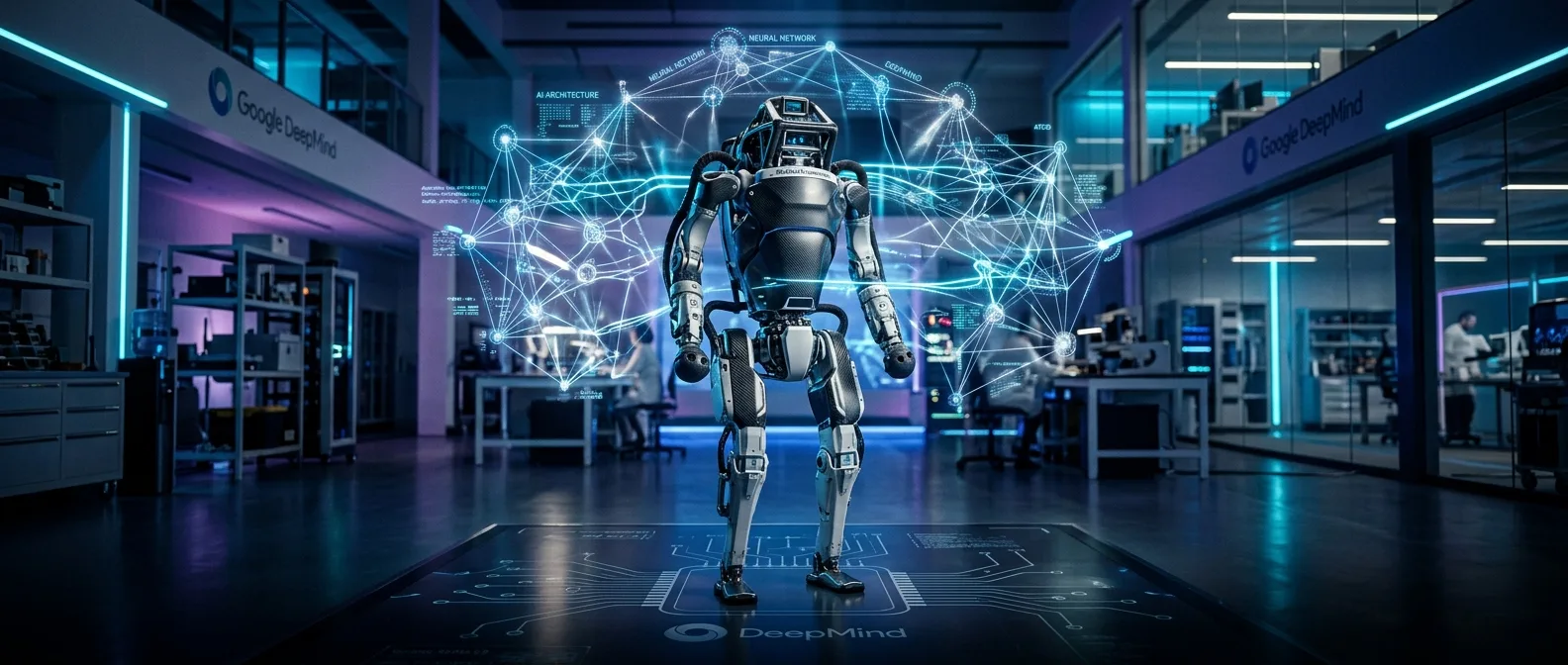
CES 2026 delivered a bombshell. On Hyundai's stage in Las Vegas, the new humanoid Atlas robot from Boston Dynamics took center stage — but this time with a game-changing twist. Google DeepMind stands behind it, bringing AI foundation models into the physical world. The partnership announced that January could reshape how we think about humanoid robots and their role in industry.
Forget the dancing Atlas videos that go viral every few months. This isn't about another acrobatic stunt. Boston Dynamics and Google DeepMind are combining forces to create humanoid robots that aren't just athletic — they're intelligent. Smart enough to work alongside humans in real industrial applications without needing a programmer for every single task.
🤖 When Gymnastics Meets Artificial Intelligence
We already knew Atlas could flip, jump, and balance on impossible surfaces. Those viral Boston Dynamics videos proved the hardware was ready. But hardware alone doesn't make a useful robot. You need brains to match the brawn, and that's where Google DeepMind enters the picture.
DeepMind brings Gemini Robotics AI models to the table — foundation models designed specifically for robotics, not chatbots retrofitted for physical tasks. These models aim to give robots the ability to perceive, reason, use tools, and interact with humans naturally.
What does this mean in practice? A robot that can learn a new task by watching a human perform it a few times — not by getting programmed line by line for every possible movement.
⚙️ The New Atlas: More Than a Dancer
The specs on the new Atlas are impressive. 56 degrees of freedom — movement points — with rotational joints and human-scale hands equipped with touch sensors. It can lift up to 110 pounds and has 360-degree cameras to see what's happening around it.
But the technical specs are just the beginning. The real breakthrough lies in how these capabilities will combine with DeepMind's AI. As Carolina Parada, senior director of robotics at Google DeepMind, explains: "Instead of having pre-programmed tasks loaded onto the robot, we believe robots need to understand the physical world the way we do."
Visual-Language-Action Models: The Robot's New Language
The partnership centers on visual-language-action models. These systems combine visual perception, natural language understanding, and physical action into a single model.
In practice? A robot that can receive a command like "put that component over there" and understand what we mean, see where the component is, calculate how to grab it, and place it in the right spot. No programming required for every possible scenario.
🏭 Hyundai Places Its Bet
Hyundai Motor Group, which owns a stake in Boston Dynamics, isn't waiting to see if the technology works. The company already has plans to bring Atlas to its Savannah, Georgia factory later this year. The goal? Using humanoid robots for tasks like parts organization by 2028.
Hyundai is also opening a new center this year — the Robot Metaplant Application Center (RMAC) — that will "teach" robots how to map movements like lifting and rotating. Data from there will combine with real factory data for continuous improvement.
🧠 Gemini Robotics: AI That "Sees" the World
The Gemini Robotics foundation models aren't random. DeepMind built them on top of the large-scale, multimodal Gemini model. This means they can process text, images, video, and other data types simultaneously — exactly what a robot needs to react to complex environments.
These models are designed to work across different types of robotic hardware. Not just Atlas, but any robot — from quadrupeds to industrial arms. DeepMind is aiming for a "general" robotic intelligence that can adapt anywhere.
The Generalization Gamble
Here's where the big bet lies. Instead of programming a robot for specific tasks, the goal is to give it the ability to learn from few examples and generalize. As Parada puts it: "Whether it's assembling a new car part or tying your shoes, robots need to learn like we do — from few examples."
Sounds ambitious? Absolutely. But Boston Dynamics has already proven it can build robots with incredible physical capabilities. Now it needs the intelligence component — and that's where DeepMind comes in.
🎯 Safety Takes Center Stage
As impressive as Atlas's specs are, the critical question is safety. A robot that can lift 110 pounds and move with such dexterity must be absolutely safe around humans. Here, AI can help — giving the robot the ability to predict and avoid dangerous situations.
The 2026 challenge: How do you make a powerful, fast robot behave predictably and safely next to humans? The answer might lie in connecting advanced AI with proper hardware design.
Atlas already has some safety measures — its 360-degree cameras let it see when someone approaches. But the real challenge is learning how to react to unpredictable situations. That's where DeepMind's visual-language-action models could prove crucial.
🔬 What to Expect in 2026 and Beyond
Joint research between the two companies is expected to begin in the coming months, with work happening at both companies. The first target is the automotive industry — but obviously it won't stop there. If everything goes well, we might see humanoid robots across various industrial sectors.
Boston Dynamics already has commercialization experience — the quadruped Spot works in over 40 countries, while the warehouse robot Stretch has unloaded over 20 million boxes since 2023. The company wants to transfer this experience to humanoids.
The Next Generation of Factories
Picture a factory where human workers and humanoid robots work together — not in separate sections, but in the same space, on the same production line. Robots handle dangerous or repetitive tasks while humans focus on more complex decisions and creative problem-solving.
This isn't distant future — Hyundai is already testing it. And if the results are positive, other companies will follow quickly.
"We're building the most capable humanoid in the world, and we knew we needed a partner who would help us create new kinds of visual-language-action models for these complex robots."
Alberto Rodriguez, Director of Robot Behavior for Atlas
⚡ The Challenges Ahead
Despite the impressive partnership, real challenges remain. Integrating advanced AI with complex robotic hardware isn't simple. Latency, reliability, safety — all these must be solved before we see mass applications.
Cost also remains a question mark. Humanoid robots are expensive to manufacture, and adding advanced AI won't lower the price. To go mainstream, they must prove they offer value that justifies the cost.
Finally, there's the human side. How comfortable will workers feel working next to humanoid robots? Human acceptance is just as important as technological maturity.
Technical Challenges
Integration complexity, latency issues, real-world reliability
Economic Challenges
High production costs, ROI for companies
Human Factor
Worker acceptance, training, cultural adaptation
However, if any companies can tackle these challenges, Boston Dynamics and Google DeepMind are among the best choices. One has proven it can build incredible robots, the other is a pioneer in AI research.
We might be at the tipping point where humanoid robots move from the lab and demo videos to real applications. The Boston Dynamics-DeepMind partnership could determine what this future looks like — and how quickly it arrives.